I recently purchased a Remington 770 in .308 for my son’s graduation present. He was home the other day, so we took it out to give it a try, and I thought I would post our impressions of this rifle. Pictured below: The Remington 770 
First off, if you are gun as work of art type person, this is not the rifle for you. If you are a gun as tool type person, then read on.
The Remington 770 is a very plain utilitarian type of rifle. It is bolt action with a synthetic stock and comes with a factory mounted 3 – 9 x 40 scope. The 770 that we bought has a matte black barrel and stock and is chambered for .308 Winchester. You can see at a glance that it is not a fancy rifle. No burled walnut, skip checkering, ivory inlays, or etc.; but on the plus side it does not carry a fancy price tag. You can pick one up for around $300.
Before you fire it you need to give this rifle a good cleaning. The bolt in particular needs to be de-gunked, and it wouldn’t hurt to work it over with a little 0000 steel wool. The bolt is not a tight fit in the receiver and the play causes it to feel a little rough sometimes when you are cycling the bolt. Don’t misunderstand, the bold locks down tight and solid. There’s no safety concern here. It’s just a matter of not operating as smoothly as you might like. Pictured below: top, the 770 receiver; bottom, bolt drawn back 
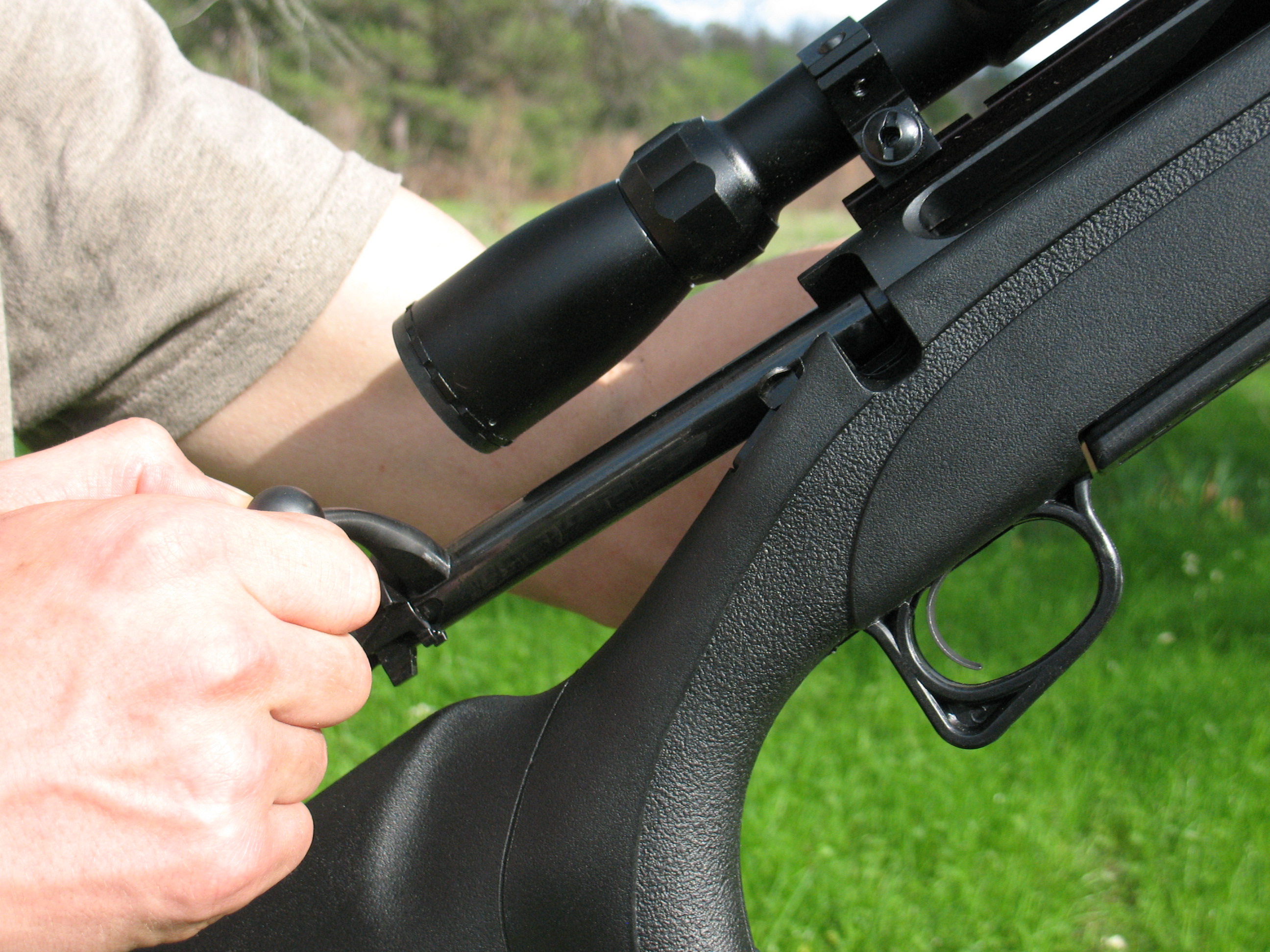
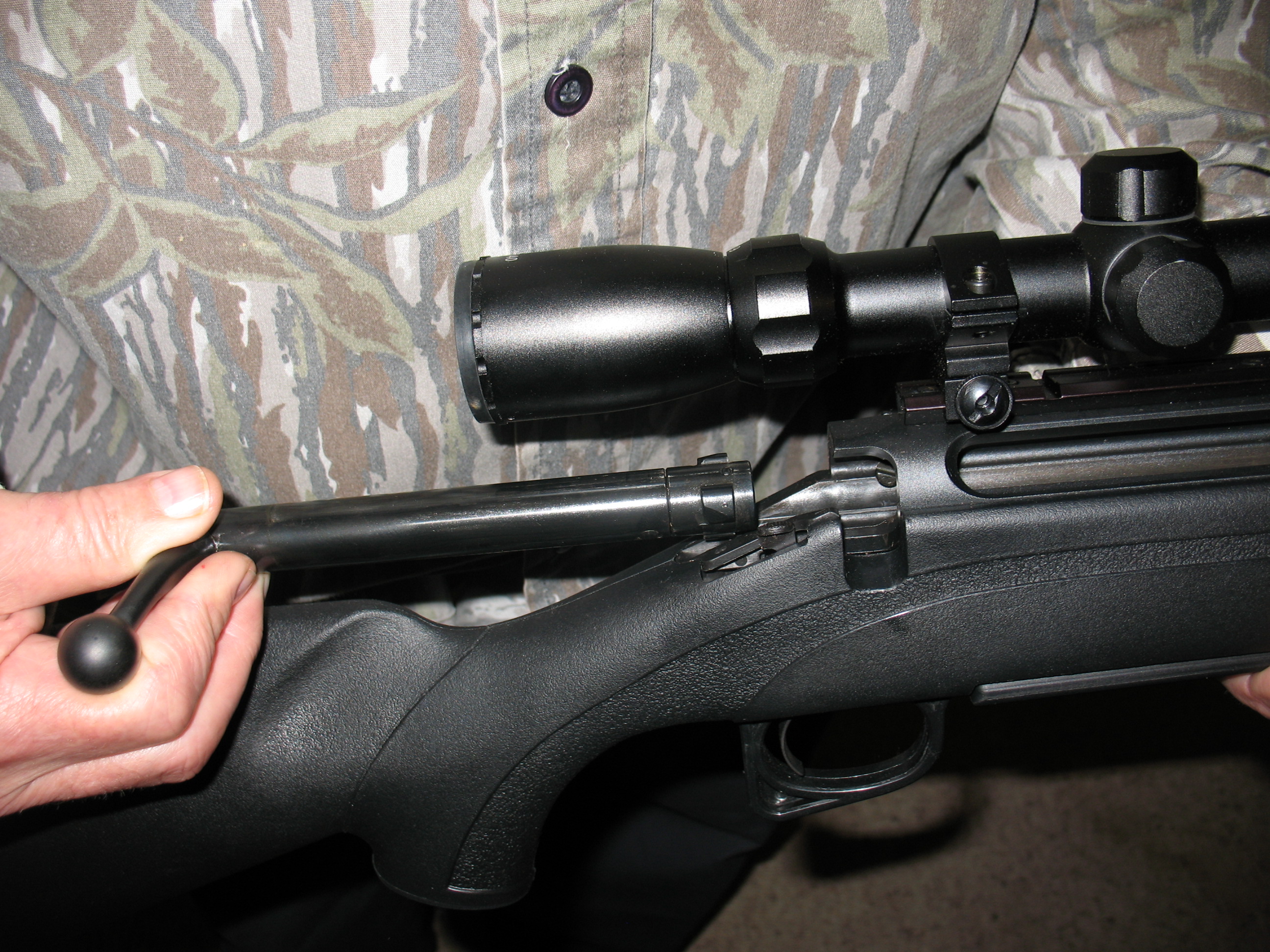
Pulling up a small lever on the top left of the receiver allows you to withdraw the bolt for easy bolt and barrel cleaning. Pictured below: top, bolt release lever; bottom, bolt withdrawn 
The 770 has a four round box magazine which is easy to remove and load. I like this feature. Pictured below: The detachable box magazine 
The scope has been bore sighted at the factory so when we started off at 50 yards we were at least on the paper, only about three inches off center. When you sight this rifle in get some sand bags and do it right. At a dollar a round you don’t want to burn a lot of ammo getting sighted in. Pictured below: Factory mounted scope 
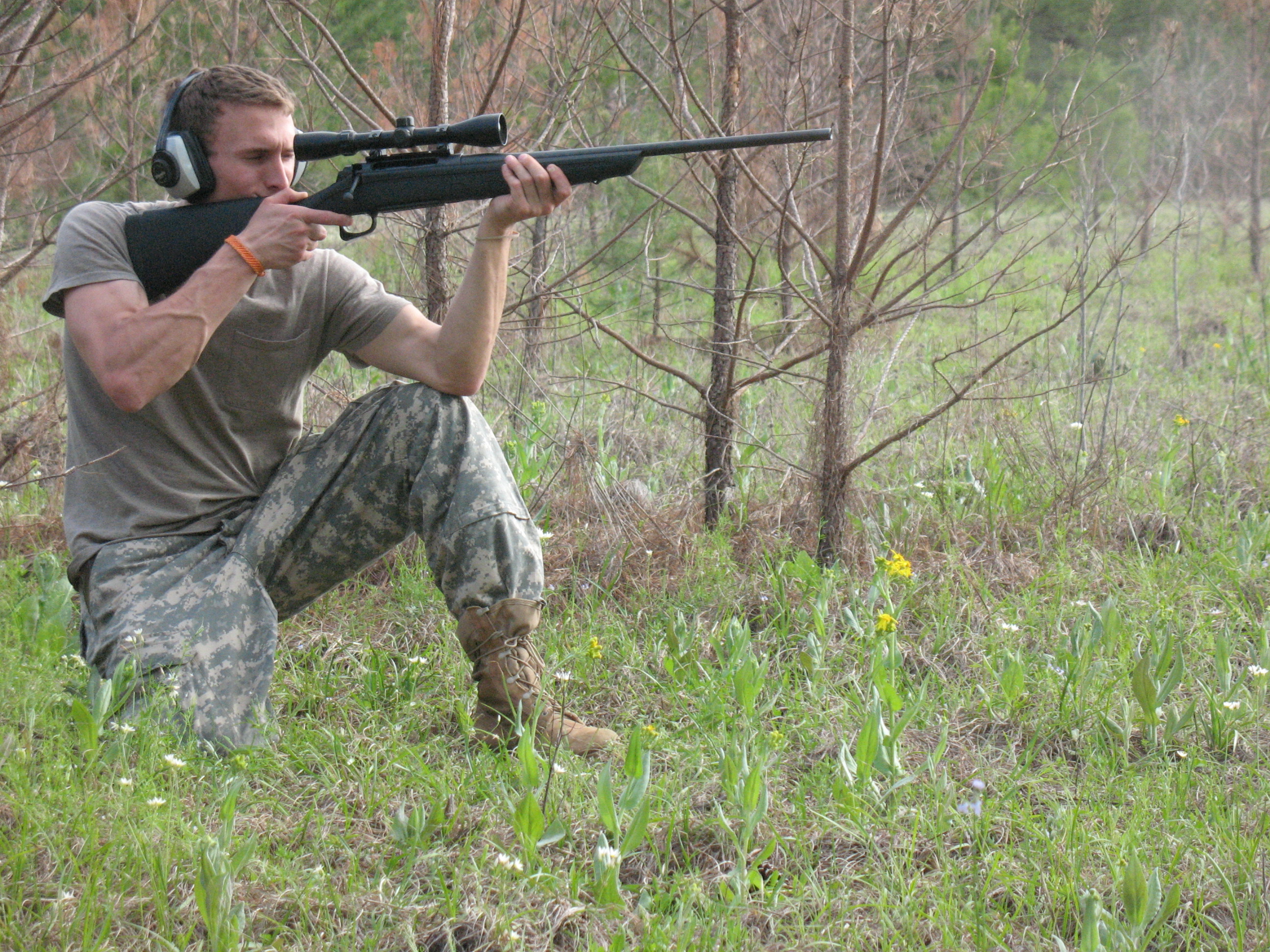
The rifle shoots fine. Accuracy is well within our deer hunting needs. We were a little worried about recoil since the synthetic stock makes this a very light firearm, but it was not bad at all. Pictured below: top, Rifle sighted on target; bottom, rifle in recoil 
This is not a gun that you would want to buy if you are going to shoot a thousand rounds a year on the range. It just wasn’t intended for that kind of use. But if you are going to run a box of shells through it every deer season, it will still be in good service when your grandchildren are ready to use it.
All in all we are happy with this rifle. It will do the job that we need it for, and it didn’t cost an arm and leg, so what’s not to like.
It’s been two weeks and the sinew on our bow is completely dry, so now it’s time to finish it out. Pictured below: Bow with dried sinew backing
The first thing that we will do is to wrap the tips with sinew to keep the backing from coming lose at the tips. You can just take a few strands of sinew and chew on them for a minute. The chewing and the enzymes in your saliva will soften the sinew and activate the natural glue in it. Wrap both ends and set the bow aside for an hour to dry. When the sinew wraps are dry you can trim off the excess sinew that is lapped over onto the belly of the bow. Pictured below: Bow tip wrapped with sinew

Next we need to make a string. Sinew stings are very nice and very authentic, but they require considerable care. Since this bow is for a little boy I am going to make the string out of waxed Dacron. It looks good and it is very durable. Pictured below: Dacron string 
The bow may require a little re-tillering after it is backed. No matter how carefully you apply the sinew, you are going to get a little more on one side than the other. It usually doesn’t make a great difference, so only a little tillering will be required.
Now the bow is essentially finished so we are going to apply a good coat of polyurethane to seal the wood and protect the sinew from moisture. Let the polyurethane dry over night and then there is one last thing to do. Pictured below: Applying polyurethane to the bow 
It is by no means necessary, but a nice leather hand-grip gives the bow a finished look. On this bow I decide to use tanned deerskin for the grip. After careful measuring and cutting, I punch holes in the grip, apply some glue, and sew the grip in place. Pictured below: Leather grip glued and sewn in place 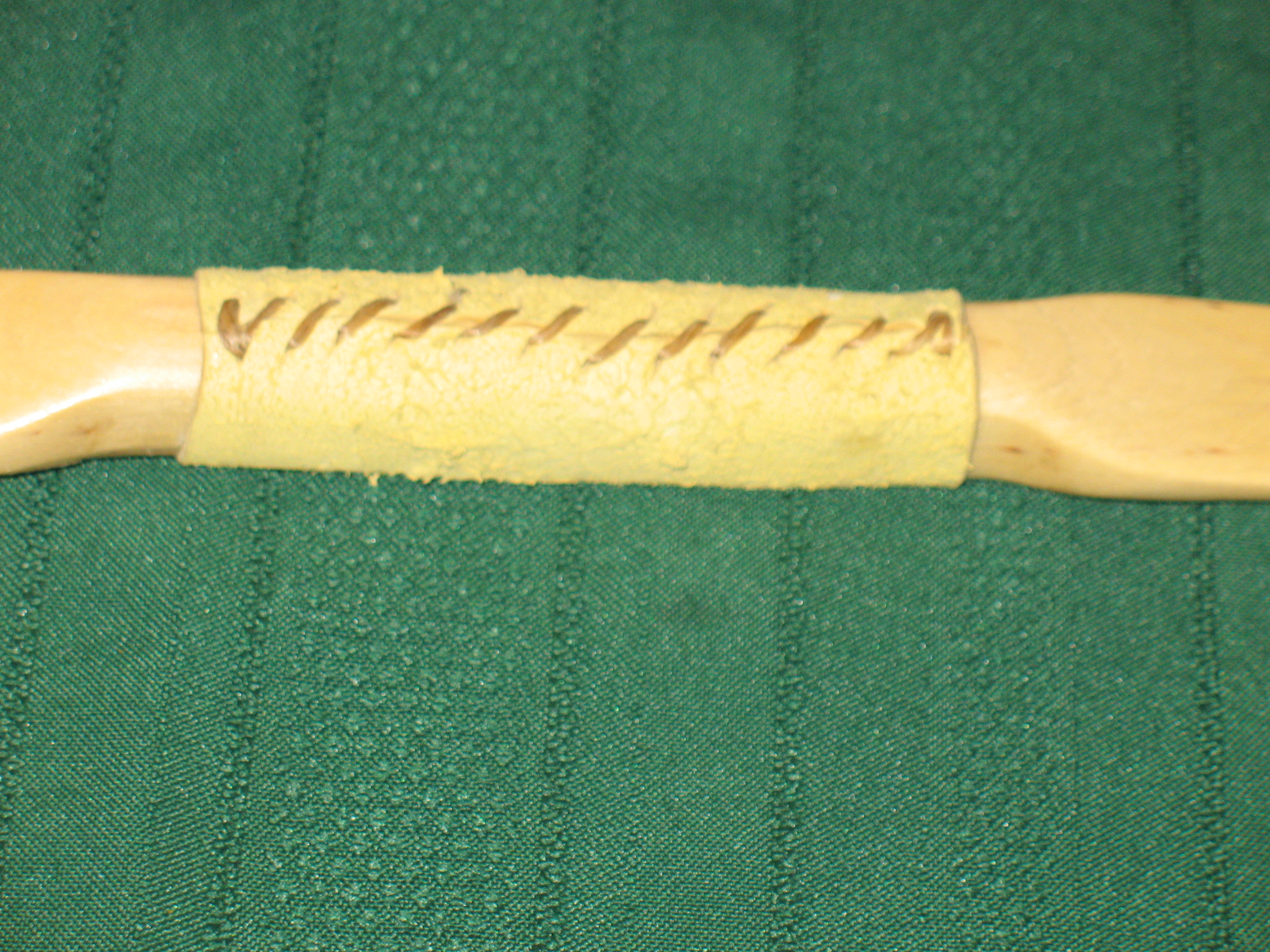
And here is the finished product, strung and ready to wreak havoc on the neighborhood cats. Pictured below: Finished bow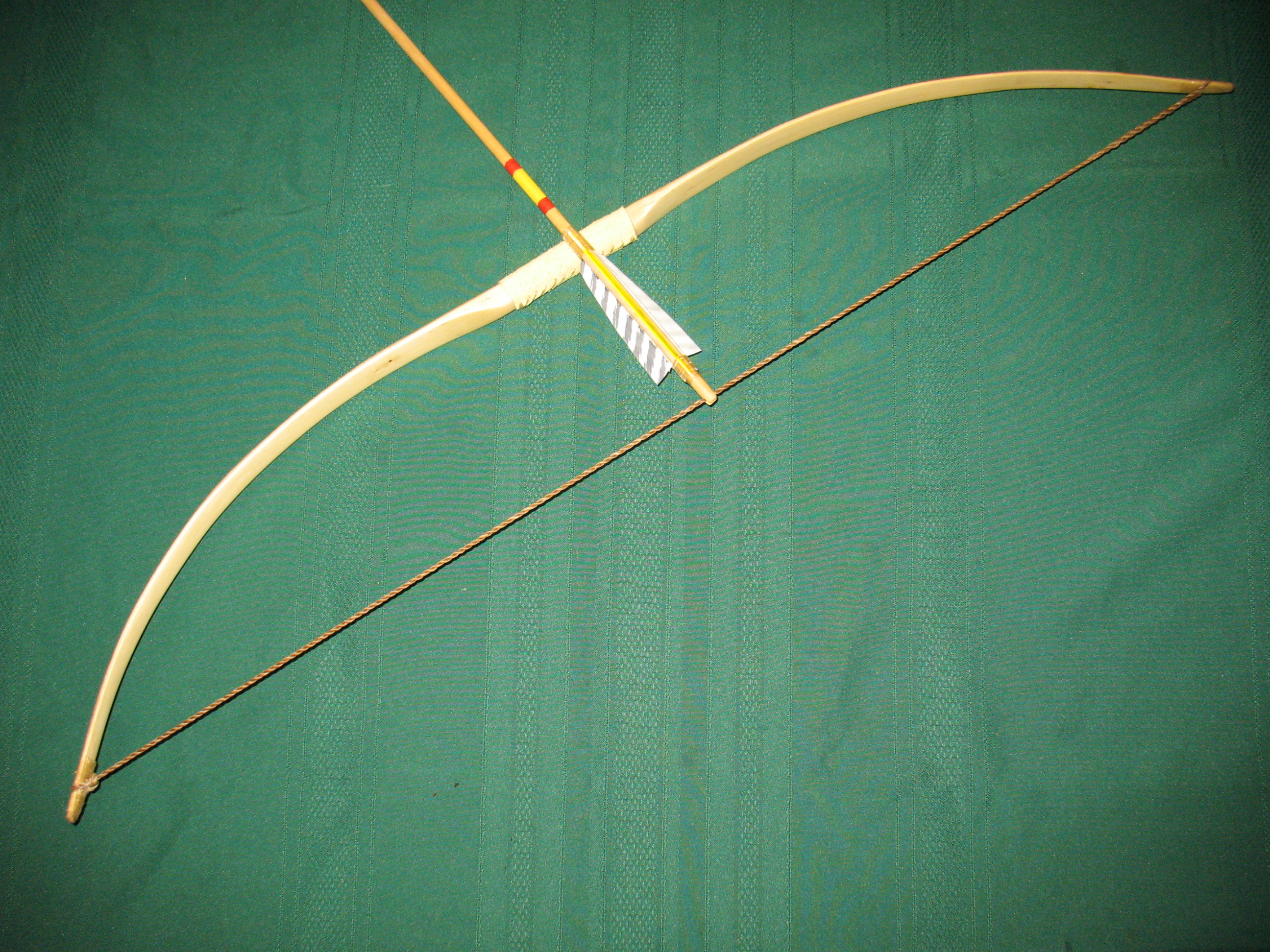
So now we have everything organized so let’s start sinewing. By the way, you probably want to do this in the kitchen or somewhere that has a good supply of water. You will be washing your hands continuously to get the sticky rawhide glue off of them. So, back to sinewing. Take a bundle of sinew between your fingers and dip it down completely into the warm glue. Swish it around a little to make sure it is completely saturated with glue. You may even want to just leave it in the glue for thirty seconds or so to make sure that it is soft. Pictured below: Dipping sinew bundle in warm glue 
Now lift the bundle up out of the glue and use the fingers of your other hand to squigee the excess glue off of the bundle. Pictured below: squeezing excess glue off of the sinew 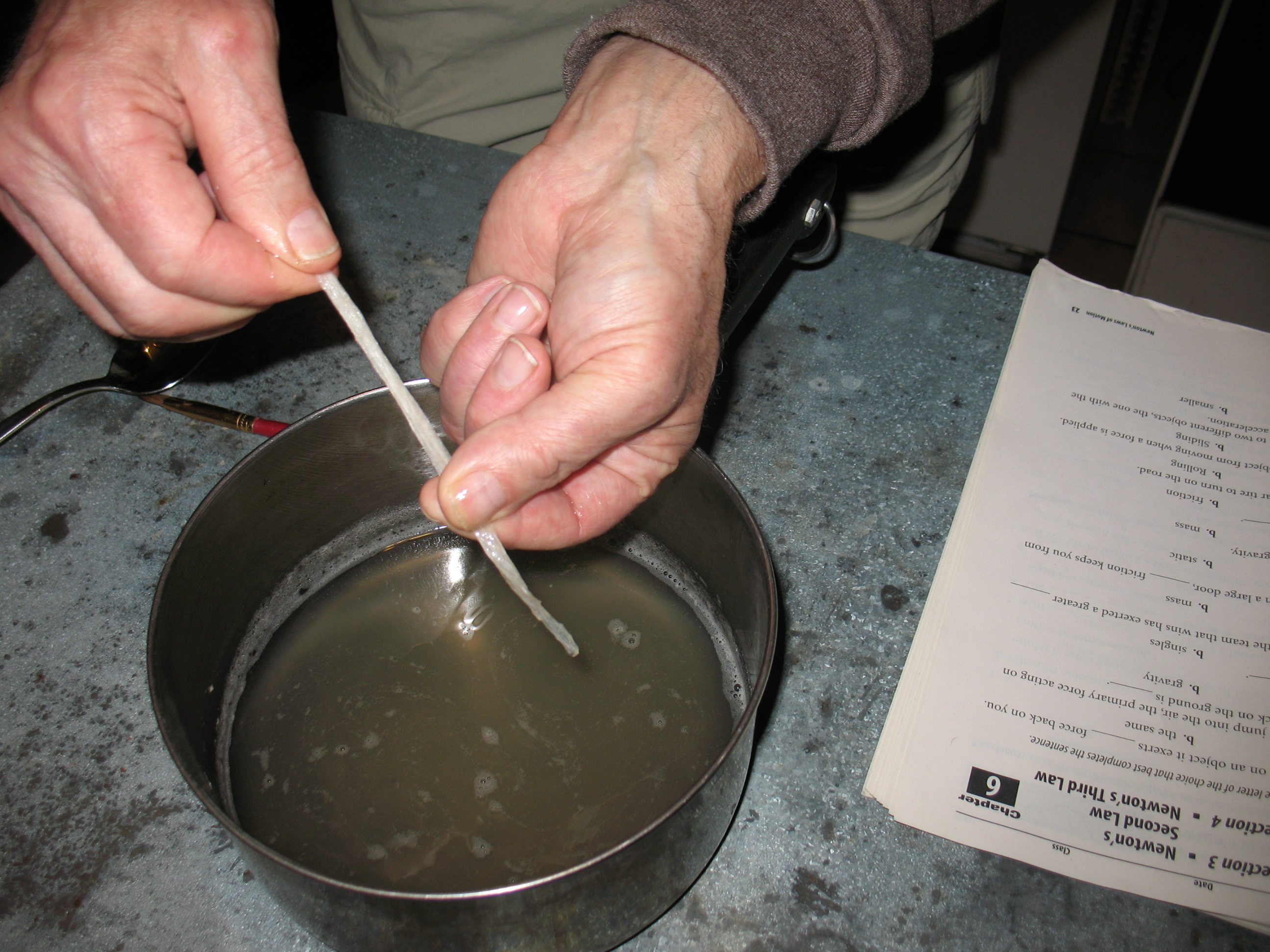
I like to start in the center of the bow at the handle with my first bundle and then work a straight line out to one end of the bow; so take your first bundle, lay it down on the bow back in the center of the handle, and press it down flat. Rub it with your finger to flatten it out. Pictured below: Laying on the first bundle of sinew 
You’re on your way. Do another bungle and lay it up so that it just overlaps the end of the first bundle. Pictured below: Applying the second bundle 
Keep extending your line of bundles down the center of the bow until you reach the end, then lap the last bundle over the end and about an inch and a half down the belly (the side of the bow that faces you when you are shooting). Pictured below: Folding sinew over the tip and onto the belly 
Now you can start your second course of bundles. You want to lay these up right next to the first course but place them so that they are staggered in relation to the first course. In other words, you want to lay them like you are laying bricks so that the joints don’t line up. Pictured below: Starting the second course of sinew 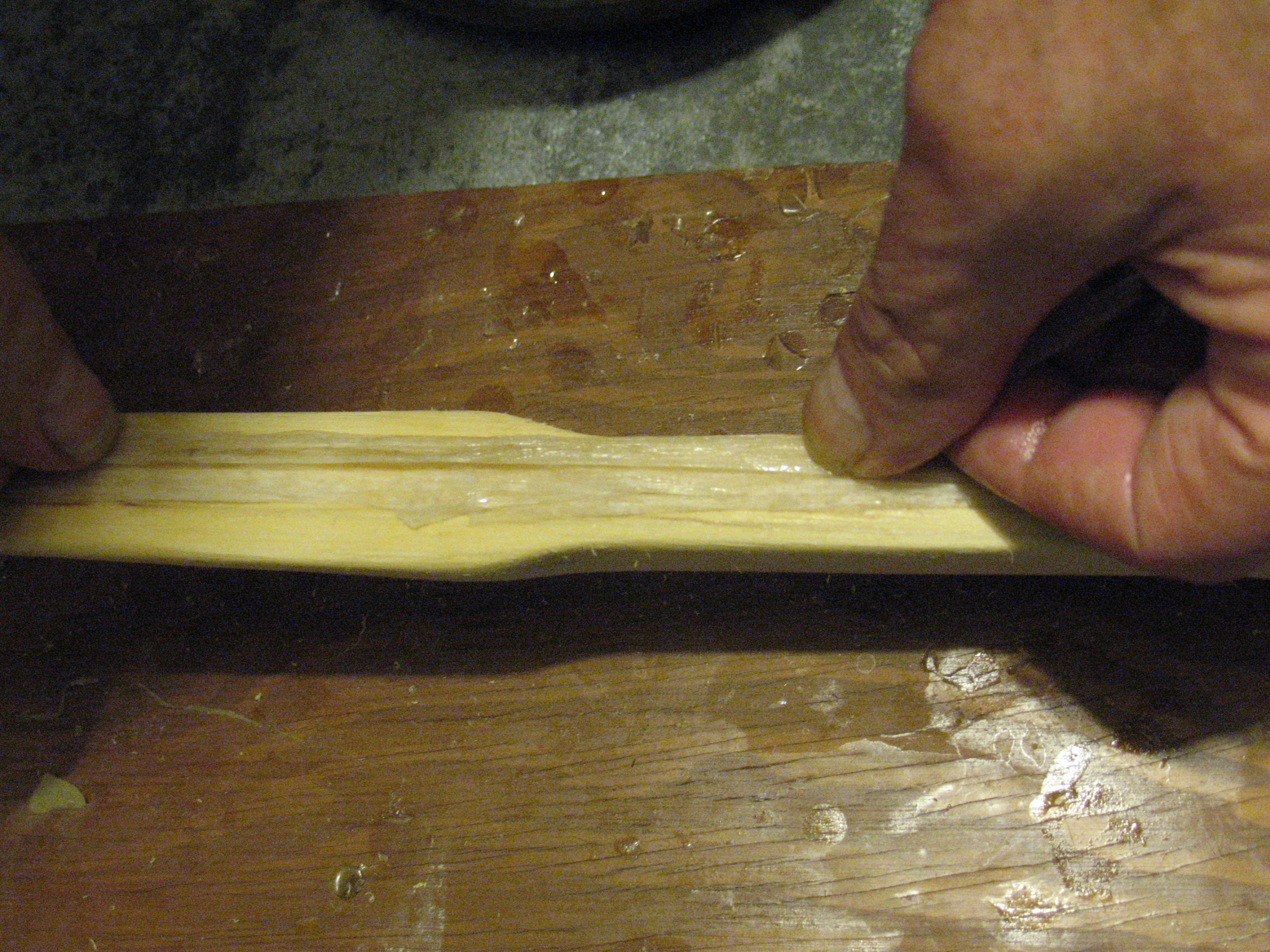
Keep running new courses of sinew until you have completely covered half of the bow, and then you can start on the other half of the bow and follow the same procedure. When you have the entire back covered with sinew, paint a coat of rawhide glue onto the backing and set the bow aside to dry. Pictured below: Bow with sinew backing in place 
If you are going to put a second layer of sinew on the bow it is best to let the first layer set up for an hour before you start the second layer. Apply the second layer just as you did the first layer. Paint it with a coat of glue and set it aside to dry.
If you are going to apply more than two layers of sinew the first two layers must be allowed to dry completely before you add any more.
Now comes the hard part. It will take the sinew at least a week to dry out. I usually give mine two weeks because I’ve put too much work into the bow to have it ruined by impatience. If you string or bend the bow before the sinew is completely dry, the sinew will separate from the wood and you will have nothing. As the sinew dries it shrinks and you will probably see the bow begin to pull into a slight reflex.
So, let’s set our bow aside to dry for a week, and then we’ll finish it out.
Putting a sinew backing on a wooden bow will improve the bow in a number of ways. It will keep fibers from lifting up on the back of the bow, and thus help prevent the bow from breaking. It will help keep the bow from following the string (the tendency of the bow to stay a little bent after you have un-strung it). It will give the bow more snap when you release an arrow, and it will increase the draw weight of the bow a little. For all of these reasons, sinew backing is a good policy with wooden bows; and I rarely build a bow anymore that I don’t sinew back.
I am currently building a bow for a friend’s little boy, so I thought this would be a good opportunity to do a post on how to sinew back a bow. The bow in question is thirty-six inches long and made of hickory. Hickory is a very good bow wood, but it is a little sluggish on release and it does have a tendency to follow the string. A layer of deer sinew on the back of the bow should eliminate the string follow and give the bow more snap. Pictured below: The bow that I will be sinewing

To sinew back a bow you will need the following:
A wooden self bow (see posts of January 25 through February 15, 2009 on how to make a wooden bow)
Some liquid detergent
A hacksaw blade or coarse wood rasp
Something to hold the bow while you sinew it
Sinew fibers (see post of November 7, 2011 on how to prepare sinew)
Rawhide glue (see post of November 27, 2011 on how to make rawhide glue)
A brush to apply the glue with (see post of February 20, 2012 if you want to make your own brush)
A cook pot and heat source
A lot of clean water
The question is often asked, “How much sinew does it take to back a bow?” I’ve tried to work out some kind of formula for this, but I haven’t had any luck. There are just too many variables. Sinews come in different thicknesses and different lengths, bows can be wide or narrow, they can be long or short. You may just want one layer of sinew on your bow, or you may want four or five. I guess you could figure out how many grams of sinew it takes per square inch, but my guess is that you would probably be wrong. With the type of bows I usually make I figure four to six sinews per layer of backing. I always do up more sinew than I think I’ll need. That way I don’t run out in the middle of backing a bow, and I can always use the excess on the next bow that I make.
I like to use a trick that I learned from one of Jim Hamm’s books to help keep my sinew organized while I’m backing a bow. After you have your sinew separated into fibers, sort it into little bundles of six to eight strands. Take these little bundles and put them in an old magazine with a page separating each bundle. All you have to do is turn the page and you will have a new bundle of sinew fibers ready to use. Pictured below: Sinew organized in bundles between the pages of a magazine

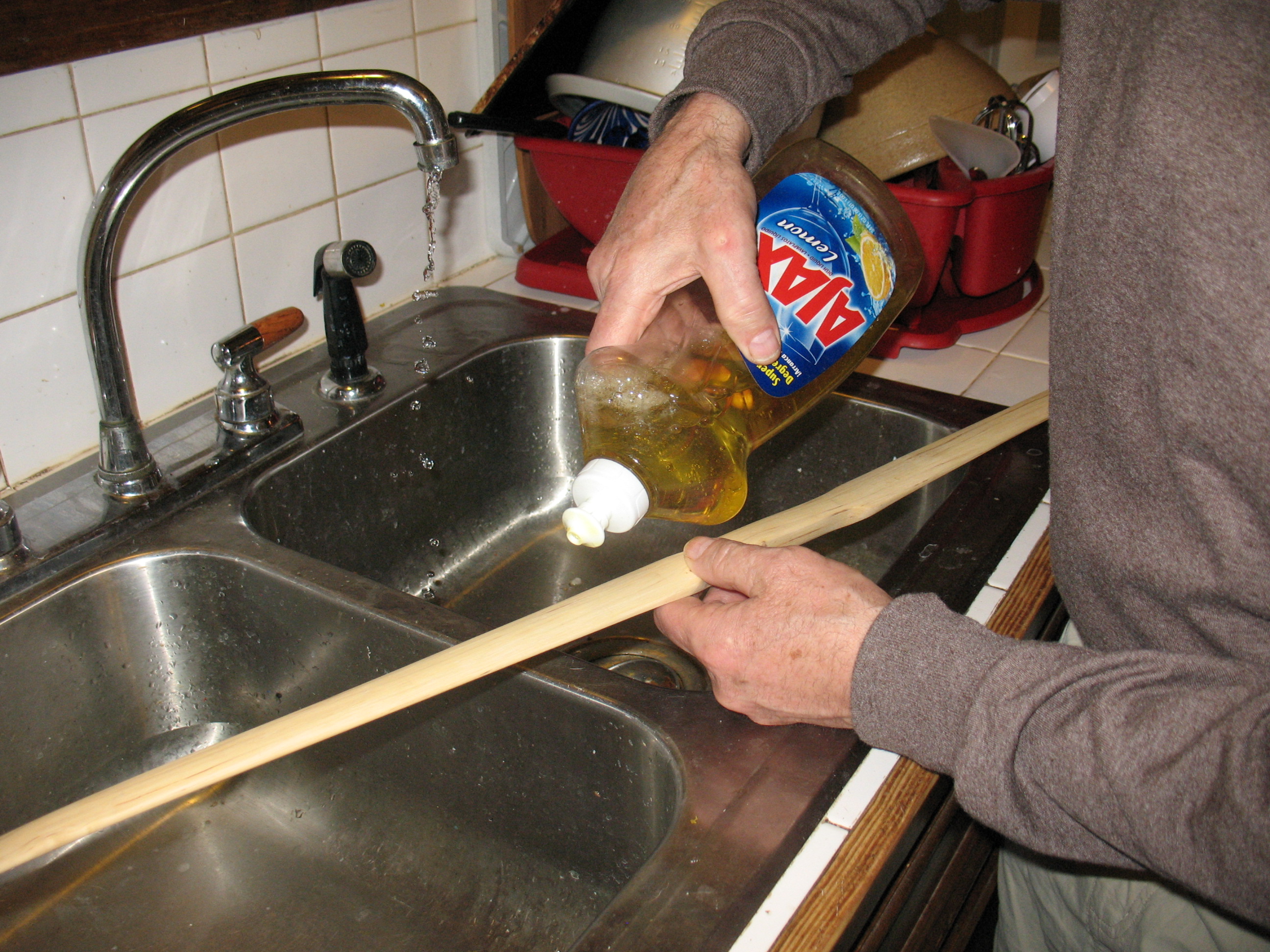
The first step in preparing a bow for sinew backing is to thoroughly wash the back of the bow with detergent to remove any oils that might be on the bow. If the back of the bow is not clean when you sinew it, the sinew may separate from the wood when you draw the bow. So, don’t skip this step. Some people wash the back of the bow with a lye-water solution. Lye has become increasingly hard to find. Somebody told me that it is used somehow in the process of making meth, so a lot of stores have quit carrying it. I don’t know if that’s true or not, but I do know that our local grocery store doesn’t cary it anymore. So now I just wash my bows with detergent and it seems to work fine. Pictured below: top, Washing the bow back: bottom, drying the bow

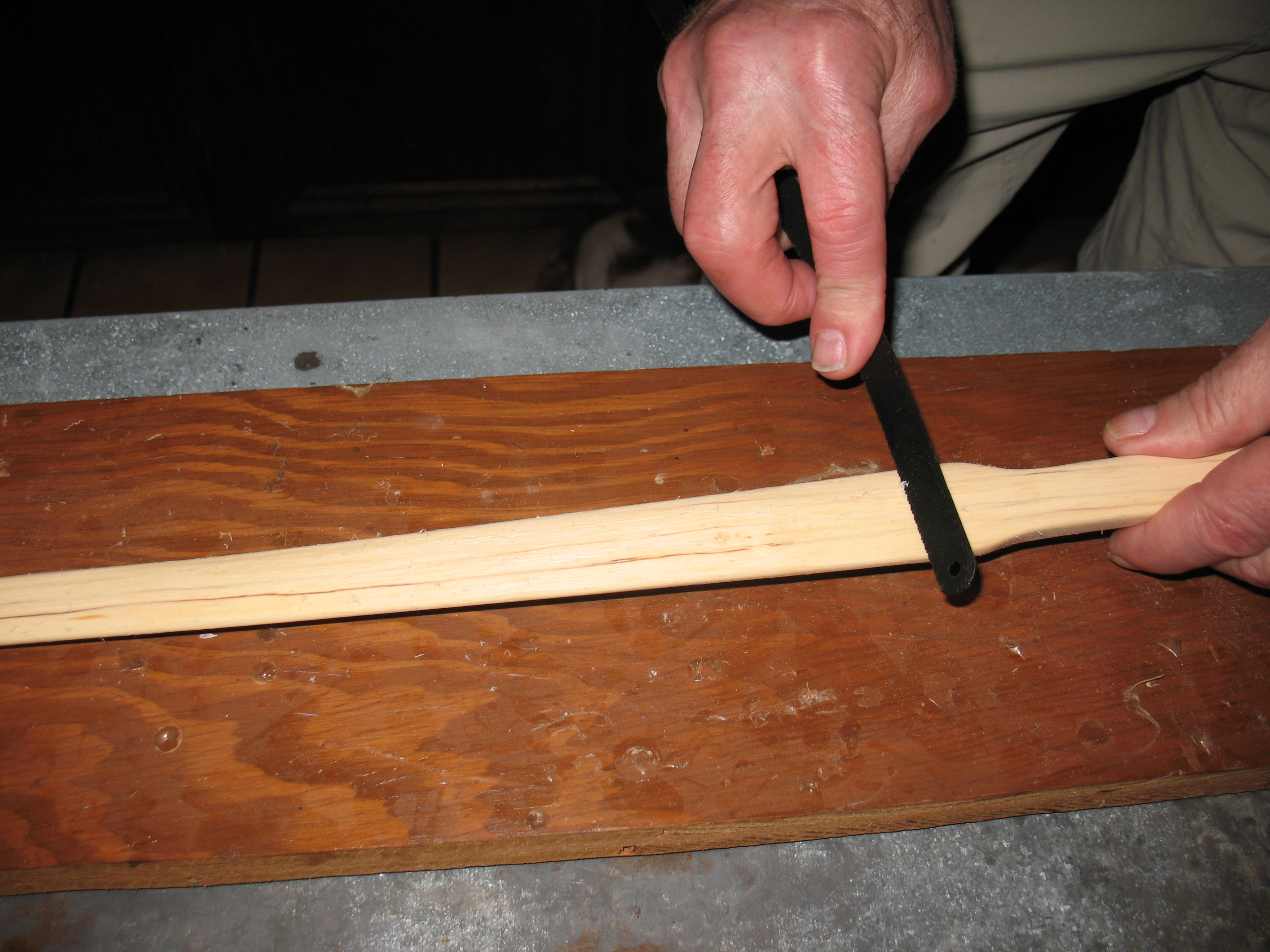
Step two is to rough up the back of the bow so that the sinew will adhere to it better. You can do this by dragging an old hacksaw blade along the back, or you may use the coarse portion of a wood rasp. You’re not trying to remove any wood. Just scratch the surface up a bit. Pictured below: roughing the bow back with a hacksaw blade
When you have the bow roughed up it is time to warm up your rawhide glue. I am using unflavored gelatin for my glue. Most people don’t realize that gelatin is made from powdered beef hide. Don’t tell your kids this or they will never eat Jello again. All you have to do to make your glue is dissolve the gelatin in some warm water. I put a pot on the stove and heat about two cups of water and then stir in about three of the small packs of gelatin. Don’t cook the glue; just warm it up. If you can’t dip your fingers into it, it is too hot; and it will cook the sinew and make it useless. Pictured below: Mixing up some rawhide glue

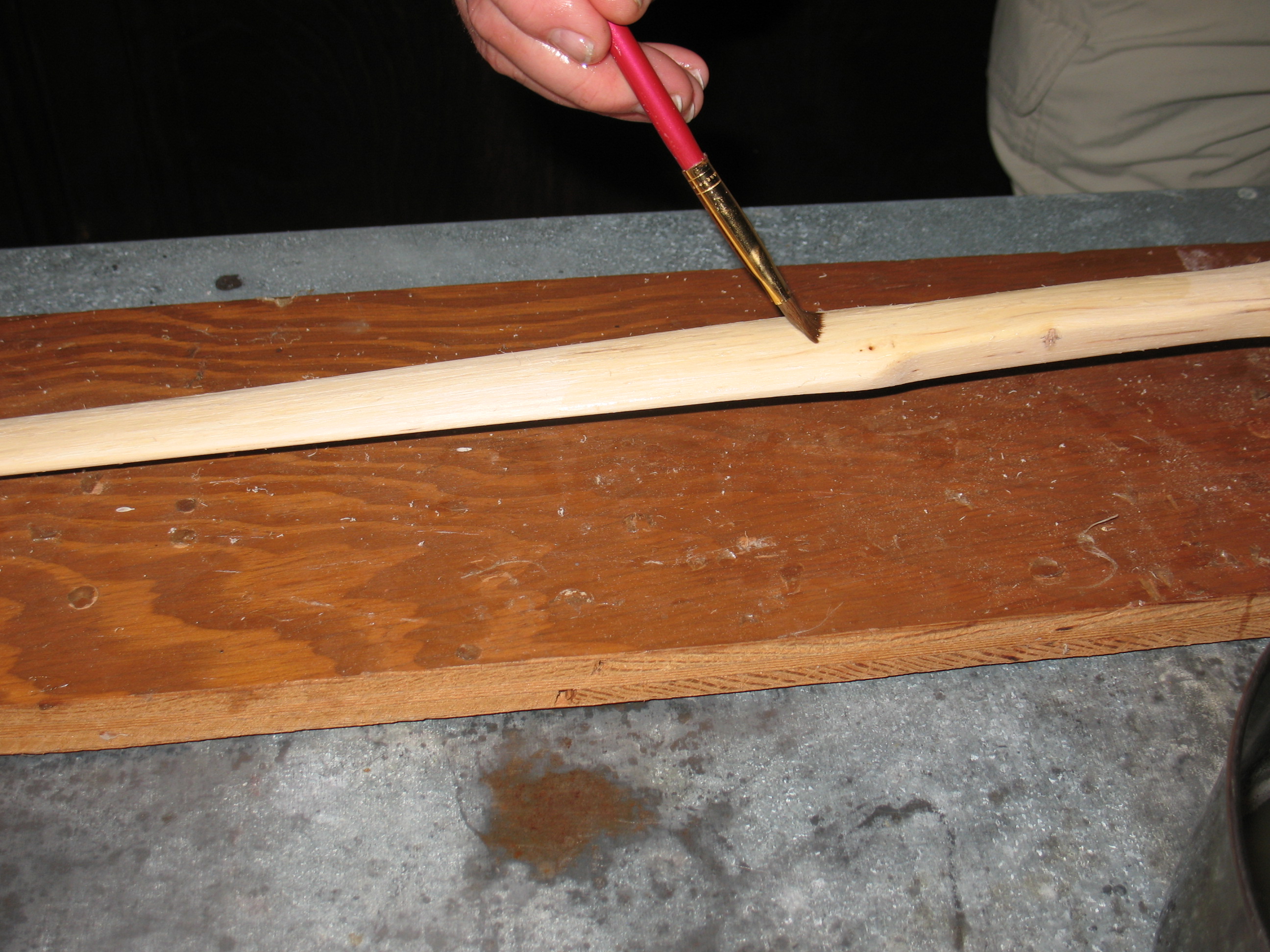
When the glue is ready, take your brush and paint a coat of rawhide glue onto the back of the bow to prime it. Give the glue about ten minutes to set up and it will be time to start applying sinew. Pictured below: sizing the back of the bow with rawhide glue
In the next post we will apply sinew to the bow.
The first step in making fire is to burn-in your fire board. Burning-in is the process of making the hole in your fire board that the spindle will fit into. You should have already used your knife point to start a small hole in the fire board. This starter hole should be in the center of the fire board about two inches from either end. When the starter hole is complete you may begin the-burning in process.
BURNING-IN (directions for right handed person):
1. Lay the fire board on the ground with the starter hole to your right.
2, Kneel down on your right knee and place the ball of your left foot firmly on the fire board about two inches to the left of the starter hole.
3. Take the bow in your right hand and the spindle in your left hand and wrap the bowstring one time around the spindle about three inches above the pointed end. This may take a few tries. Remember, you have to end up with the bow in your right hand, the string to the left and the pointed end of the spindle pointing down. Pictured below: Proper position of the string around the spindle. 
4. Place the pointed end of the spindle into the starter hole. Take the handhold in your left hand and set it over the top of the spindle. Brace your left wrist on the outside of your left ankle so that the spindle won’t wobble around when you start to turn it.
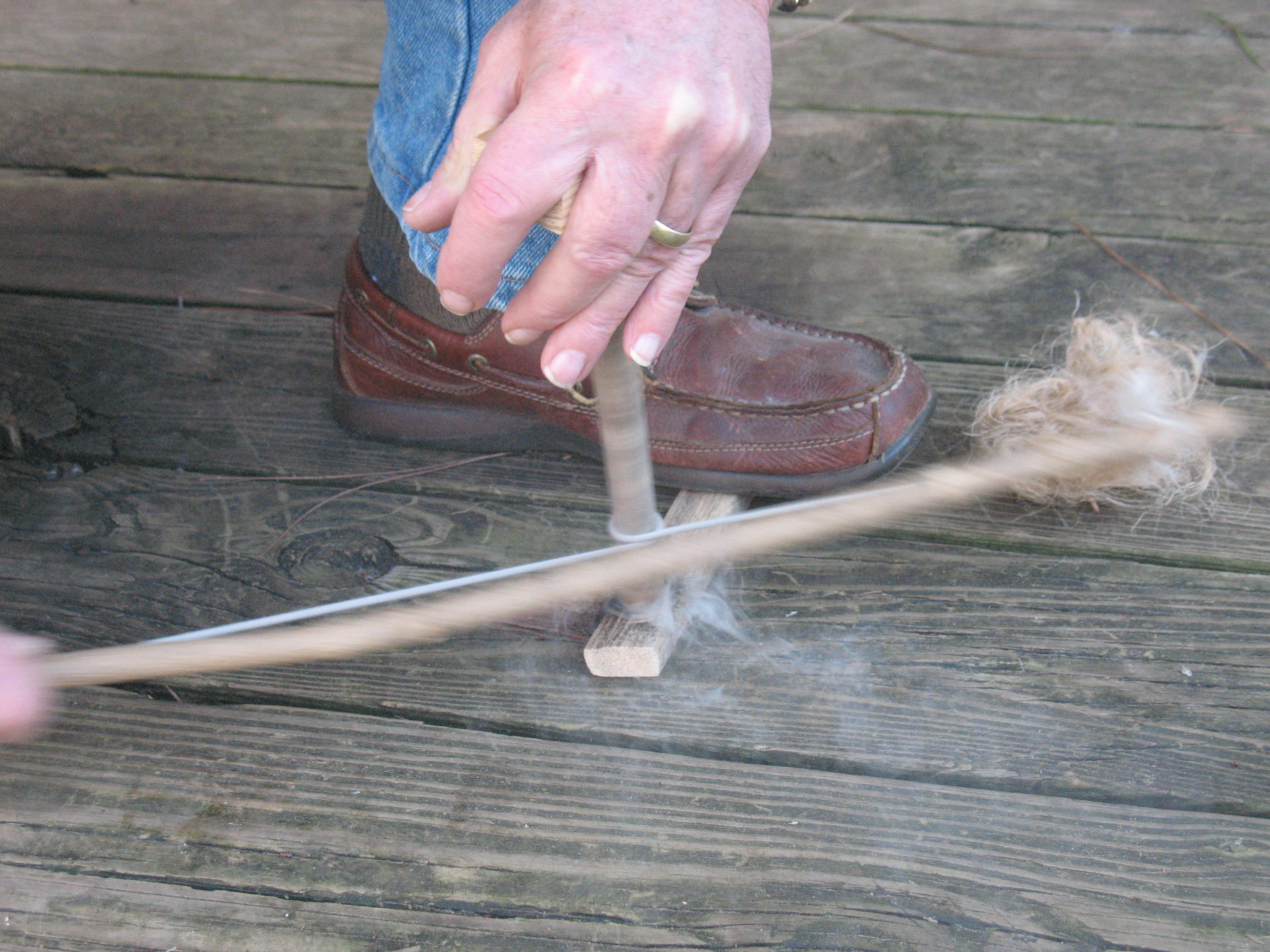
5. With your right hand, very slowly begin to move the bow forward and back the full length of the string. Be sure to keep the bow parallel to the ground through the entire length of the stroke. If you saw up and down with the bow it will cause the string to run up and down the spindle and either run off the end of the spindle or pop the spindle out of the starter hole. Pictured below: Turning the spindle to burn in the hole.

6. Hold the handhold onto the top of the spindle with very light pressure. It is a common mistake to apply to much pressure in which case the spindle will become hard to turn, and the bowstring will begin to slip.
7. Once you get the spindle turning properly it should only take a few strokes and you will begin to see a small whiff of smoke as the spindle begins to burn a hole down into the fire board. Do not burn to deeply. One fourth of an inch is plenty. Pictured below: Burned in hole in fire board
NOTCHING THE FIRE BOARD
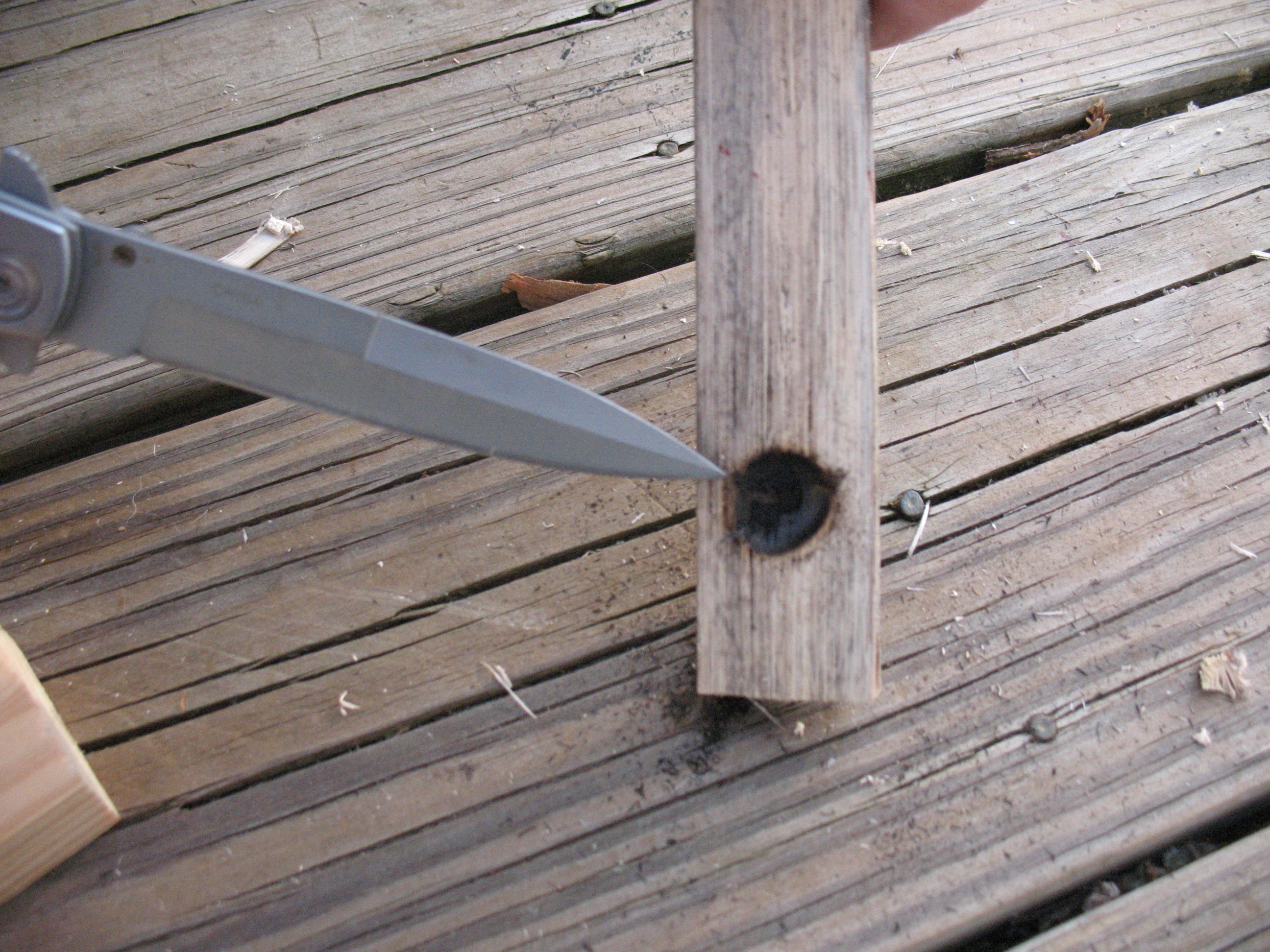
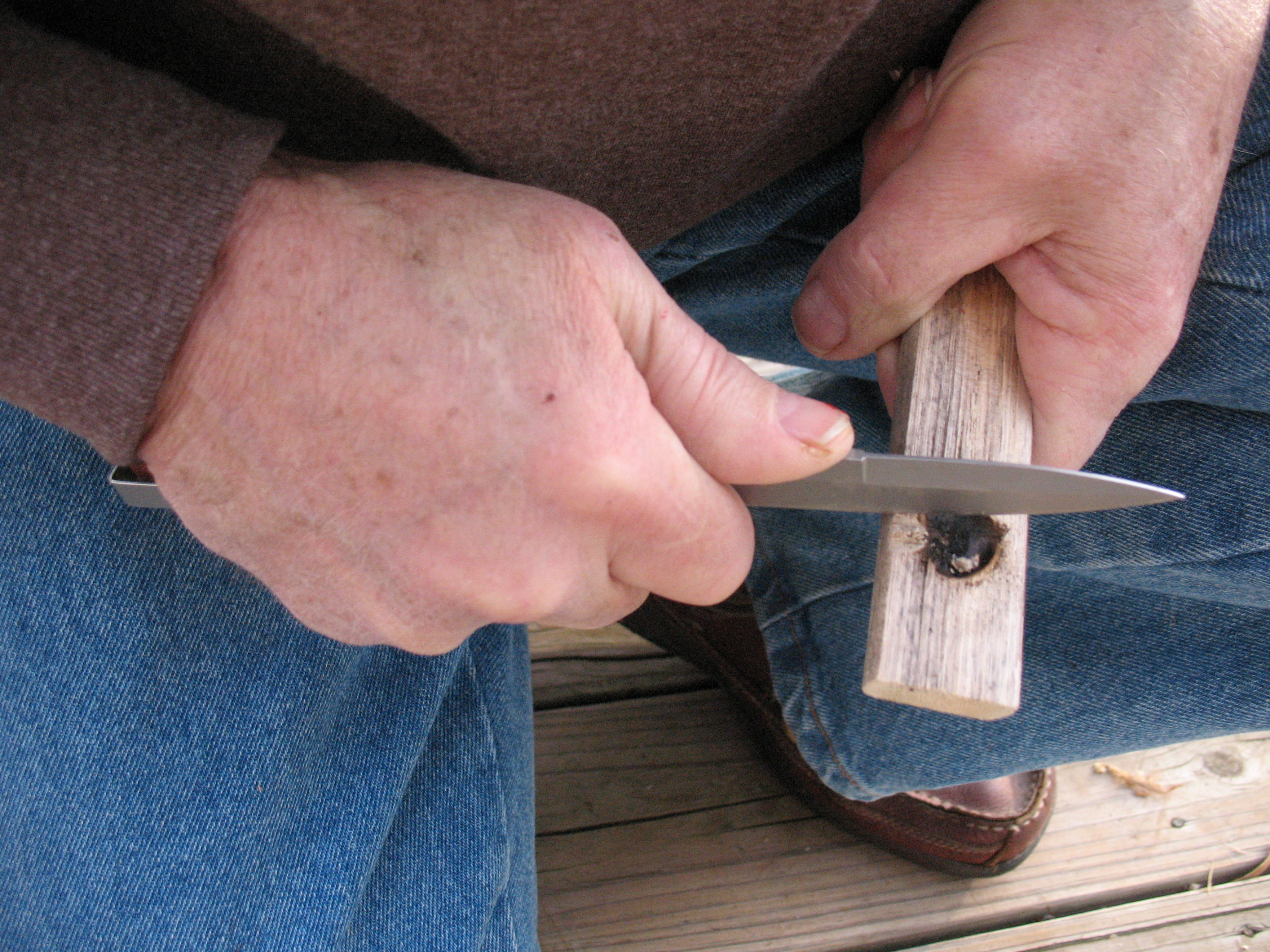
Now that you have burned in your fire board it is time to carve the all important “notch.” The notch is a pie shaped hole that is cut out of the side of the fire board. The notch starts at the edge of the fire board where it is about 1/4 inch wide and tapers to a point at the center of the hole that you have just burned into the fire board. The glowing coal that you will use to start your fire will form in this notch. Pictured below: top, cutting the notch; bottom, the finished notch

PREPARING THE SPINDLE
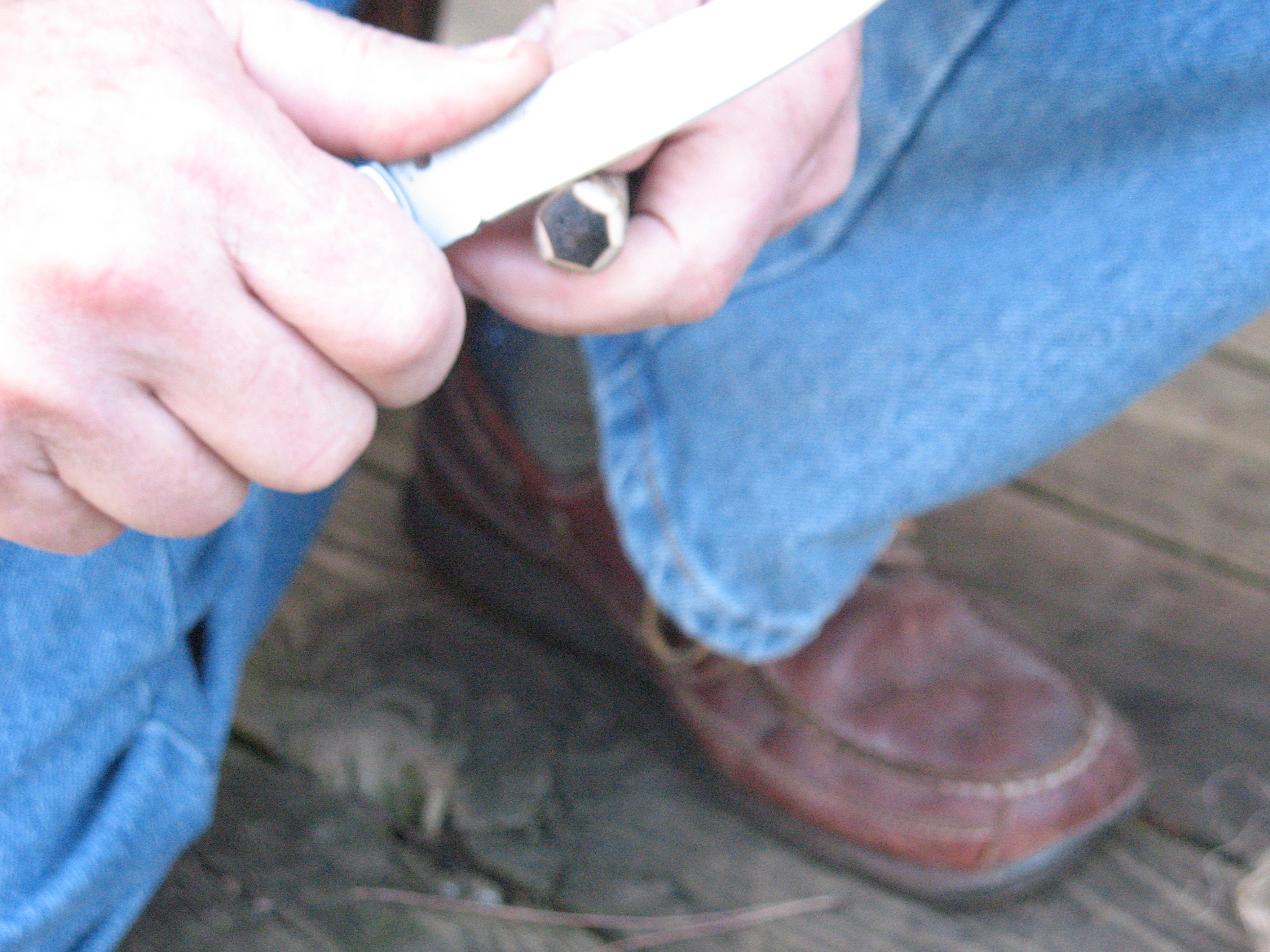
There is one last thing to do before you actually start the fire. Take your knife and re-sharpen the point of the spindle. Be sure to remove all of the charred wood from the end of the spindle. This step needs to be repeated each time you use the spindle. Charred wood on the end of the spindle will cause the spindle to turn to easily in the hole, and you won’t have enough friction to form your coal. Pictured below: Removing char from the end of the spindle
FORMING THE COAL
Now you are ready to form a glowing hot coal with your fire making tools. Be sure and have a double handful of dry, fluffy tinder ready to accept the coal once it is formed.
To begin forming the coal set your fire board and spindle up just like you did to burn-in the hole. The only difference in the set-up is that this time you need to set a dry leaf, thin chip of wood, piece of bark or something under the notch in the fire board. The purpose of this piece of material is to catch the coal as it falls from the notch. You can then pick up the leaf or piece of bark and transfer the coal to your bundle of tinder. Pictured below: Bark placed below the notch in the fire board.

Some people set the fire board down on top of the bundle of tinder so that the coal will fall directly into the tinder. This will work fine as long as the tinder is setting on a perfectly dry surface. But if the surface is the least bit damp, the tinder will suck up moisture like a sponge, and your coal will never turn into a flame.
Now that you are all set up, begin working the bow back and forth just as you did to burn-in the hole. Remember to use very light pressure at first. Take long, fairly slow strokes to warm up the spindle and fire board. As the fire board begins to smoke a little, increase the pressure on the handhold just a little and turn the spindle a little faster. Remember to use the full length of the bow when you are turning the spindle. Don’t make the stroke any shorter just because you are moving your hand faster. Pictured below: Fire board and spindle starting to smoke.

The spindle and the fire board should now be smoking heavily and a pile a black, smoldering powder should be filling up the notch. It is now time to sprit for the finish line and form that coal. Apply more pressure to the handhold, (not to much or the string will start slipping). Now, stroke hard and fast, the full length of the bow, about ten or twelve times. Smoke should be pouring off of the spindle and fire board. Pictured below: Lots of black powder and heavy smoke mean the coal has probably formed and is ready to transfer to the tinder bundle.
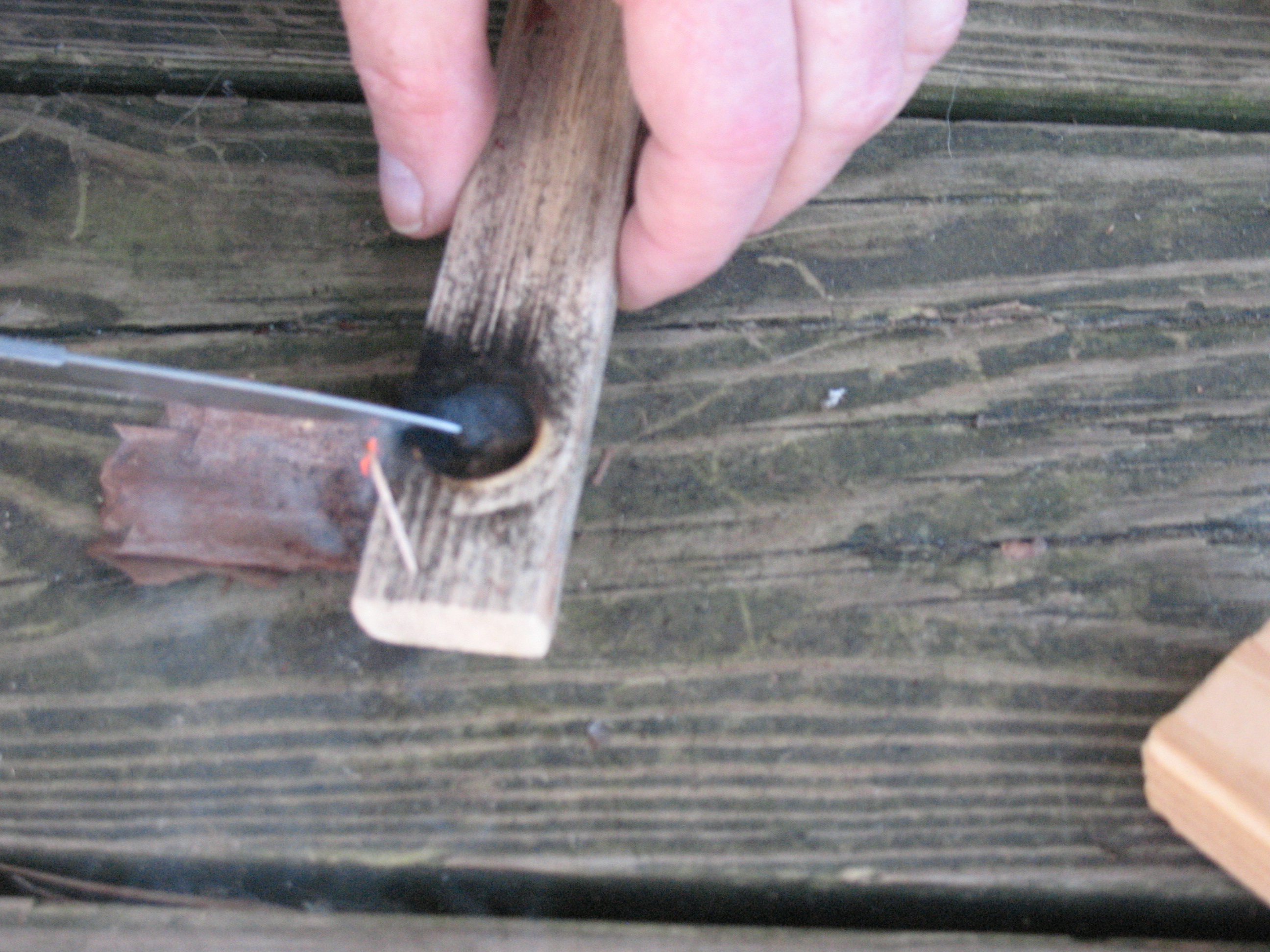
Stop stroking. Set the spindle and bow aside. Don’t get in a hurry. If you have a coal, the powder in the notch will still be smoking and the coal will burn for quite a while. Now take the point of your knife and place it at the top of the notch. Lift the fire board gently as you press the knife point down through the notch. The still smoldering coal should fall out onto the leaf or bark that you placed under the notch. Carefully transfer the coal to the center of your bundle of tinder. Pictured below: top, Using knife point to flick the coal out of the notch; middle, glowing coal on the piece of bark; bottom, transferring the coal to the tinder bundle.


BLOWING THE COAL INTO A FLAME
You would be surprised at how many people can produce a coal and get it into the tinder bundle and then never get the tinder to flame up. Often this is because of moisture, but sometimes it is because of poor technique.
When you have transferred the smoldering coal to the tinder bundle, pick the tinder up very carefully and cup it in your two hands. Very gently fold your hands up so that you bring the outside edges of the tinder bundle up and around the coal like a fluffy nest. Don’t press in so hard that you smother the coal or flatten out the tinder. Just nuzzle the tinder up gently around the coal. Now blow softly, not like you’re trying to blow out a candle, but softly. The coal should begin to glow a dull red. Blow a tiny bit harder and keep the fluffy edges of the tinder in light contact with the coal. The coal will begin to glow a brighter red, then orange, then yellow and then the tinder will begin to catch the spark and smolder. Pictured below: Blowing on the coal.

When the spark begins to run out into the tinder, hold the tinder bundle out in front of and a little above your face. Turn your head to the side and breathe in. This will keep you from getting a lung full of smoke. Now turn your face back to the smoldering bundle long and steady, not hard, just steady. Turn your head to the side and breathe in. Turn back to the bundle and blow. Be careful because at any moment the tinder bundle will reach critical temperature and burst into flame. When this happens, be ready to pop the blazing tinder into your pre-laid campfire and blow the fire to life. Pictured below: Tinder bursting into flame.

Long before the invention of matches, long even before the discovery of metal, man was making fire. His fire making equipment was simple but reliable. The friction of two sticks rubbed together created heat. The heated wood began to char and form black smoking powder. The black powder became hotter and a red glowing coal began to come to life. This red coal was flipped into a pile of dry tinder and a little gentle blowing produced a flame which was used to light the waiting campfire.
It sounds simple, and with a little practice and the right equipment it really is simple. Once you have mastered the technique of primitive fire making and have your equipment prepared and in place, you can consistently start a fire in under one minute.
To make a fire with a bow and drill you will need to prepare six items of equipment. They are a fire-board, a spindle, a handhold, a bow, a bowstring and some tinder. Since the proper selection and preparation of these six items is over half the battle in primitive fire building, let’s talk about each one of them in a little more detail:
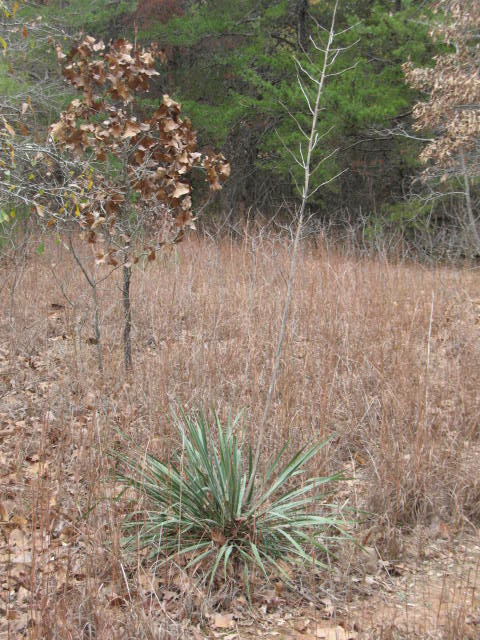
FIRE BOARD & SPINDLE – The fire-board and spindle should both be made of the same kind of wood. A dry soft wood like yucca stalk or cottonwood root is best. Woods like willow or cedar can be used but are not as good. Avoid hard or resinous woods like oak, hickory or pine. Whatever kind of wood you use, it must be dead and completely dry. Wood that has been dead at least six months is recommended. Pictured below: Yucca plant.
To make a fire board take a stick of wood about an inch to an inch-and-a-half in diameter and about a foot long. Trim off two opposite sides of the stick to leave a flat board about 3/4″ thick. Take the point of your knife and dig a small starter hole in the middle of the board about two inches from the right end. Pictured below: top, Section of dry Yucca stalk; middle, Removing sides of the stalk to leave a flat board; bottom, Making a small starter hole in the fire-board.
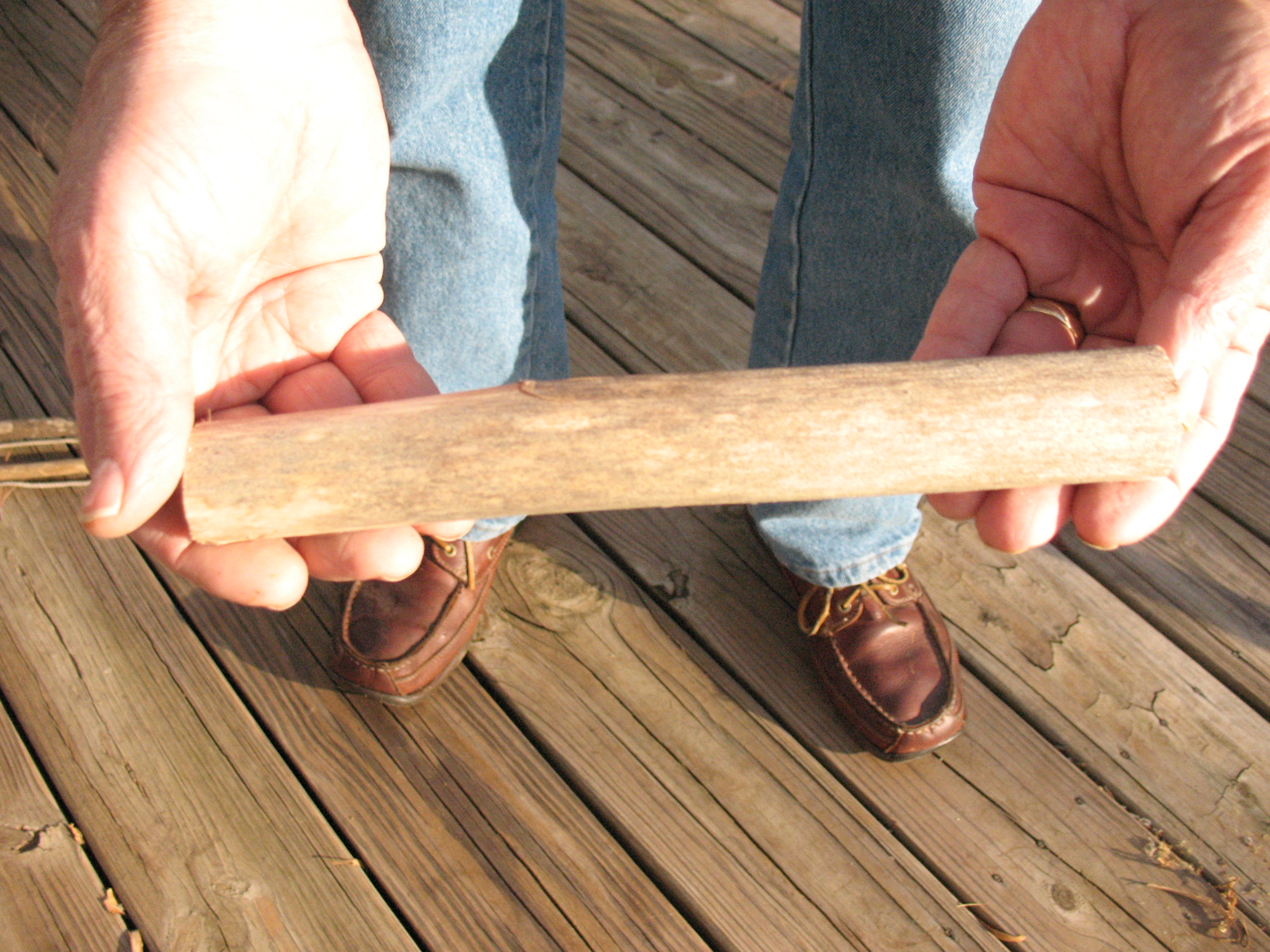
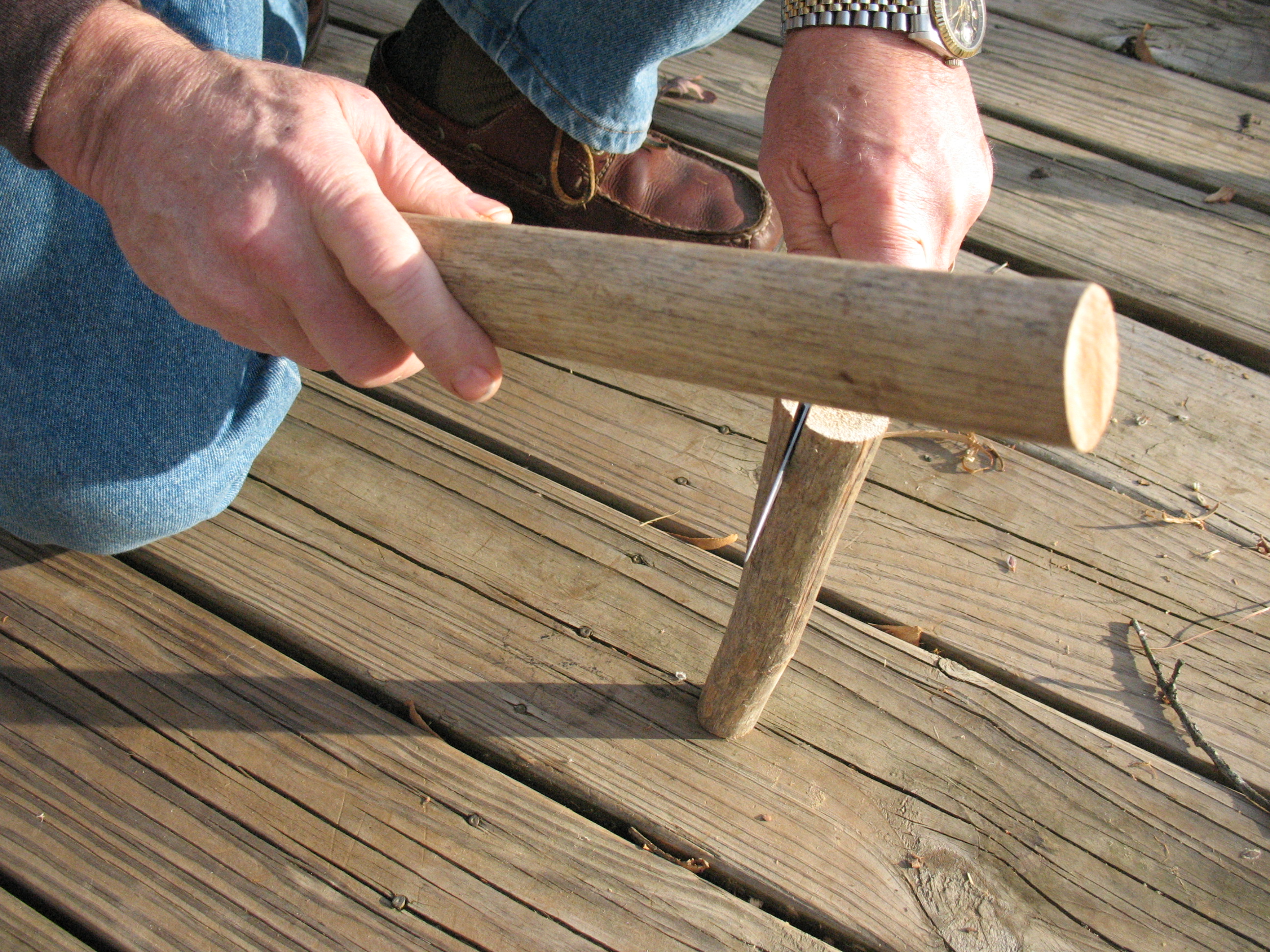

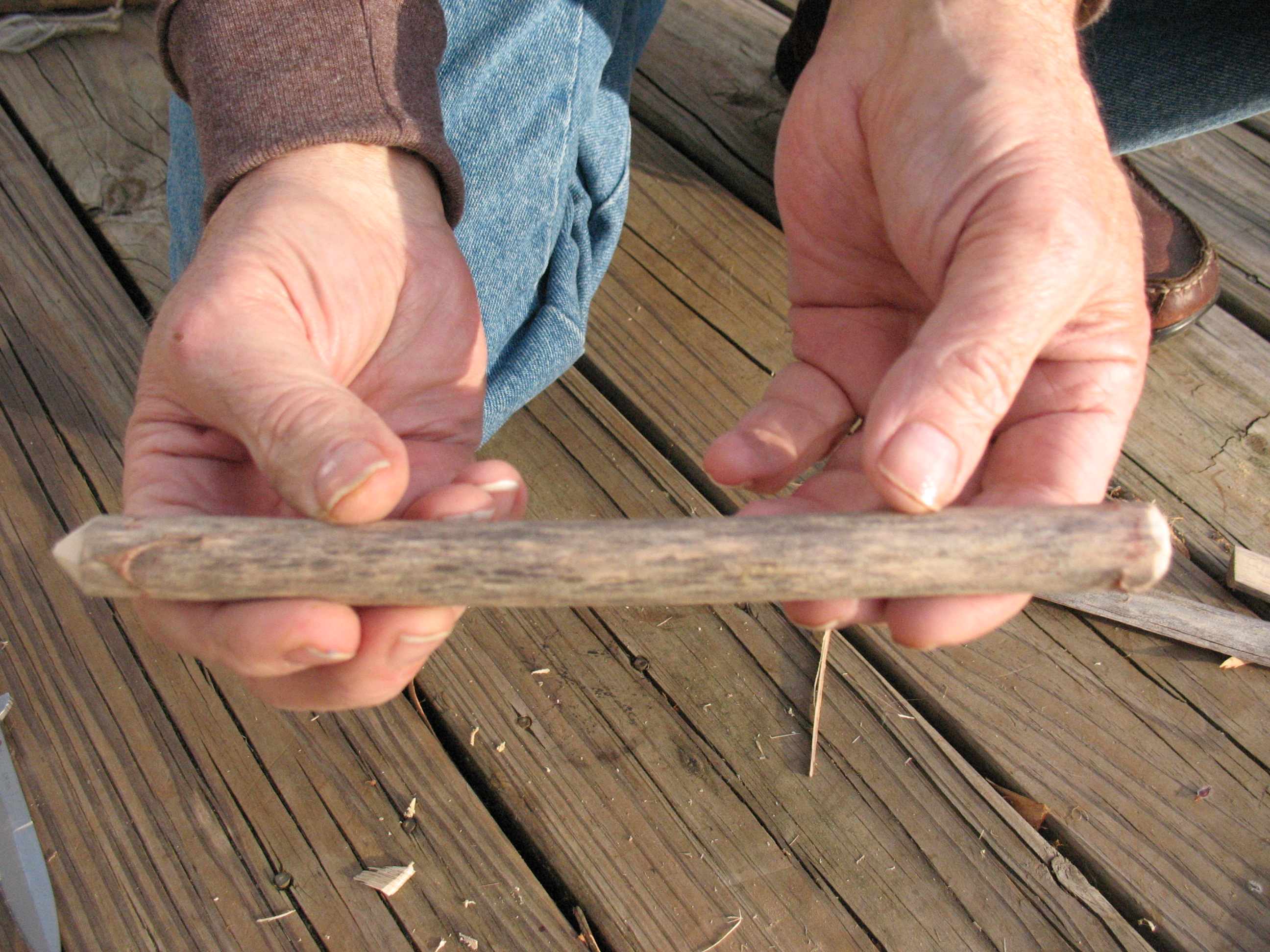
To make a spindle cut a stick about 3/4″ in diameter by ten inches long. Round one end of the stick and carve the other end to a shallow point. Do not smooth the stick off. A rough surface will grip the bowstring better when you are turning the spindle. Pictured below: The spindle.
HANDHOLD – The handhold is the socket that fits on top of the spindle and allows it to turn freely in your hand. The handhold may be made out of hardwood, stone, bone, a seashell or etc. The handhold should fit comfortably in the palm of your hand. The handhold should have a hole in the center that is large enough to accept the rounded end of the spindle and deep enough to keep the spindle from jumping out as it turns. Pictured below: Various different handholds.

BOW – The bow that you will use to turn the spindle can be made from any fairly strong but flexible wood. Oak, hickory, cedar, ash and elm will all make a good bow. You may use these woods green or dry; it really doesn’t matter. In fact you don’t even have to remove the bark from your bow. Make your bow from a stick that is about 3/4″ in diameter and about two feet long. You will need to carve two shallow grooves around the stick to hold the bowstring. Carve one groove about 1/2″ from one end of the stick and the other groove about six inches from the opposite end of the stick. This way you will have about a six inch handhold left after you string the bow. Pictured below: Fire bow.
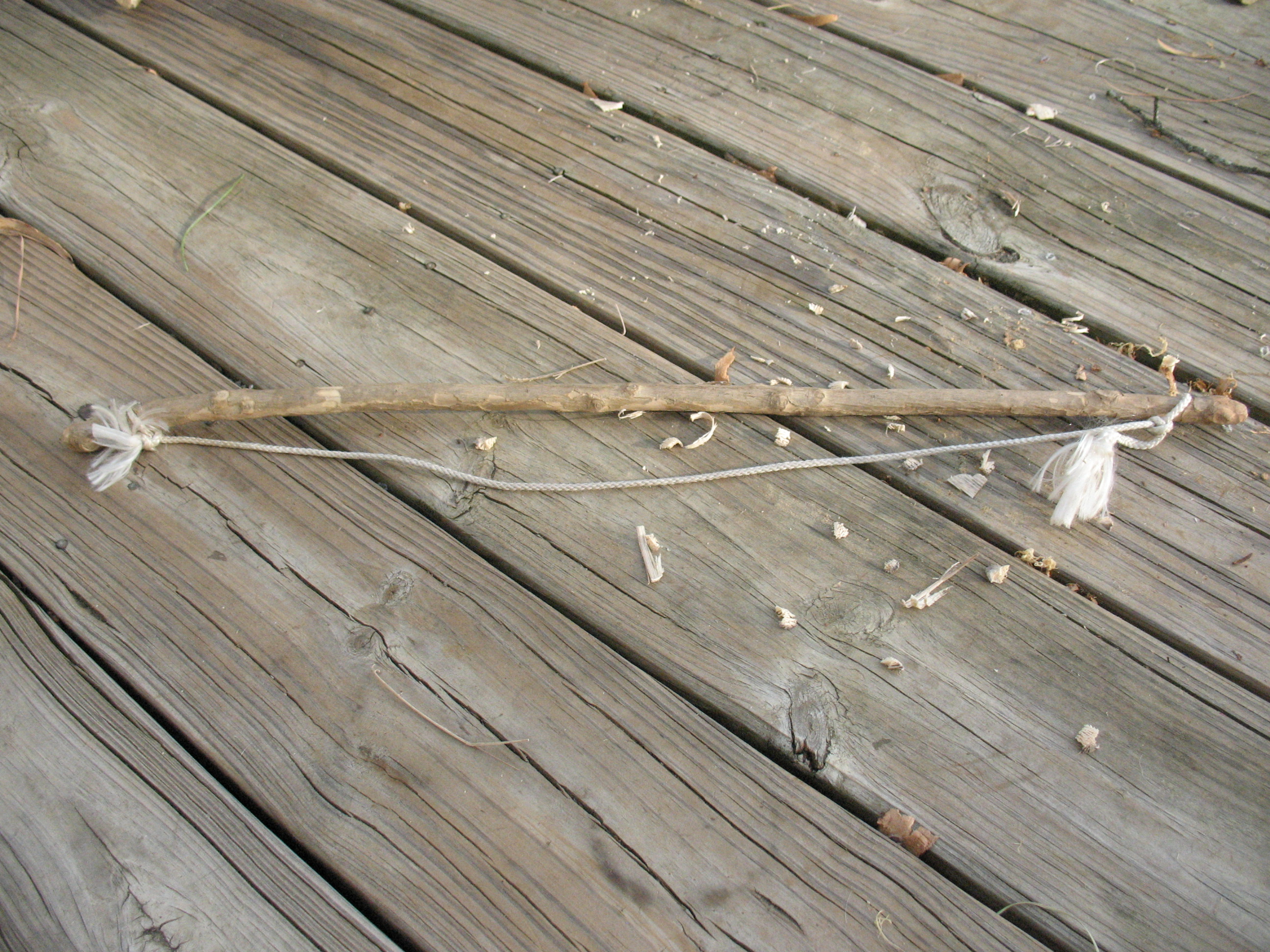
BOWSTRING – You will need about two-and-a-half to three feet of string for your bow. There are many sources of string. You may have some nylon cord with you already. If you are wearing lace-up boots or shoes you can use your shoe laces. You may cut a strip of leather from your belt. You can tear several strips of material from your shirt, skirt or pants and then twist or braid these together to form strong cordage. If you have the knowledge and skill you can make your own cordage from yucca leaves, agave leaves, nettle stems and many other wild plants. In short, your imagination is the only limit when it comes to producing a bowstring.
TINDER – Good quality, dry tinder is very important for primitive fire building. Nothing is more frustrating than to get a good glowing red coal from your fire board and then not be able to set your tinder ablaze with it. In order to catch fire from a glowing coal, tinder must be dry, dry, dry. Finely shredded dead cedar bark makes good tinder. Very dead, very dry shredded grass will work as tinder. Good tinder can be made by unraveling jute or hemp rope to the smallest possible fibers. Old bird’s nests make good tinder if they are made of fine grasses and fibers. A good trick to help your tinder catch fire from a coal is to work some very dry cattail fluff or thistle down into the tinder. This fluff or down will not actually blaze up, but it will catch a spark and help spread it throughout the tinder. Pictured below: top, cutting cedar bark from tree; middle, strips of cedar bark; bottom, shredded cedar bark tinder. 

 Now that we have our materials together, in the next post we will use them to build a fire.
I make these quick and easy brushes when I need something with which to apply rawhide or pine pitch glue. They just take a minute to make, and when you’re through with them you can chunk them into the fire. All you need in the way of materials is a small piece of cane for the handle, a dry yucca leaf for the fibers, and some dry pine sap to hold the fibers in the handle.
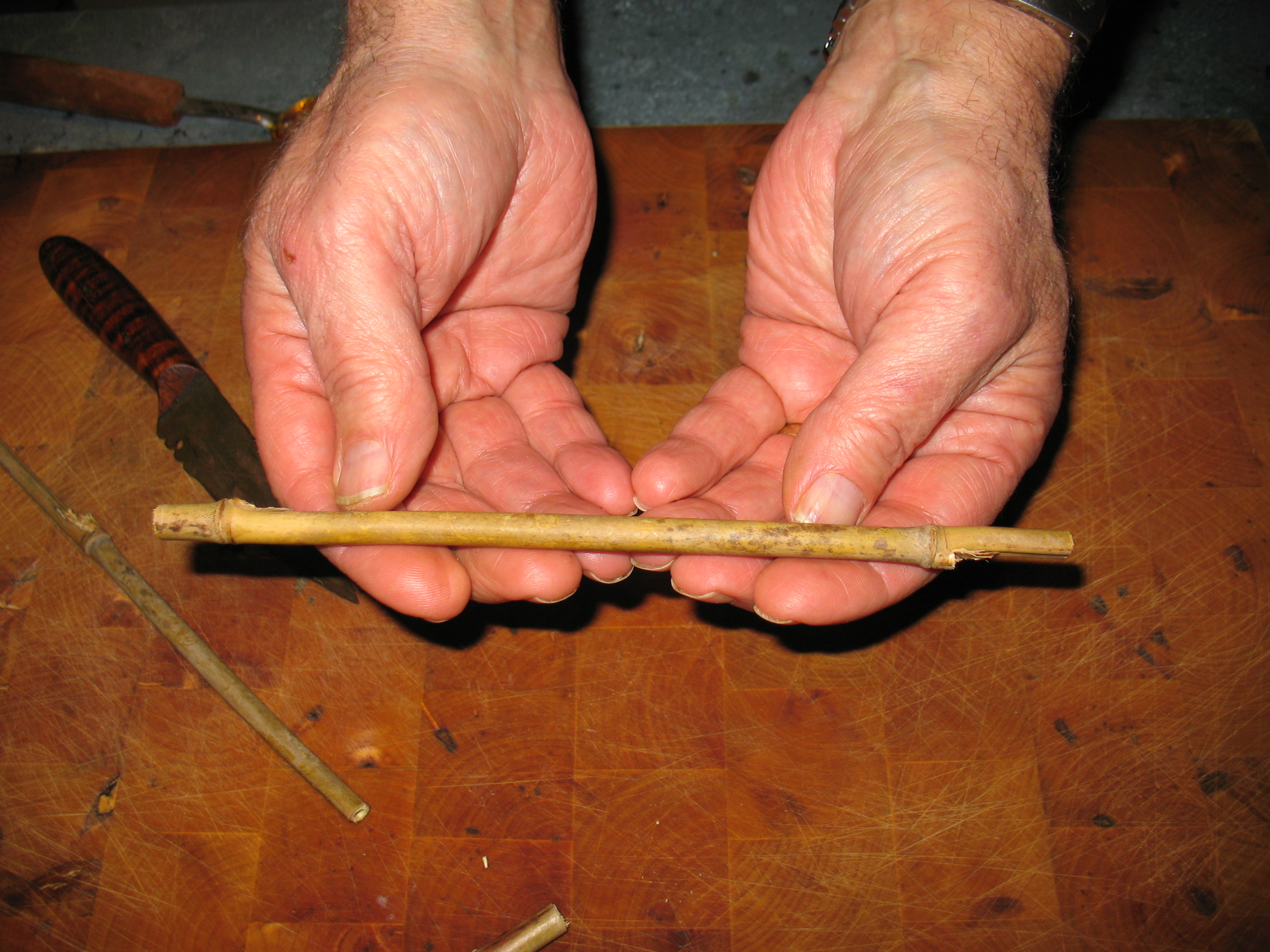
To make a brush, take a piece of cane that is about three-eights of an inch in diameter and cut it about eight inches long. Make sure that a cane joint is about three-eights of an inch from one end of the handle. Pictured below: top, cutting the cane; bottom, finished handle.

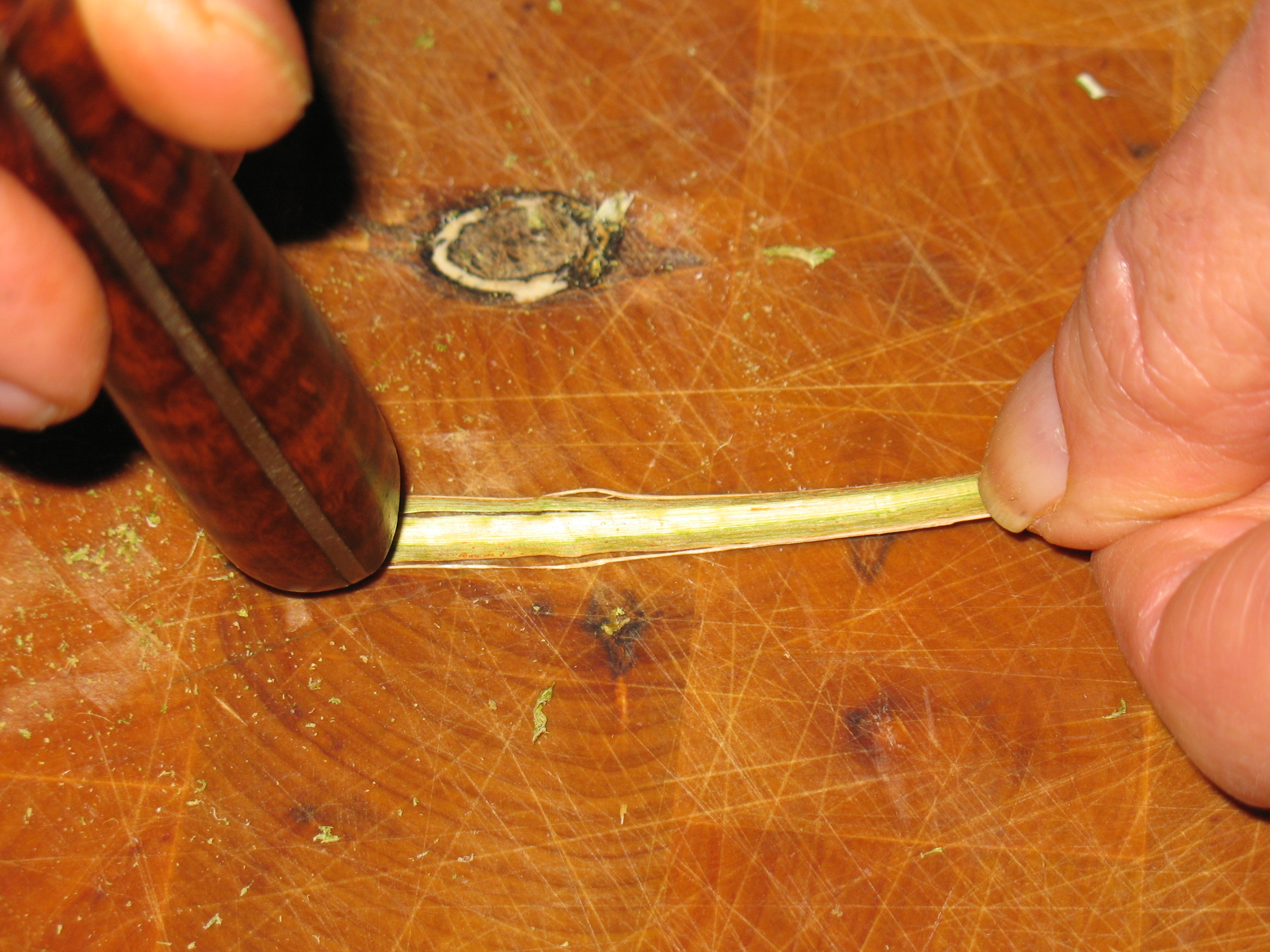
 Now take your dried yucca leaf and peal of the outer membrane to expose the fibers. Use the butt of your knife handle to pound the fibers and separate them. Cut two or three sections of fibers about an inch long. Pictured below: top, scraping yucca leaf; middle, pounding leaf fibers; bottom, one finished fiber bundle.

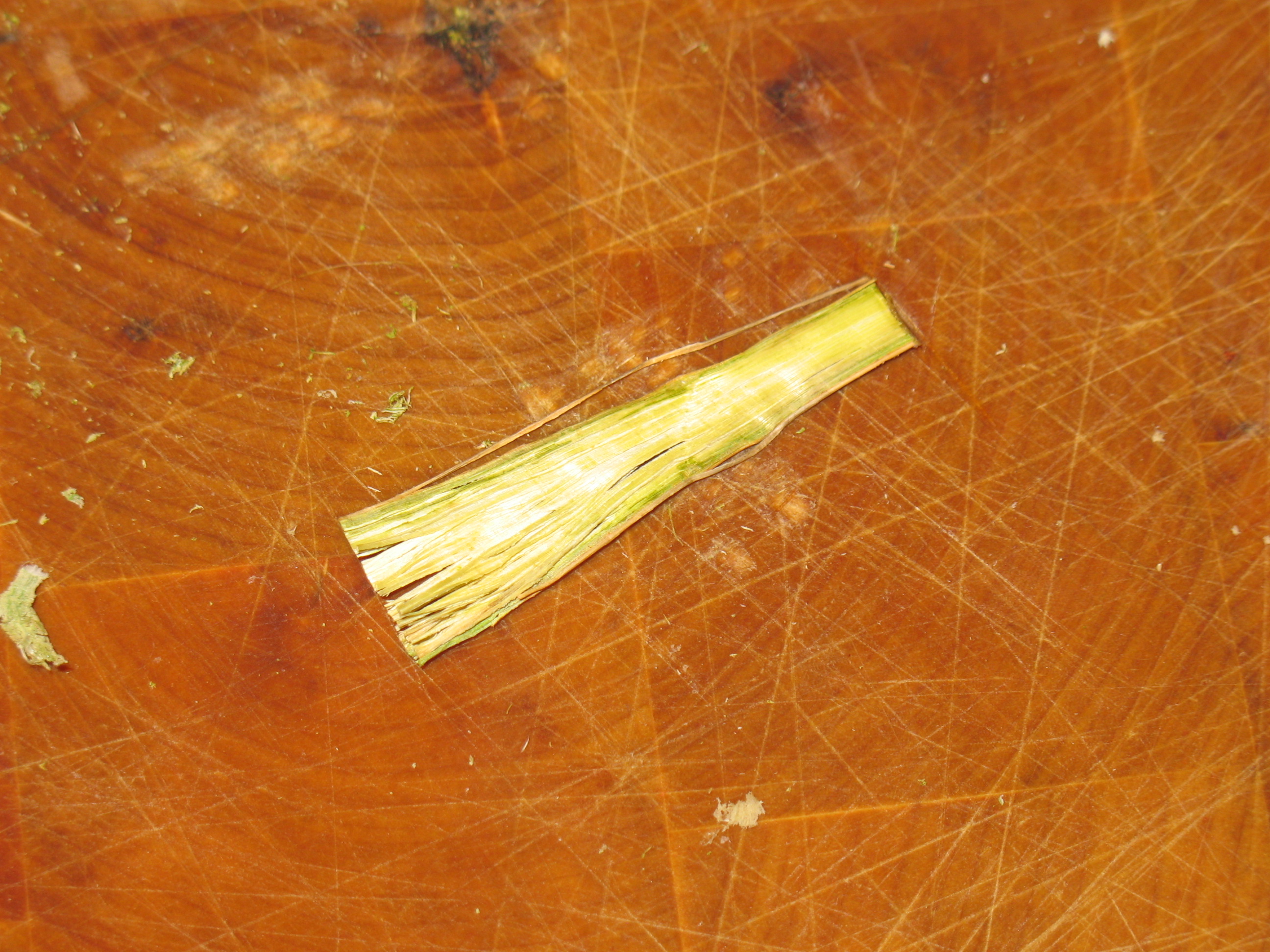 Check to see if you have enough fibers before you try to glue them in, then warm your pine sap and drop a little into the end of the cane. Pictured below: top, checking the fit; bottom, putting pitch in the cane.
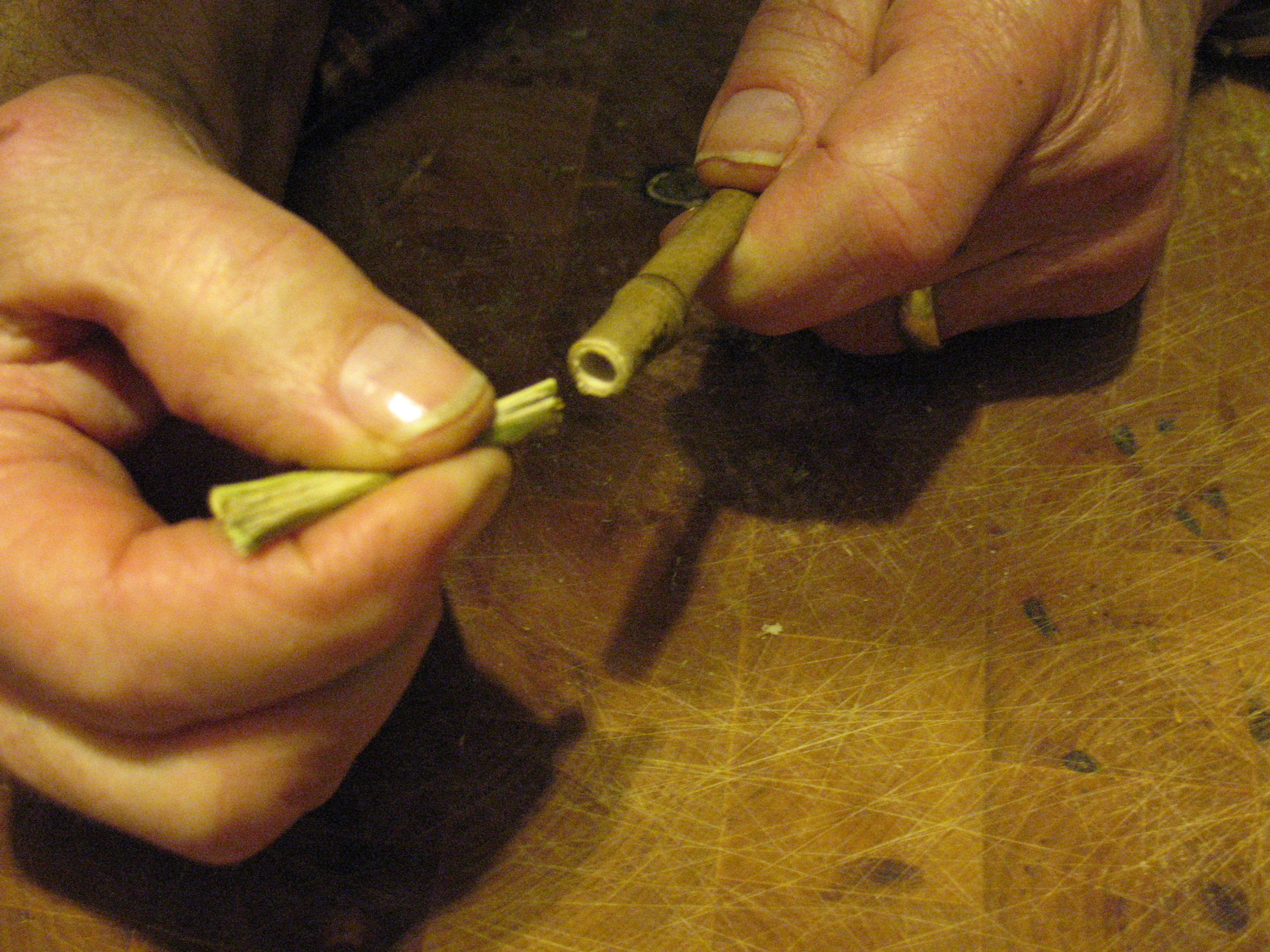

Quickly, before the sap hardens, push the yucca fibers down into the cane. Pictured below: top, cutting bristles to length; bottom, finished brush.
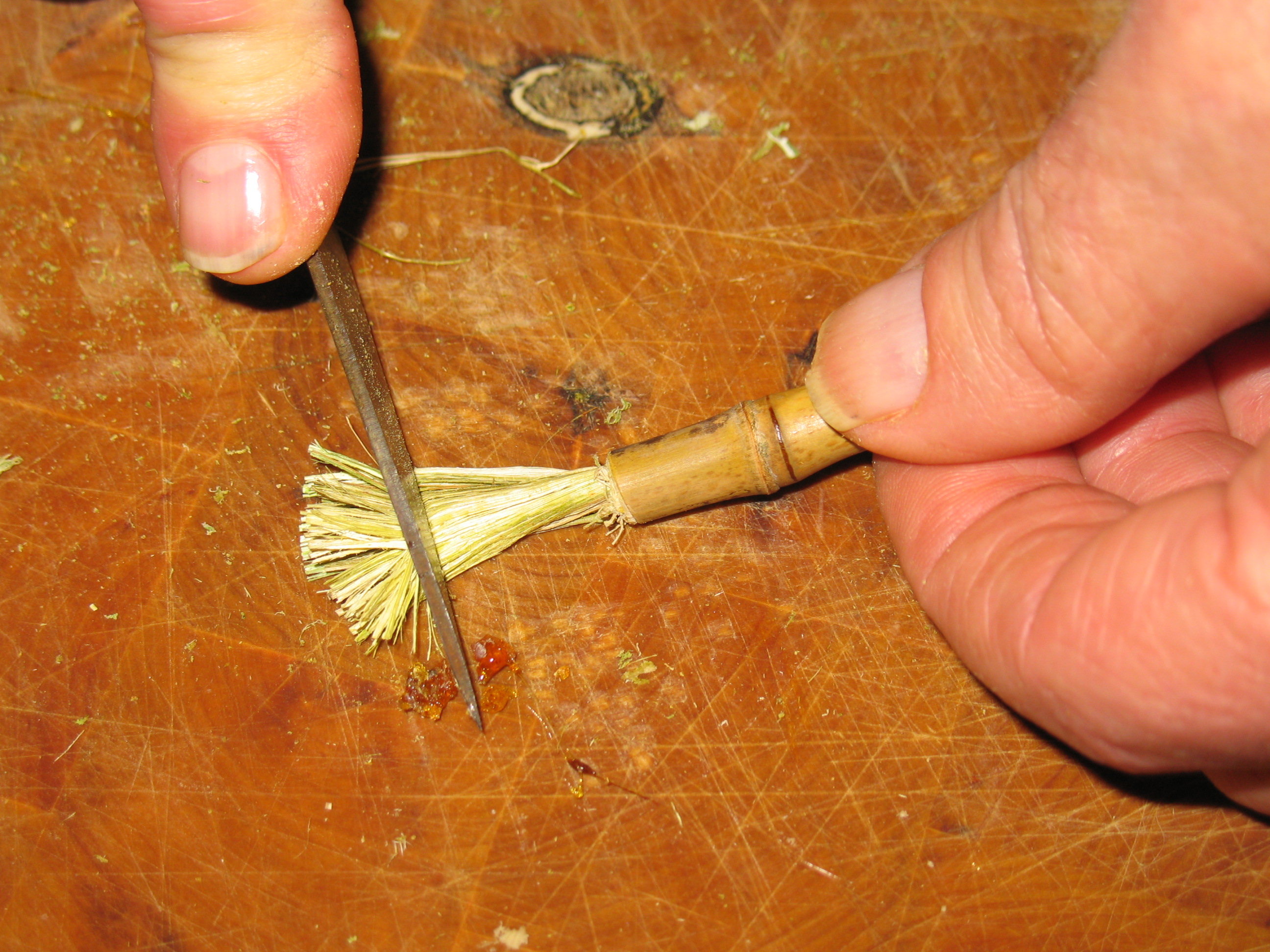
 That’s all there is to it. You now have a brush that you can use when sinew backing a bow or you can use it to paint glue onto arrow bindings. Heck, if you have any artistic talent you can even paint with it.
There are many edible wild plants that can be found in the wilderness. I’m no expert, but I know of at least forty-five edible wild plants that I can find on my farm. You would think that with that many edible wild plants available it would be fairly easy to survive on a vegetarian diet in the wilds. It is not. A life supporting diet doesn’t just depend on the quantity of food available. It also depends on the quality of the food available.
The human body needs carbohydrates, proteins, and fats to survive. Wild plants have a goodly amount of carbohydrates but protein and fats are a problem. Wild fruits and vegetables have virtually no protein. Wild seeds and nuts have more protein, nearly the concentration that is found in meat, fowl, or fish. But one big drawback to getting your protein from plants is that the plants that produce protein are very seasonal. Acorns, pecans, hickory nuts, black walnuts, and pine seeds are only available in the fall. Most grass seeds are harvestable only in the late summer and fall, though some may remain of the stalk into the winter. Not much help if you are trying to survive in the spring or summer.
I think it is ironic that one of the greatest plagues of the modern diet is fat. We look for low-fat this and low-fat that at the grocery store. We trim the fat from our meat and try to avoid butter and lard. The ironic thing is that fat is one of the hardest dietary substances to find in the wild. Even wild meat is pretty low in fat. People that have to live on wild meat prize animals, like possoms, bears, or wild hogs, that have fat in the meat. Wild seeds and nuts have fat in them, but the problem is the same as stated above, they can mostly only be found in the fall.
Maybe you can enlighten me, but I know of no native culture that did or does subsist only by foraging for wild plants. All gatherers that I know of were hunter/gatherers even if they were only hunting grasshoppers. Even native groups with fairly advanced agriculture supplemented there diets by hunting. It’s just hard to get enough protein and fat without eating meat.
So if you are a vegan in modern life, be warned. If you are going to survive in the wilderness, you will become an omnivore, so you better start cultivating a taste for possom right now.
This weekend I did two things which I rarely do. I decided to buy a new gun, and I went to Wal-Mart to do it. The reason that I rarely buy a gun is because I have all the guns that I need, and I am not in the habit of buying things that I don’t need. In fact, I don’t think I’ve bought a gun since the Brady Bill was passed into law.
The reason that I rarely go into Wal-Mart is because I loath everything that they stand for. They predatorily destroy local businesses, they bully and exploit their vendors and employees, they are a major source of the U.S. trade deficit, and they are a supporter of the Communist Chinese economy.
So here’s what happened. My son is getting ready to graduate from college, and he has been wanting a Remington 700 in .308 caliber. Wal-Mart had them on sale with scope and mount for $297 plus tax, so I drove to a nearby town to buy him one for a graduation present. Those of you who are familiar with the Brady Bill probably know where this is going. I went to the sporting goods section and the salesman pulled out a 700 for me to look at. I cycled the bolt, pulled the magazine out, replaced it, and told him I’d take the gun. I told him I was so happy to find it because I had been looking for one for my son’s graduation present and they were hard to find in .308.
Now here’s where the stupidity starts. At this point the salesman could have said, “Gee sir, if you’re going to buy it for your son, you’ll have to have him come in to fill out the paperwork on it because the Brady Bill requires the person who will own the gun has to sign the papers. I would have disagreed with the law, but I would have understood his position, and I would have had my son go up there with me the next weekend when he was home from college and fill out the papers. But is this guy smart enough to do that. Sadly, no. He is either the dumbest gun salesman in the world; or, more likely, he is not permitted to deal with something of this magnitude without the approval of higher management. So we go through the whole rigmarole of filling out papers, checking ID, calling for a background check, etc, etc. This process is interrupted by him taking a phone call which, in his defense, he was polite enough to ask me if he could take. He then had to go check a price for the person on the phone. Then he had to go to the back and find a box for the gun which took an unusually long time. I later realized that it took so long because he was alerting the manager to a major crisis that was developing at the gun counter. To whit, a good citizen was trying to buy a hunting rifle for his son in violation of the Brady Bill straw purchase clause.
So, a half hour after I told the guy that I was buying the gun for my son’s graduation present, he finally makes it back to the counter with the box. I have my money clip in my hand ready to pay for the gun when here comes “Mike the Manager” rolling up on his walkie-talkie equipped electric scooter. Mike is in his thirties I would say, weighs about 220, and is bald as a billiard ball. He gets off his scooter and walks around the counter. He takes one look at me, 145 pounds, $500 snakeskin boots, and a money clip full of 100 dollar bills in my hand, and his eyes light up with joy. He’s fixing to get to stick it to one of those guys that he knows he’ll never be.
The situation could still have been salvaged at this point. The conversation could have gone like this:
Mike: “Sir, I’m sorry but we may have a problem with selling you this gun today.”
Hank: “Oh really. What kind of problem could that be?”
Mike: Well there’s this law called the Brady Law. It’s a pain in the rear for us and for honest citizens like yourself, but we have to follow it or we can get into big trouble.”
Hank: “So how does that apply to me?”
Mike: “Well, you said you were buying this gun for your son’s graduation present, right.”
Hank: “Yes. He’s graduating from college in May.”
Mike: “Well according to the Brady Law, and again I apologize for this, the person who’s going to own the gun has to fill out the paperwork and sign it if he’s over 18 years of age.”
Hank: “Oh, I wasn’t aware of that. That’s a pretty stupid law.”
Mike: “I agree. Everybody knows that this won’t keep bad guys from getting guns, but we have to follow the law. If you could just bring your son in and have him fill out the papers we’d be happy to sell you the gun.”
Hank: “OK. It’s a pain in the butt, and it will ruin the surprise, but he’ll be home next weekend and I’ll bring him in then.”
There could have been a happy ending for everyone, but apparently Wal-Mart doesn’t spend much time working with their managers on people skills because this is how it went:
Mike smiles and asks, “What are we buying today?” “A Remington 700 in .308,” I tell him. “Going to do a little deer hunting are you?” he asks. “Well my son will probably go deer hunting with it next year,” I say. “I’m buying it for his graduation present.” “Oh really. How old is your son?” he says like he’s a nice guy who’s just interested in my family. “He’ll be 22 in April,” I say. He gets a look on his face like he just personally caught Osama Ben Laudin. “Well sir, I can’t sell you this gun.” He says with a kind of satisfied smirk on his face, “If you’re buying it for someone over the age of 18 he has to fill out the paperwork or it’s a violation of the Brady Law.” “You’ve got to be sh__ing me,” I said. “No, I can’t sell it to you,” he says. “Well, I’ll buy it for myself then,” I say. “No, you already said you’re buying it for him. You can’t take it back once you say you’re buying it for someone else. I’m sorry,” he said, “I can’t sell it to you.” So I told him what I thought about him and the Brady Bill and left never to return.
They could have made me feel like they wanted to sell me the gun but that their hands were tied by a bad law that we were both victims of, and that if I would come back with my son they would be happy to sell me the gun. Instead they made me feel like they’d set a trap to try and catch me consciously committing a criminal act, that they were way too smart to get fooled by little ole me, and that I should be on my way. Not a very good way to keep customers, but then again I guess Wal-Mart thinks they’re so big that they don’t have to worry about losing a few customers. Well, it may take a while, but the bankruptcy courts have a long relationship with businesses that think they can lose a few customers without consequence.
So let’s recap. We have a stupid law that prevents a law abiding father from buying a graduation present for his son, but a law that every terrorist, drug dealer, and gangbanger in the U.S. knows how to get around. We have a stupid salesman that wasted a half hour of my time and turned a potential sale into a lost customer. And we have Mike. God bless you Mike. I hope you enjoyed yourself. A guy like you needs a break every once in a while, but I’d try to brush up on my customer relations skills a little if I were you.
P.S. I’ll just give my son the cash and tell him to buy his .308 wherever he wants, as long as it’s not from Wal-Mart.
The rest of my gear is carried in, or on, a small back-pack; what some people refer to as a day pack. The pack has several different compartments and pockets. It also has some straps for tying things to the outside. Starting on the outside of the pack, I have a fleece bag strapped to the left side of the pack. The fleece bag is like a blanket that is folded in half with a zipper along the side. It is adequate for warm to cool weather sleeping, but too light for cold weather. To make the bag comfortable is cold weather I put a foot of pine needles under it and a foot of pine needles over it.

Fleece Bag
On the right side of the pack I have strapped on a small oil-cloth tarp. This tarp is six by seven feet and can be used under the fleece bag as a ground cloth, folded over the fleece bag for extra warmth, or rigged as a shelter in rainy weather. Strapped on along with the tarp is a light-weight hand axe with a leather sheath. I also hook a Sierra drinking cup to one of the straps that secures my tarp.

Tarp and Hand Axe
There are four outside zipper pockets on the pack. The top pocket holds an emergency solar blanket, a small first aid kit and a snake bite kit.

Top Pocket

Solar Blanket, First Aid Kit, and Snake Bite Kit
The largest pocket holds a flat, one quart, Boy Scout canteen, a water filter straw, and a bottle of water purification tablets.
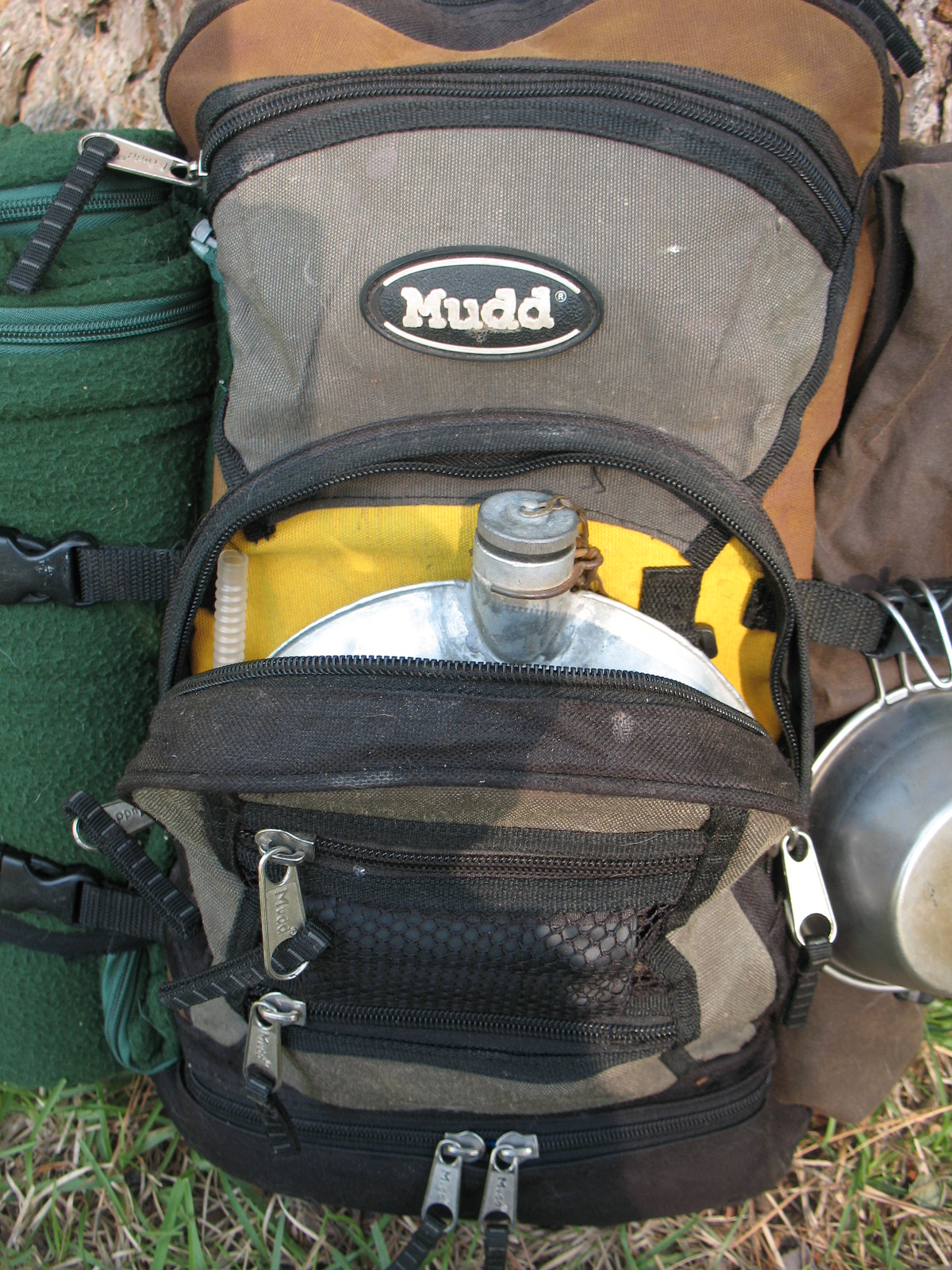
Large Canteen Pocket
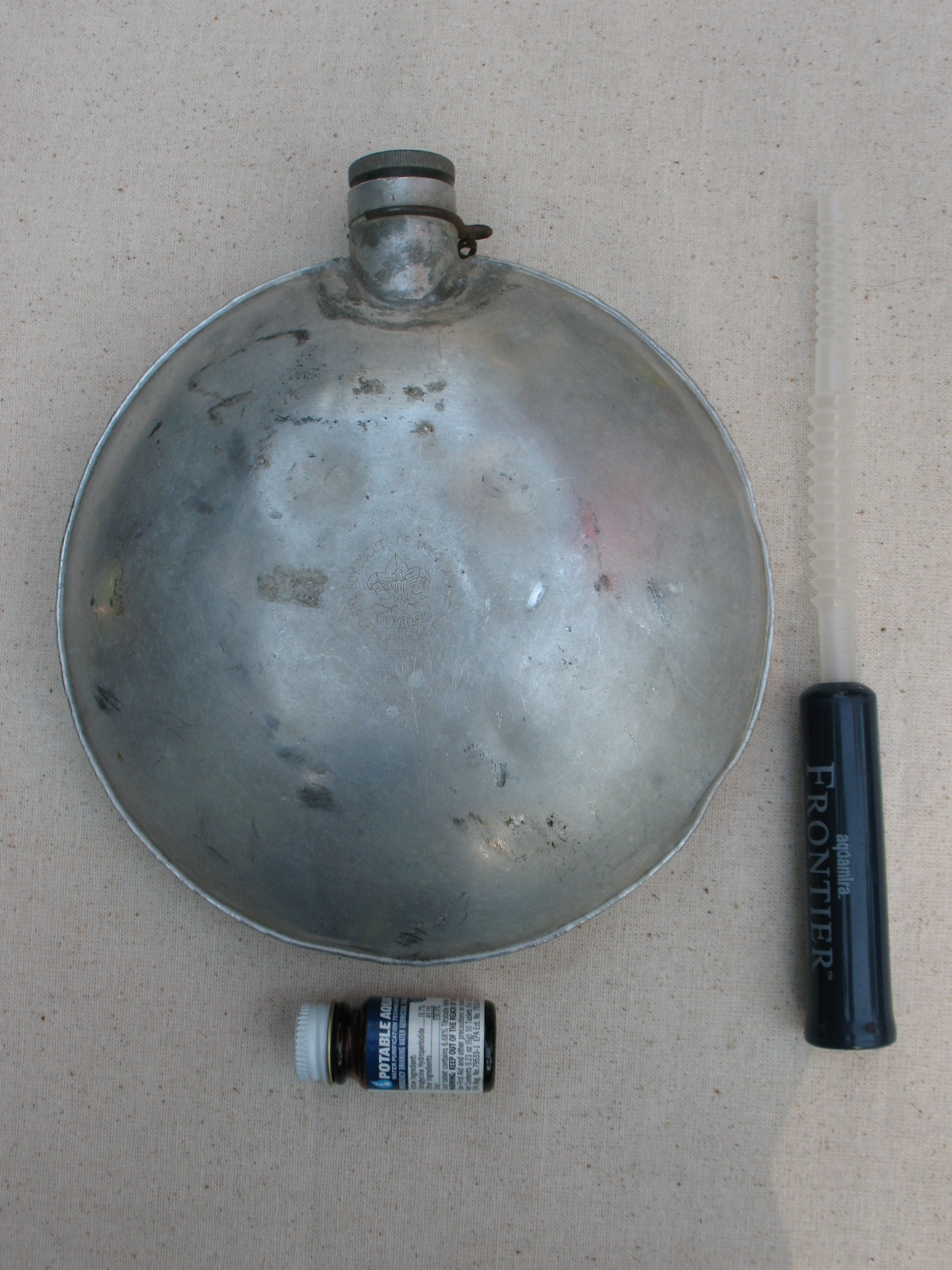
Canteen, Water Purification Tablets, and Filter Straw
A small mesh pocket holds a pair of mini-binoculars.

Mesh Pocket with Binoculars
The bottom pocket on the pack is where I keep stuff having to do with light and fire. It holds a cigarette lighter, a magnesium bar with flint striker, two paraffin and sawdust fire starters, a small LED flashlight, and a tube of six extra AAA batteries.

Lower Pocket
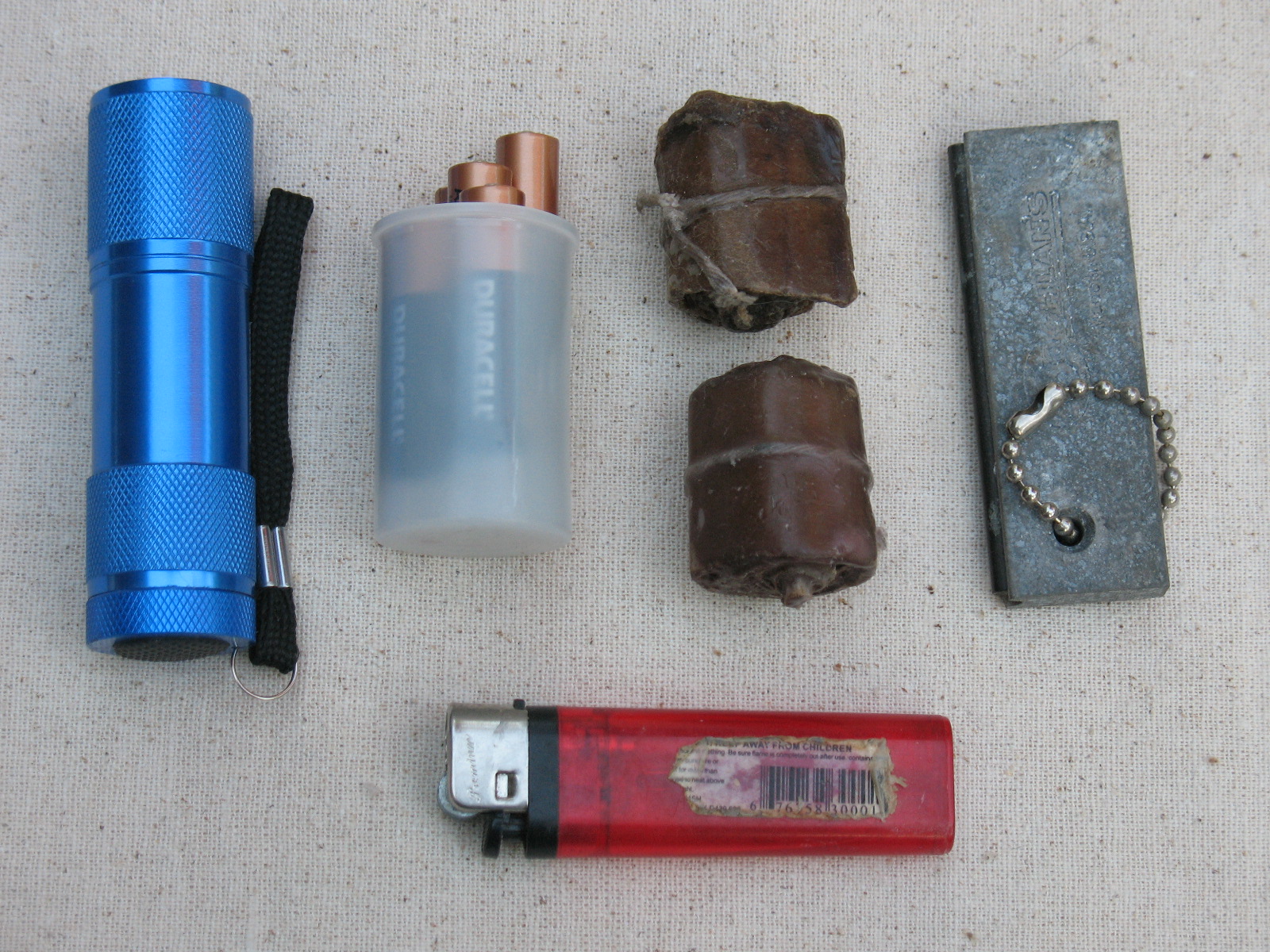
Flashlite, Extra Batteries, Fire Starters, Magnesium Bar, and Butane Lighter
The bottom of my pack has a compartment in which I keep a Frog Togs rain suit. This is a great rain suit because it breaths so you can wear it without breaking out in a sweat. I also keep a bottle of insect repellant and a tube of sunscreen in this compartment.

Bottom Compartment and Contents
The main compartment of the pack has an inside pocket in which I keep a small fishing kit, 50 feet of parachute cord, some nylon twine, a ball of linen string, and some snare wire.
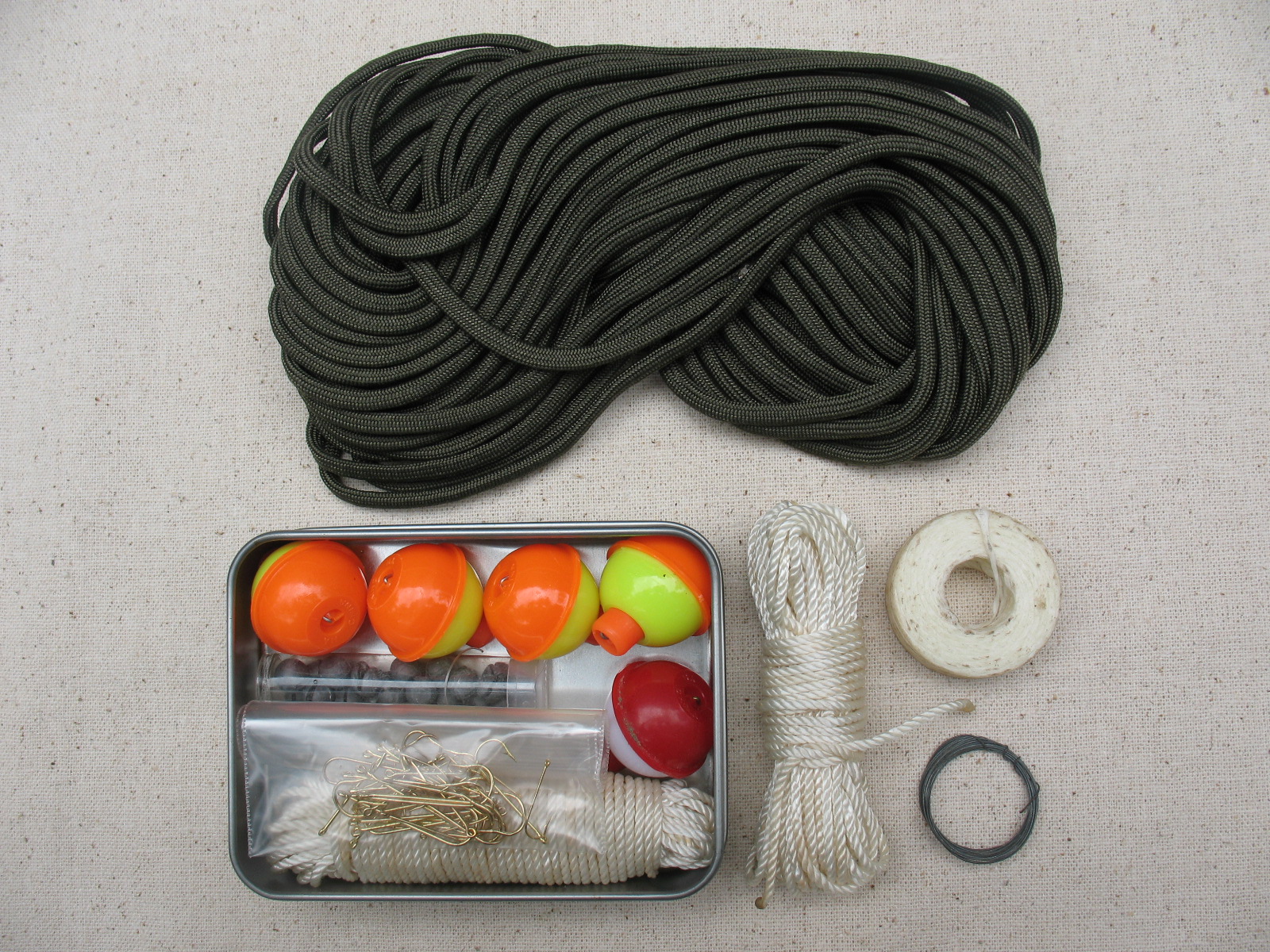
Inside Pocket Contents
Inside the main compartment of the pack I carry a small sheet-steel cook pot and three stuff bags. Inside the cook pot is a folding pocket stove, six fuel tablets, and some strike anywhere matches.
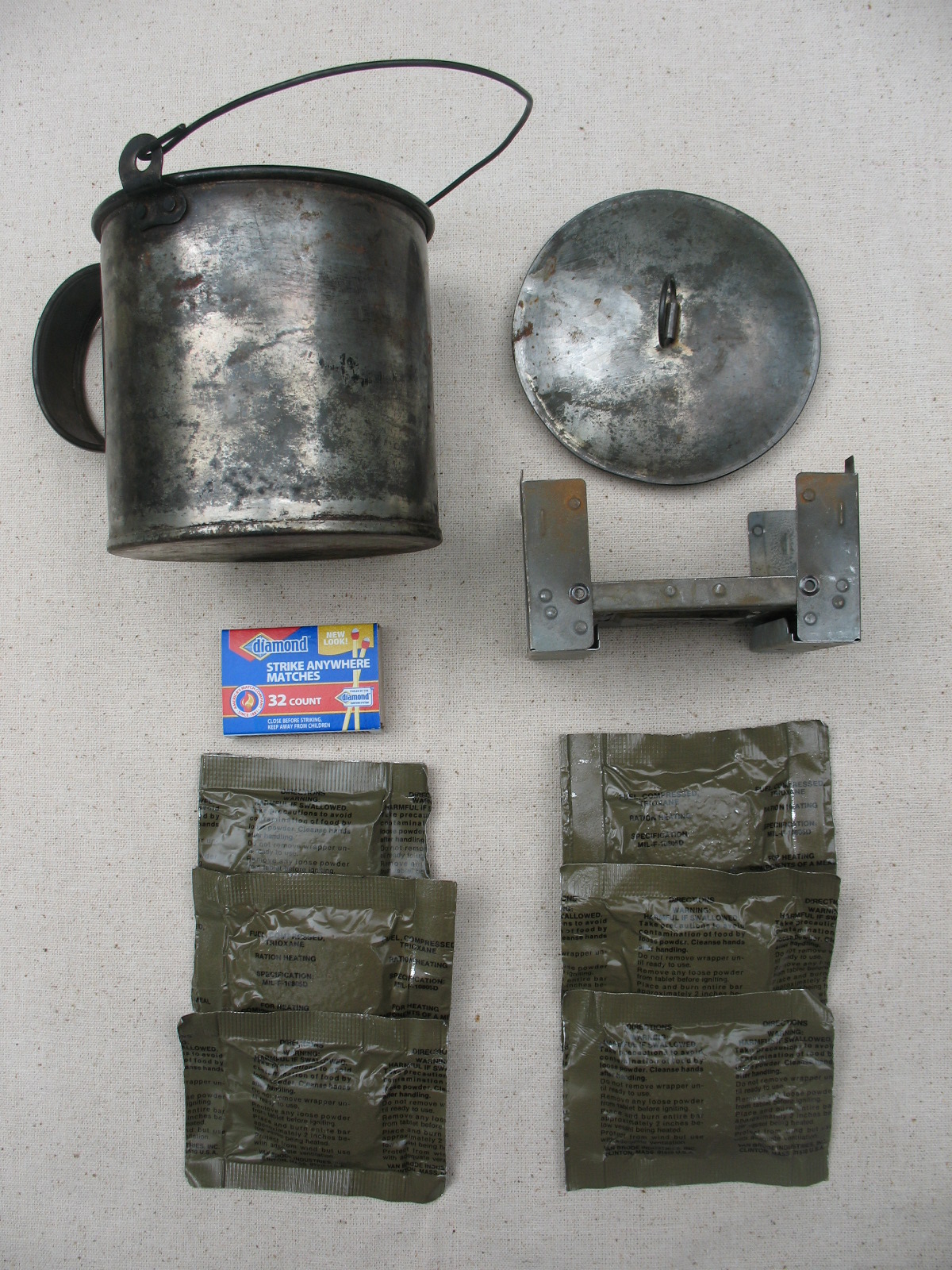
Cook Pot and Contents
Three stuff bags inside the main compartment hold the rest of my gear. One bag I call my “hardware bag.” This bag holds a gun cleaning kit, a metal gun oil bottle, a small file, a whetstone, a multi tool, and extra ammo.
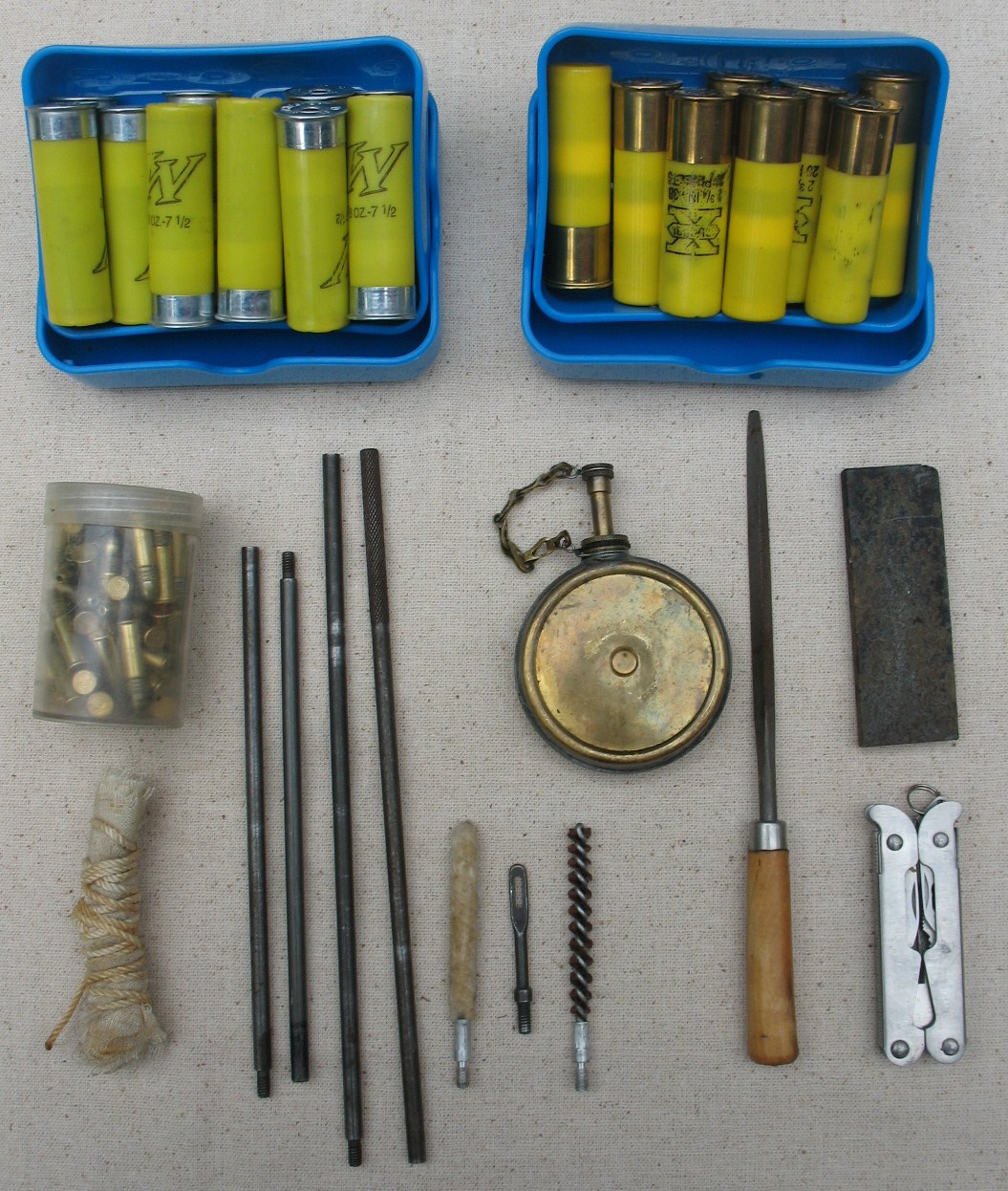
Hardware Bag Contents
My “clothes bag” contains a pair of gloves, a pair of wool socks, thermal underwear, and a balaclava hat.
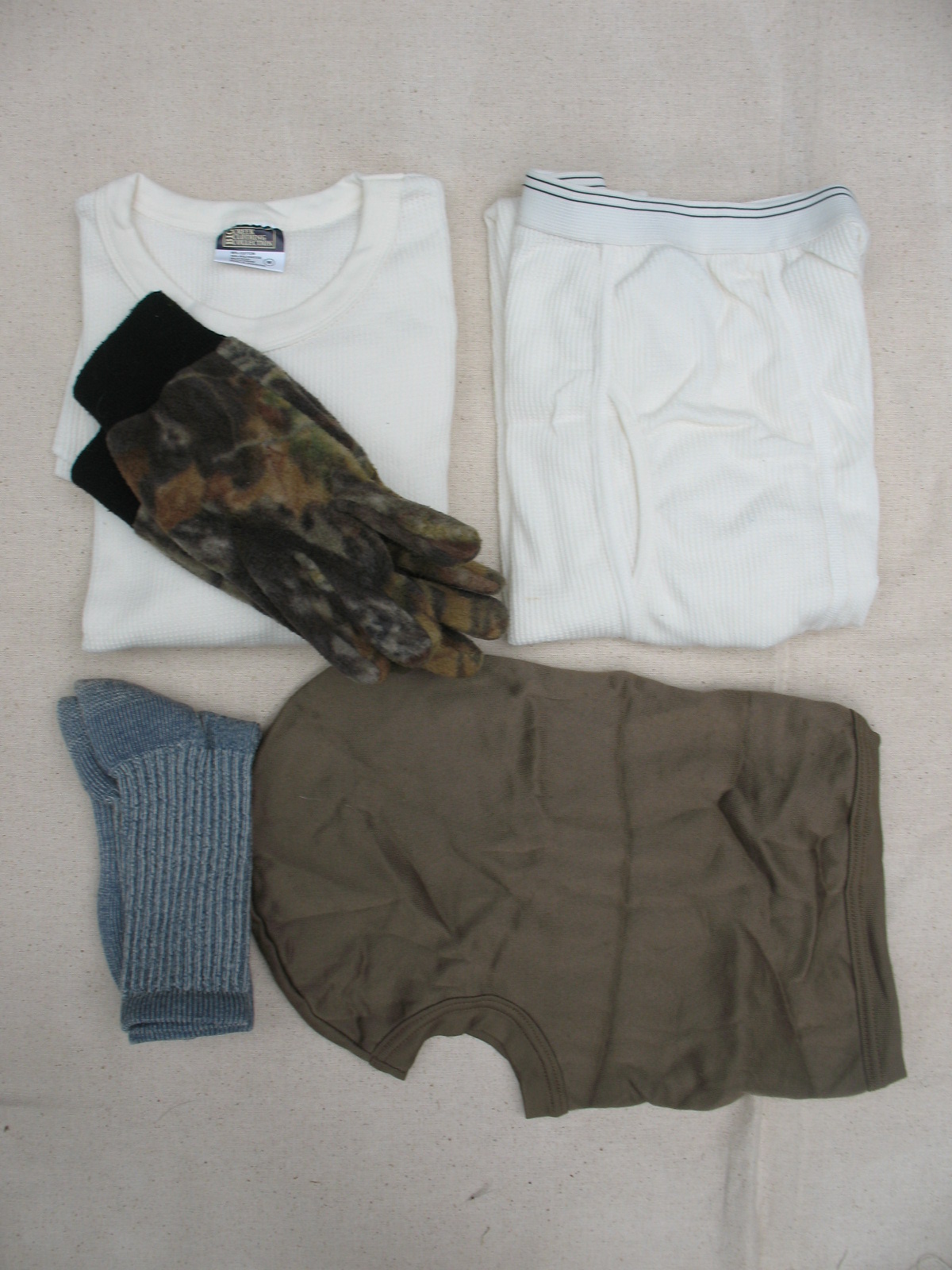
Clothing Bag Contents
The final bag in my pack is my “food bag.” The food I selected for my bag has to meet certain requirements. It has to be light-weight, it has to have a long shelf-life, it has to be compact, and it has to be very calorie and nutrient dense. These are the items I ended up choosing:
3 cups of minute rice
1 can of sardines in oil
1 can of chicken
1 package of tuna
1 package of beef jerky
3 protein bars
2 peanut candy bars
1 bag of dried fruit bits
5 bullion cubes
5 single serving coffee bags
2 tea bags
5 sugar packs
I also have a P-38 can opener and a spoon in my food bag. I carry four plastic bottles of spices in my food bag to use in the preparation of any fish or game that I may take. These spices include salt, black pepper, garlic, and chili powder.

Food Bag Contents
I find that with this gear I can travel light, set up a comfortable camp, and hunt and fish for additional food. This is the gear that works for me.
 Sensible Survival