Since I have made about a hundred and fifty posts on this blog over the past couple of years, I guess it’s about time to clarify what this blog is about. The Sensible Survival blog is really about three different and distinct areas; preparedness, wilderness survival, and primitive skills.
Preparedness
Everyone should be prepared for disasters, natural or man-made. The posts on preparedness are about being ready for things like temporary power outages, unemployment, natural disasters, biological accidents or attacks, civil disorder, or the complete breakdown of society. The social order may endure forever, but everybody’s power will go out sooner or later, so be prepared. 

Survival
A significant number of people are faced with survival situations every year. Hikers get lost. Hunters on ATV’s breakdown far from their camps. Motorists get stranded on lonely roads. Light planes crash. Skiers get stranded by snow storms. Etc., etc., etc. Most of these events end happily with the lost individuals being rescued within a day or two, but everyone should be familiar with the basic skills needed to survive in the wilderness for at least 72 hours. Preserving body heat, building a fire, finding drinkable water, and signaling for help are skills that can save your life in a bad situation. 

Very rarely, individuals are stranded in the wilderness for weeks or months. In a situation like this, additional skills such as wild plant identification, making animal traps, cooking without utensils, making cordage, making a survival bow and arrows, and how to land navigate can help insure survival. 

Primitive Skills
The rarest occurrence of all is what I call a Robinson Crusoe scenario, a situation where an individual has to live for many months or even years in the wilds. This is the situation where primitive skills would come into play. How to make a fine hunting bow, making baskets and pottery, tanning animal hides, and drying meat are examples of primitive skills that you would need in a Robinson Crusoe scenario. 

So, primitive skills are probably the least important skills that I blog about; but here’s the thing. For a certain type of individual, like me, and maybe like you, primitive skills are fun. It’s like a hobby that might possibly have a real world application at some point, but probably not. Be that as it may, I enjoy making fine hunting bows, I enjoy making baskets, I enjoy making stone tools, and I enjoy brain tanning hides; and I will continue to post about these activities along with my posts about preparedness and survival.
Hope that clears thing up a little.
A bundle bow is a bow that is made by bundling several sticks together. The great thing about a bundle bow is that it requires absolutely no bow making experience to build one. There is no shaping, worrying about wood grain, or trying to balance the pull of the limbs. All you need are the sticks and about twenty or thirty feet of cordage.
I like to make bundle bows from bamboo because it is light, strong, flexible, and easy to find. Once you’ve located a bamboo grove it only takes a few minutes to harvest enough canes for a bundle bow. You will need six to eight canes to make a bow. Select canes that are about the size of your little finger at the base and that don’t taper down too quickly. Pictured below: A nice grove of bamboo
Once you’ve collected your canes you will need to cut them to length. We are going to make about a five foot long bow, so you will need to cut your canes about three feet long. Pictured below: Bamboo canes and cordage that we will use to make the bow 
To make this bow I am using six canes, so I turn three of them one direction and three the opposite direction, and overlap the big ends about a foot. 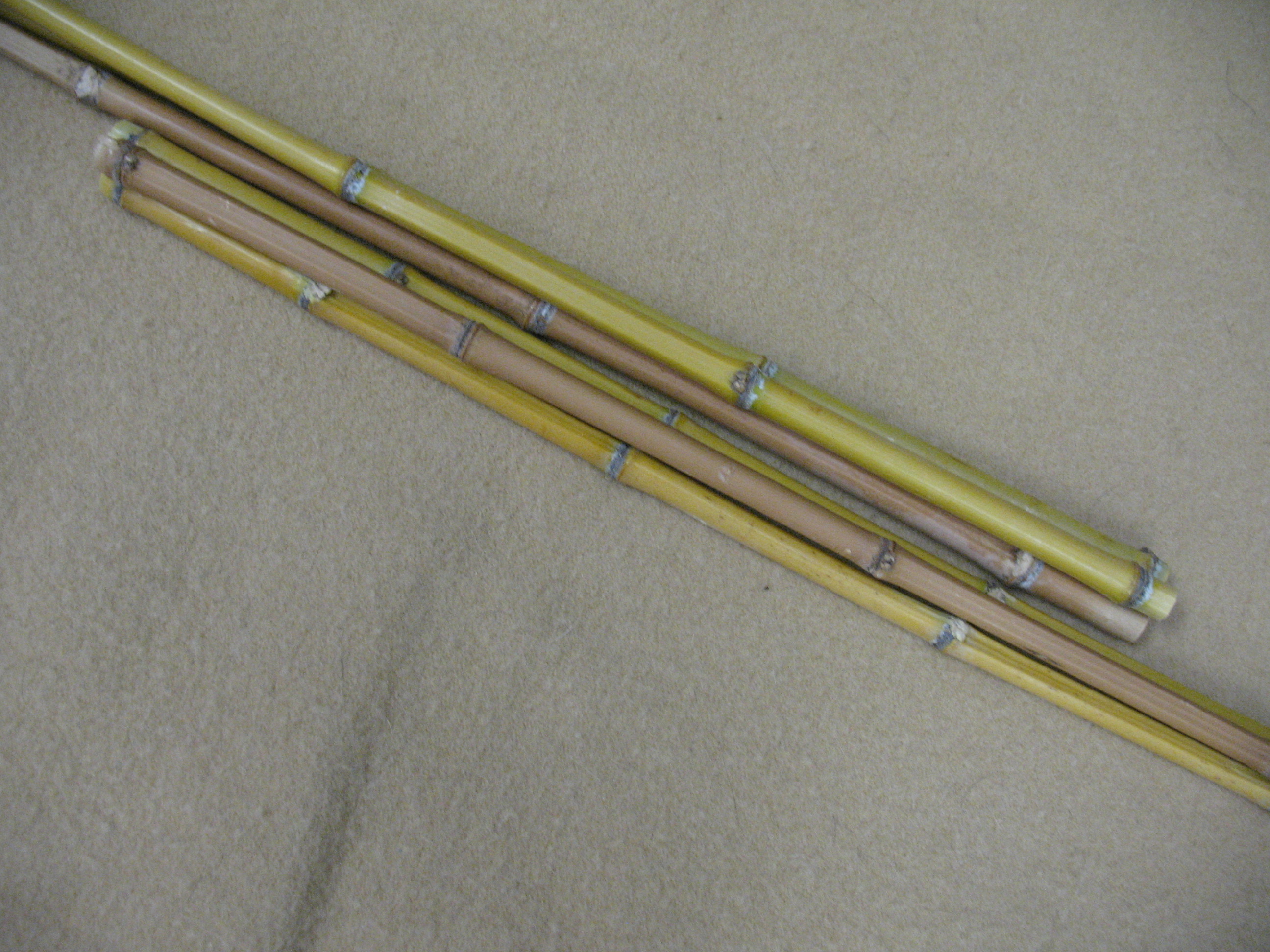
Here are the canes temporarily tied together with twine so that you can see how they overlap. Temporary ties are good to use because they will hold the canes in place while you put on your permanent wrappings. If you don’t use the temporary ties the canes will move around a lot and make your job harder. 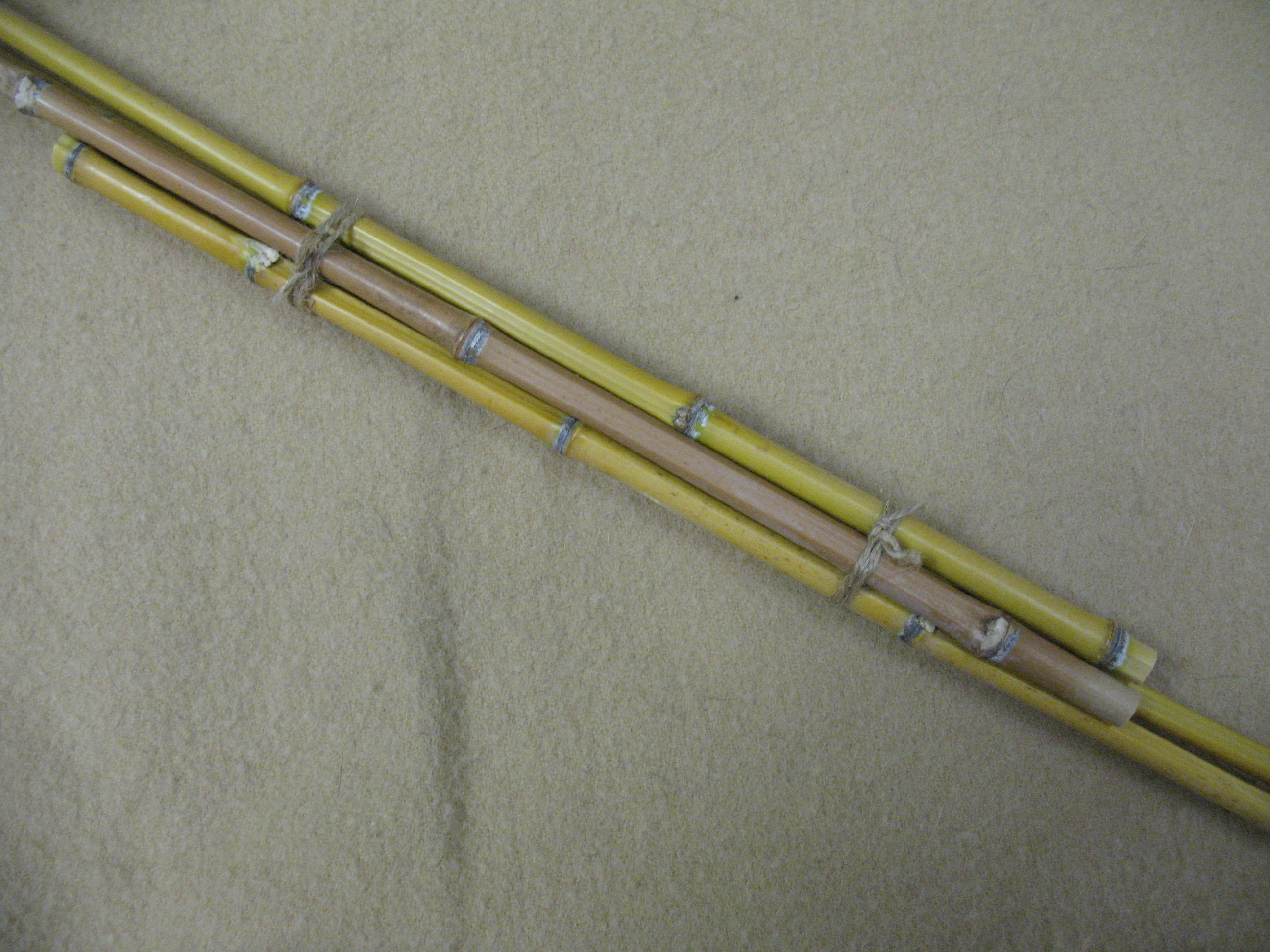
Take your cordage, for this bow I am using some light-weight jute twine, and tie the canes together at the handle. Some people wrap the entire handle with cordage, but I just put about a two inch wrap at each end of the handle. This saves a lot of cordage which can be very important if you are twisting up the cordage from yucca or some other natural fiber. The photos below illustrate how I tie the canes together and what the finished handle looks like.


When you have the handle lashed together, move out about half way to the tips and make another good, tight wrapping. These wrappings only need to be about an inch long. 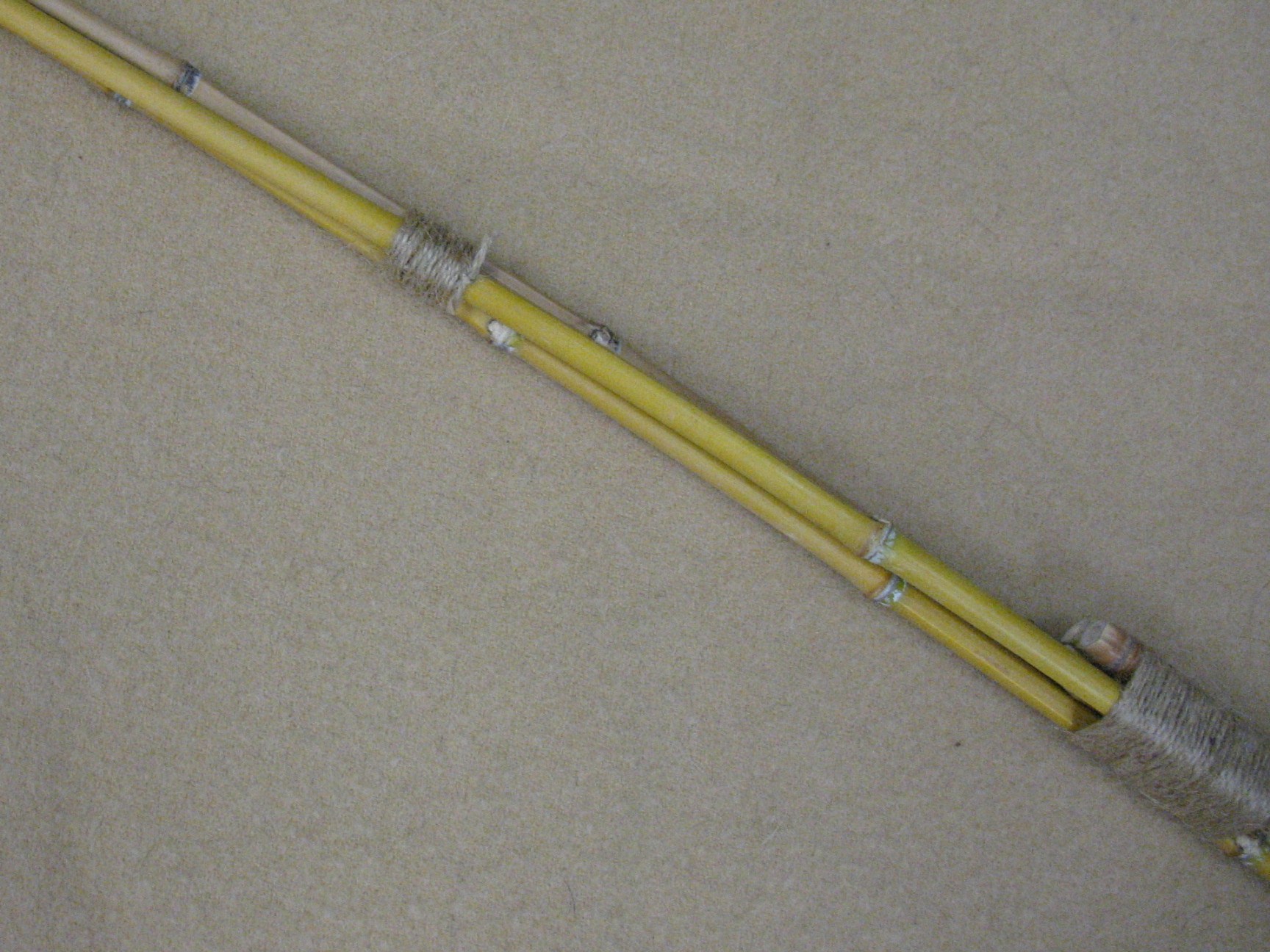
Finally, go all the way out to the tips and lash them together. Make these lashings kind of bulky so that they will keep the loops on the bowstring from sliding down. The lashings will try to slide a little, no matter how tight you make them. 

That’s all there is to it. Just fit on a bowstring and you are ready to shoot.

In this instance I twisted together three pieces of my jute twine to make the bowstring. I tied a slip loop in one end of the string and tied the other end onto the bow permanently. If the bow is not powerful enough to suit you, all you have to do is add more canes to make it stronger.
A hand axe, like the one pictured below, will work fine for cutting down small trees. In fact, the hand axe worked so well that it was man’s most advanced tool for about 200,000 years. But, man discovered somewhere along the way, that the hand axe could be made even more efficient by attaching it to a handle that would give it more leverage and force when swung. The hafted axe was born.
A hafted axe means an axe that is on a handle. This allows you to swing the axe with more force and has a less jarring effect on you hand than a hand axe. There are three components to a hafted axe: (1) the axe head, (2) the axe handle, and (3) some material or method for attaching the axe head to the handle.
The Axe Head
There are two types of axe heads that you can make; a knapped axe head and a pecked axe head. .
You don’t have to be a master flint knapper to make a knapped axe head. If you don’t know how to pressure flake, that’s no problem. You can make a functional axe head using only the percussion method. That means that you just hit on a piece of flint with another rock, knocking off flakes of flint until you have a crude but useful axe head. Pictured below: A crudely knapped flint axe head 
The pecked stone axe head is considerably more time consuming to make that a knapped axe head. To make a pecked axe head you need a good river rock that is some kind of hard, and fairly fine grained stone. I find that a fine grained granite rock makes a good axe head. Spend some extra time selecting a rock that that is already pretty close to the shape you are looking for. This will save you a lot of work in the long run. Picture below: A pecked stone axe head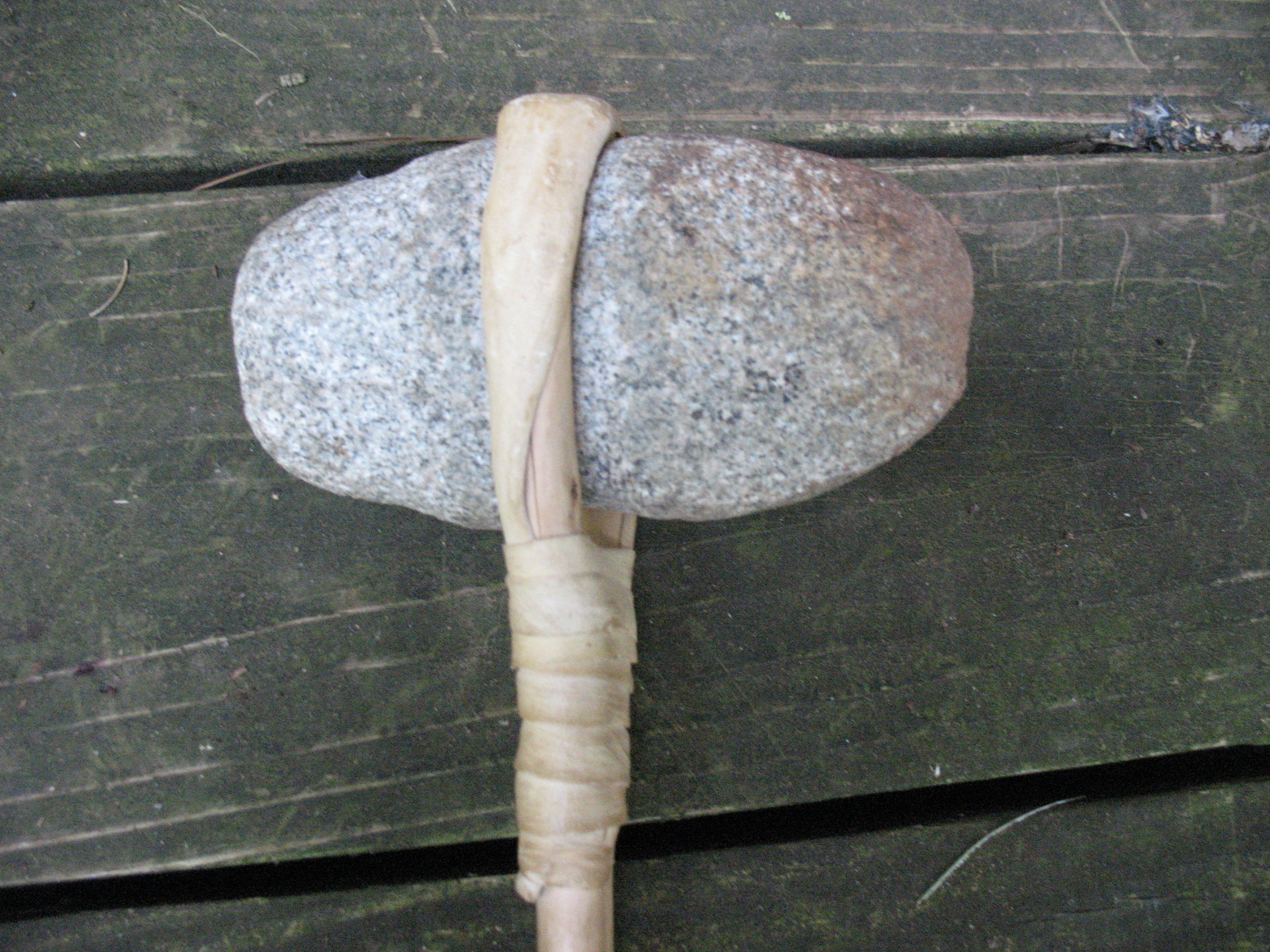
To shape the axe head use a hammer stone to very gently and slowly peck away the unwanted material and leave a finished axe head. I like a nice quartzite rock for a hammer stone. Grains of river rock must be removed very slowly. If you get in too big a hurry you will break the river rock, and this can be frustrating if you’ve already invested three or four hours on pecking away. I find it best to strike at a glancing blow. Select a small area to work on, and work at a steady pace. It will probably take you around eight hours to shape an axe head using this method. It is a good idea to find a nice spot outside to work on your axe head. The constant tapping can drive your spouse to homicidal behavior, and they may grab the axe head and turn it on you. Pictured below: This is not really an axe head. It is a pounding tool that I am going to attach to a handle,but it is made in the same manner as an axe head. You can see where the groove is starting to take shape. On the left is the quartz hammer stone that I am using. 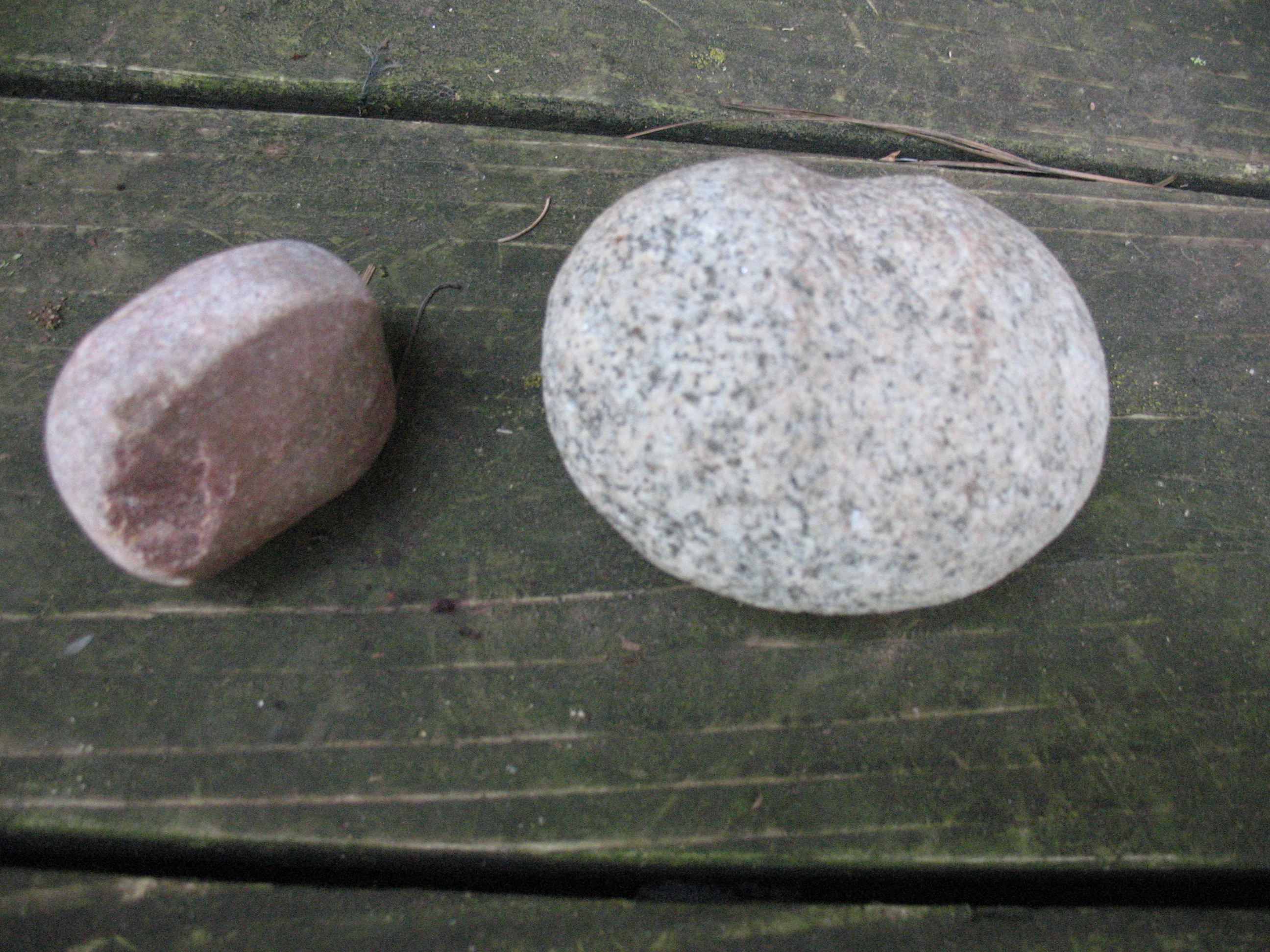
When you have your axe head shaped, there are several different ways that you can attach it to the handle.
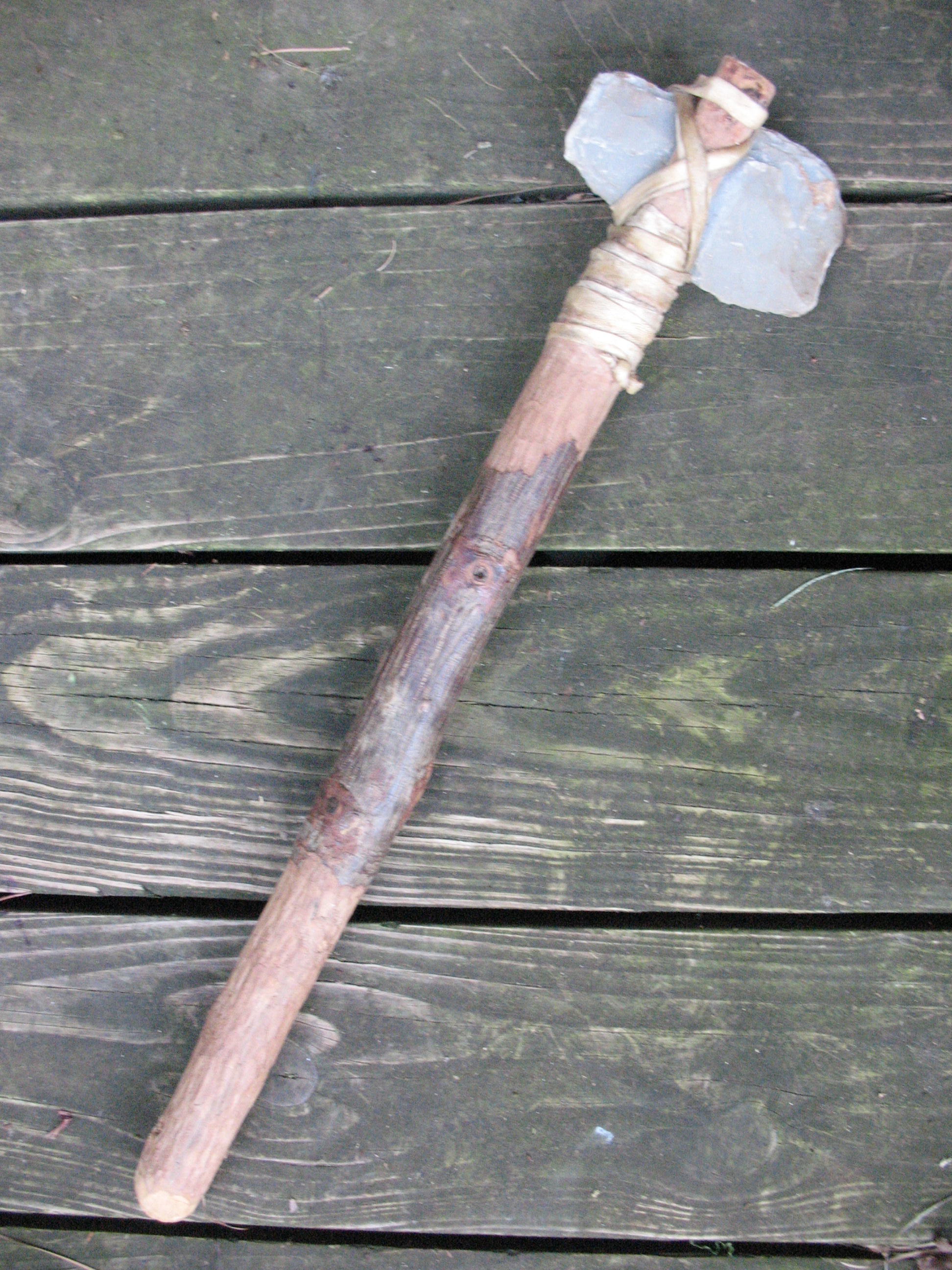
One way is to split the handle, insert the axe head into the split, and bind the head to the handle using wet rawhide or gut. The axe head pictured below is mounted in this manner. Notice that the rawhide is wrapped around the handle below the axe head in order to keep the handle from splitting any more. 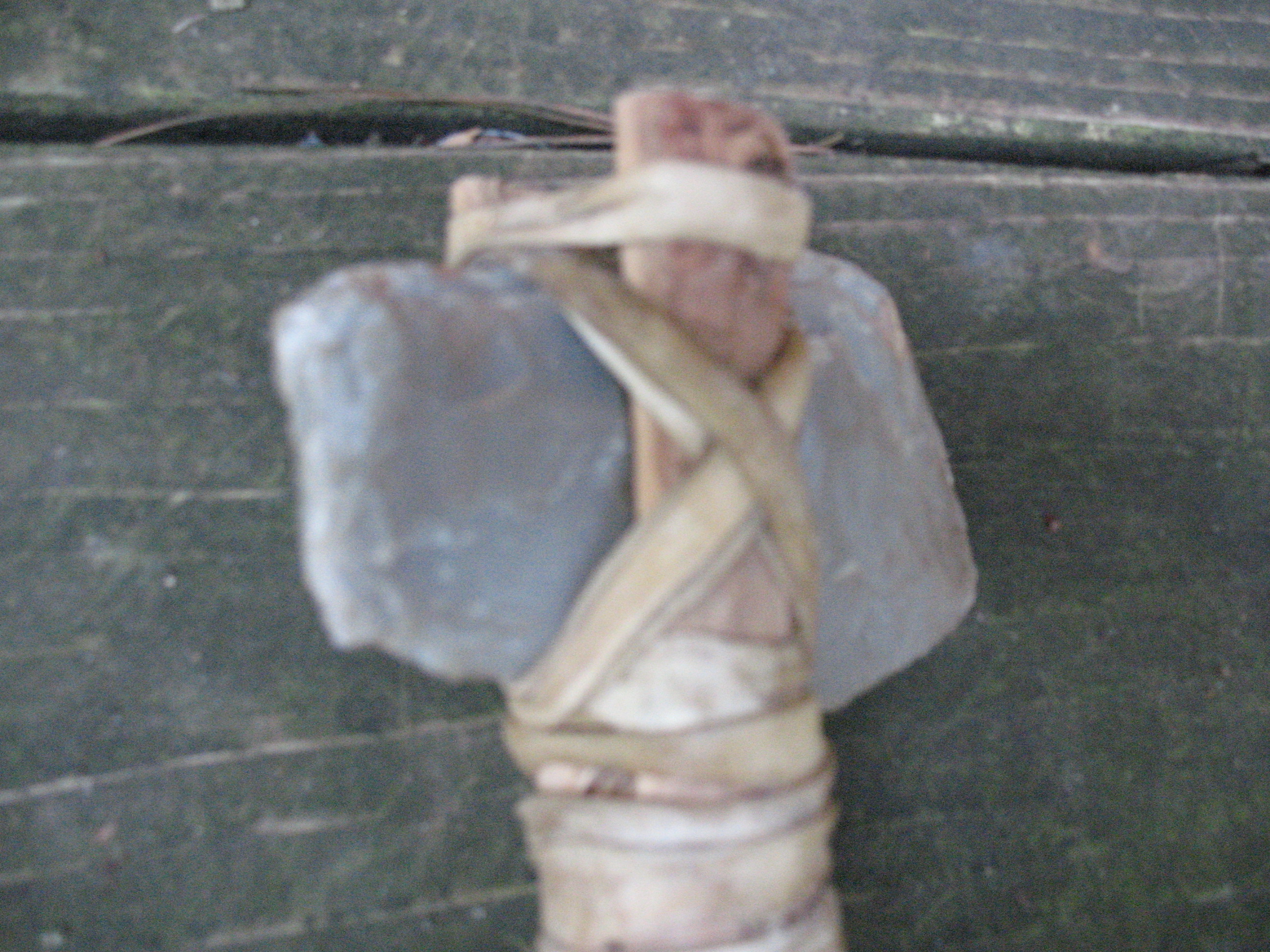
Another method of hafting the an axe head is to soak the handle in water to make it flexible, wrap the handle around the groove in the axe head, and bind it all in place with wet rawhide. The pecked axe head pictured below has been mounted in this manner. 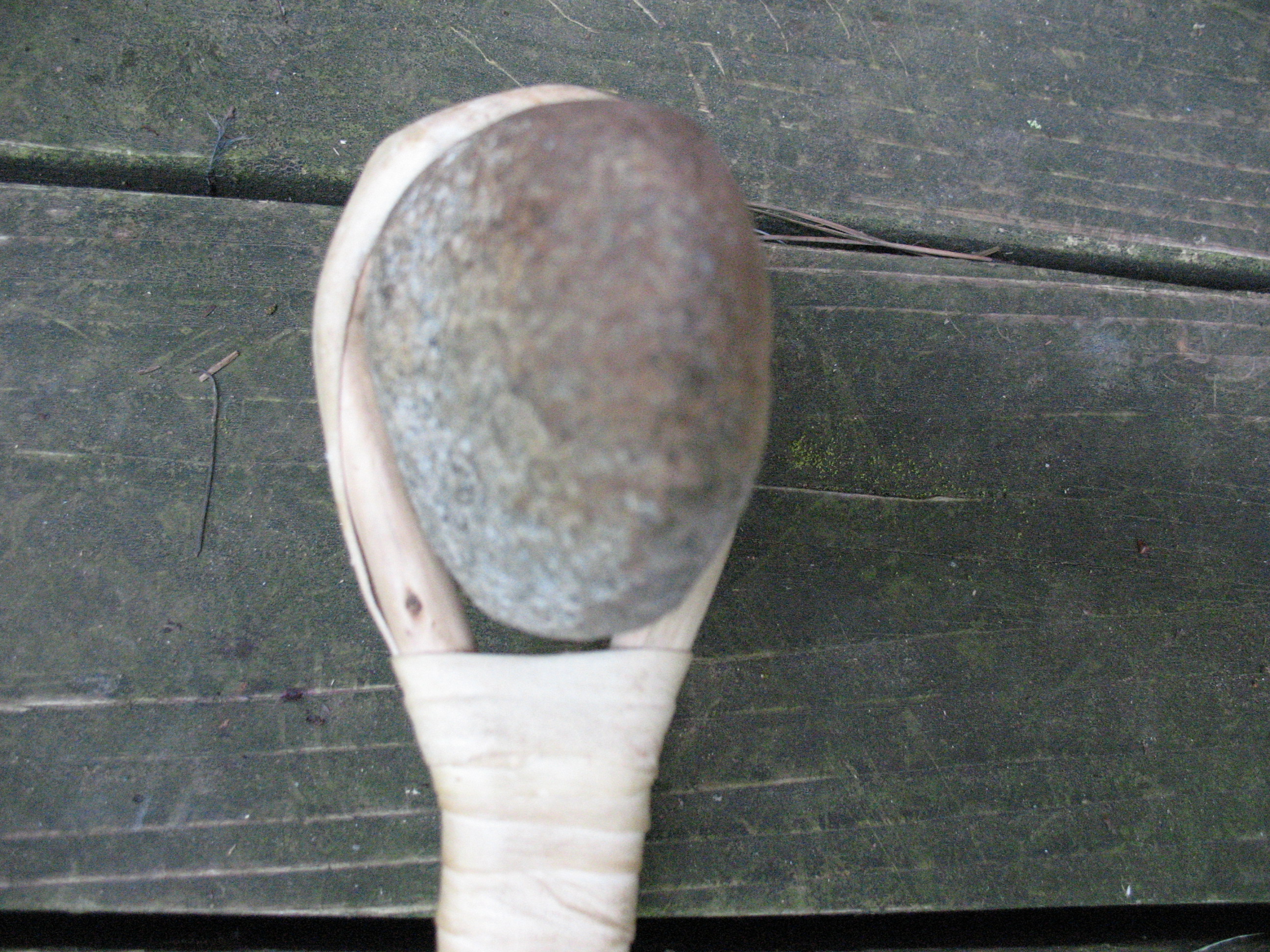
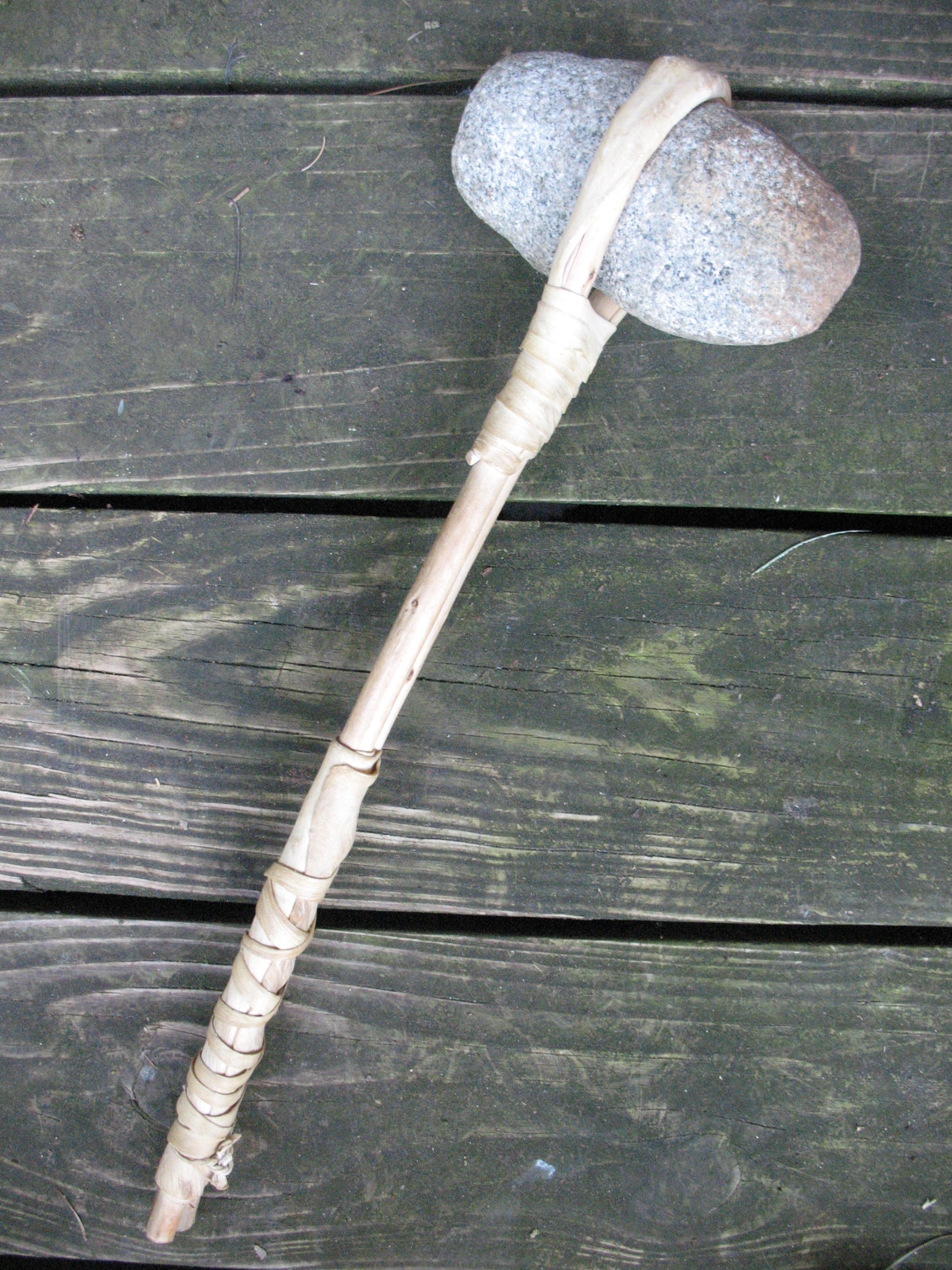
I actually used this axe to cut down a green, five inch tree in about fifteen minutes.
A third method of hafting an axe head is to mount sit the axe head into a groove on top of the handle, and bind the head on with wet rawhide. This, in my opinion does not make a strong enough mount for heavy chopping. 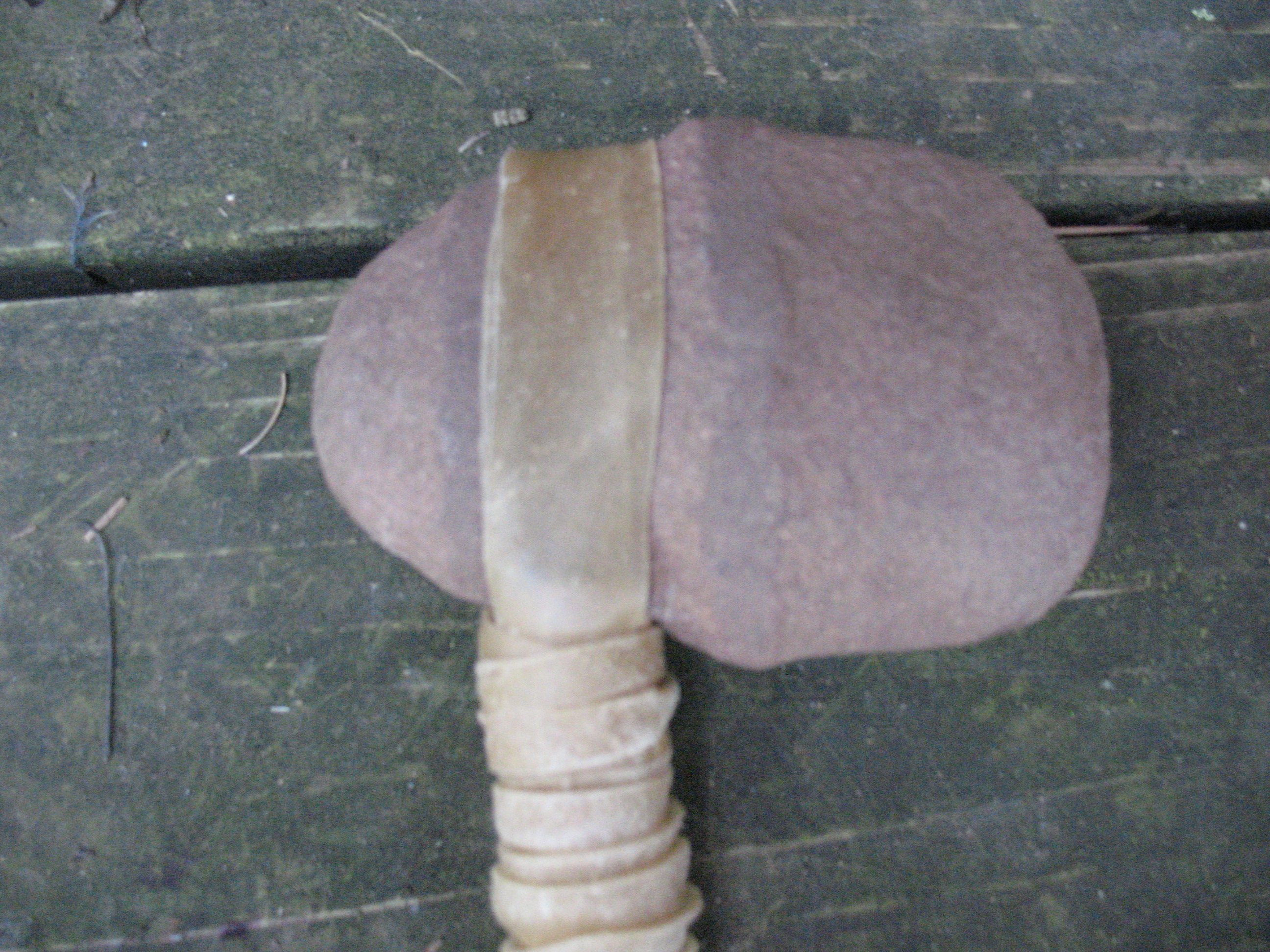
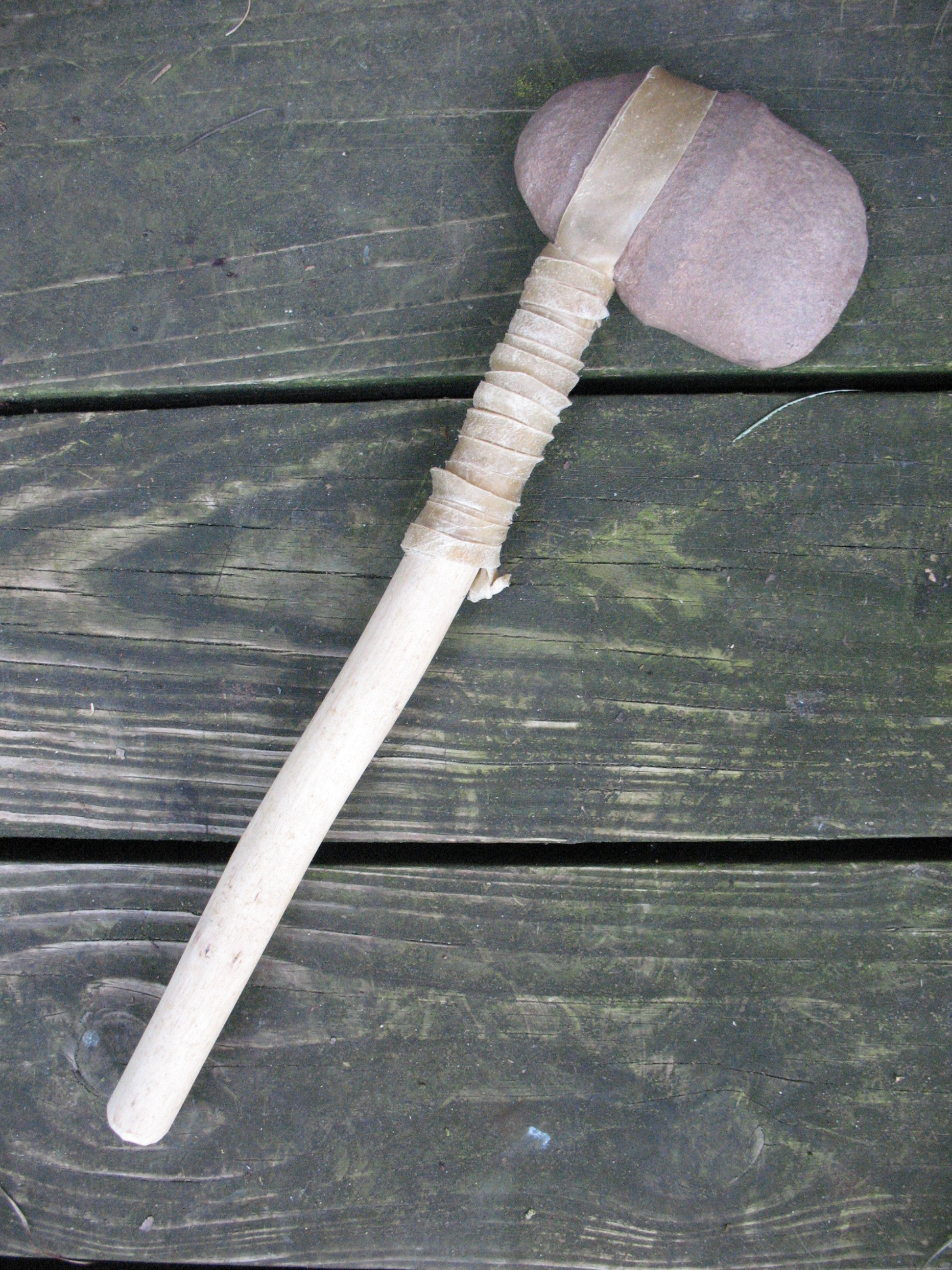
An axe head can be attached to a handle without using any binding by making a celt. A celt is constructed by carving a slotted hole through the handle and then inserting the wedge shaped axe head into the slot. An axe head that is mounted into a celt must be narrower on the head and wider on the blade in order to wedge into the slot properly. The axe head should contact the handle at the top and bottom of the slot rather than on the sides. If the head is wedged against the sides, the handle will split when you use the celt. I do not have a picture of a celt because I have never made one, but it is on my to do list, and I will do a post about it when I finally get around to making a celt.
If you’ve read much of this blog, especially my early posts, you know that I am a strong believer in keeping a low profile. Remember, we are trying to survive; so the best way to win a fight is to avoid it altogether. If society falls apart, there will be predators. There will be people who are predatory by nature, and there will be otherwise good citizens who didn’t prepare and think that what is yours should also be theirs. If you do not give it freely, they think they have the right to take it. After all, somebody else has always taken care of them.
So the best way to avoid a confrontation is to stay off the radar. I personally live back in the woods off of a dirt road, which is off of an oil-top road, which is off of a two-lane hardtop, which is 25 miles from the nearest town of any size, and over a hundred miles from the nearest city. But I still worry about security. People will be on the move looking for food, shelter, medicine, ammunition, fuel, and everything else. So I have developed a few security guidelines:
1. Stay quite – no hollering, no gun shooting, no chainsaws, No wood chopping, no power tools, no vehicles running, no generator running, and no using the walkie-talkies
2. Stay odor free – no wood stove or fireplace burning
3. Stay invisible – no wood smoke, no reflective surfaces, and no visible lights
Number three brings me to the topic of this post, blackout curtains. Even an oil lamp emits light, and on a dark night you can see this light from miles away. If you are going to have lights you need to cover your windows so that the light doesn’t serve as a signal beacon to raiders.
We have regular curtains on our windows, but these are practically useless for blackout purposes. You can still see a nice warm glow of light coming from the windows at night. You need a completely opaque covering that fits close to the window frame so that no light leaks out around the edges. My idea was to install some nice opaque, black, roller blinds; the kind that schools used to have in the “film room.” My wife shot that idea down pretty quick. Seems that when my sense of survival preparedness comes up against her sense of style, style wins. So I came up with an alternative. I bought a roll of the heavy duty, black plastic, garbage bags; and a roll of duck tape. 
These now reside in my storage closet waiting for use if needed. When these bags are taped over a window (from the inside), no light escapes. Pictured below: top, Plastic taped over one window; middle, night view with windows uncovered; bottom, night view with left window covered 


By the way, U.S. Homeland Security suggests taping plastic over your windows to help defend your home against penetration by biological weapons like anthrax. I don’t know if plastic taped on the windows will stop anthrax, but it will definitely stop light, so lay in a supply of bags and duct tape and make sure that they don’t get used up when you rake the yard.
I’m always looking for ways to save space in my garden, and one of the easiest ways to save space is to plant things so that they grow up instead of out. Pole beans are a good example of this. Since they grow up instead of out, you can get a lot more production in the same square footage than you would by planting bush beans on the ground. The problem is, pole beans are a pain; not the beans themselves, but the poles. Cutting poles and sticking them in the ground is pretty labor intensive, so I’ve tried several different methods of planting pole beans so try and cut down on the labor involved.
I tried the pole with strings running to the ground to form bean teepees. A lot of work, and I could have bought the beans for what I spent on string.
I tried setting up a welded wire fence for the beans to grow on. The problem is that most fencing is only four or five feet tall, and pole beans grow a lot taller than that.
I tried setting up a fence and then extending the fence posts and adding another two feet of fence above. Too much work. Pictured below: Extended height fence worked OK but it was a pain to set up and move
So I came up with a new idea that I’m trying this year. I asked myself, “How can I get a taller fence without having to extend the fence posts and piece the fencing together?” Well, I thought, I could cut seven feet of fencing and then turn it up and down instead of sideways. Good idea, but the fencing is very flexible and wouldn’t stand up straight unless I had seven foot tall posts. Seven foot T-posts cost about $3.50 each and I needed seven of them. I can’t see the logic in spending $25 to grow $10 worth of beans, especially when I have a whole pile of old five-foot T-posts that I could use. Then I had a minor brain-storm. What if I bent the fencing down the middle at about a sixty degree angle? This would keep the fence rigid, and because of the zigzag course of the fence I would get more feet of fence into the same length of garden row.
So that’s what I did. I cut six sections of fence seven feet log. I laid a 2 X 4 down the center of the fence sections, stood on the 2 x 4 and bent the fence up at an angle. All I had to do to set the fence up was stick a T-post in the ground, use a couple of tie wires to attach a fence section, then put another T-post at the end of the fence section. The six fence sections and seven T-posts took me about thirty minutes to put up. Pictured below: Zigzag bean trellis 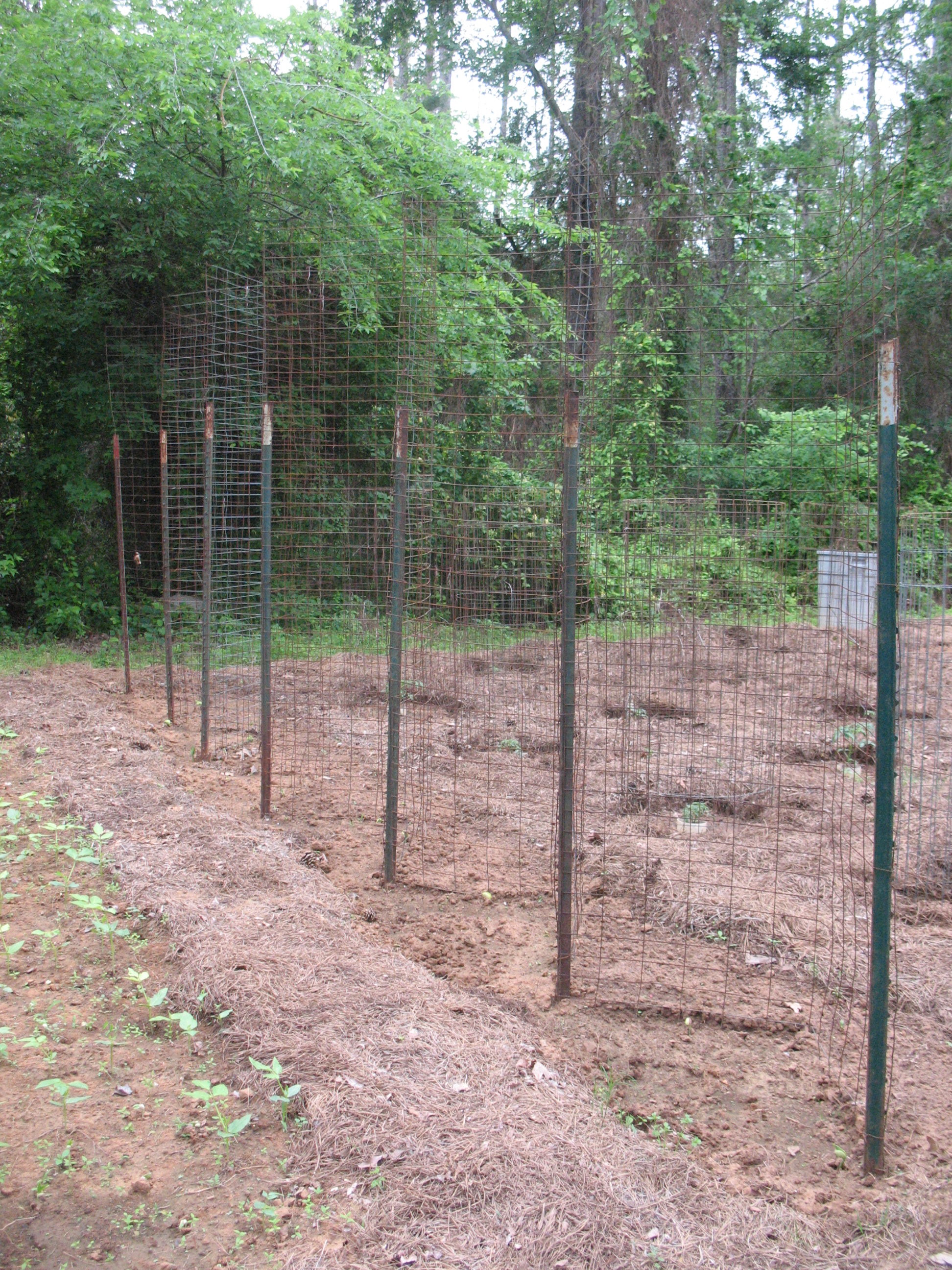
Now I have about thirty feet of seven foot tall trellis that take up only twenty-four feet of garden row. I can use this trellis, take it down, move it, and re-build it with very little labor; and it didn’t cost me a dime. I hope this is the answer that I’ve been looking for. I guess I’ll know in about three months. Pictured below: top, Zigzag bean trellis with heirloom pole beans just breaking ground; bottom, Heirloom pole beans one week later

I’m putting the manufacture of the river cane knife and the river cane spear into one post because they are made the same way. The only real difference is that the spear is just bigger and longer than the knife.
I like to make my cane knives and spears out of river cane. River cane is native to North America. It does not grow as large as bamboo but it has thicker walls and is stronger than bamboo of the same size. If you don’t have access to river cane, bamboo will do. The lighter canes, like switch cane, are too small and thin walled to work for these projects.
For the cane knife you will need to select a cane that is about an inch in diameter. It is best if the cane is already dead and dry. If it is not, you can still use it, you’re knife just won’t be as strong. When you have secured a piece of cane, cut a section of it that is about a foot long. I usually cut it so that a cane joint will be on the back of the knife handle, kind of like a pommel. Pictured below: Cane section for making a knife 
Leave the cane totally intact for about six inches. This will be the knife handle. Starting just below the handle use a knife, flint flake, or grinding stone, and cut lengthwise to remove about two-thirds of the cane. This will be the knife blade. Cut or grind the blade to a point and work the edge of the blade to sharpen it. Pictured below: Two views of the finished cane knife 

That’s all there is to making a cane knife. The edge of this knife is surprisingly sharp. My son was working on a bamboo bow a couple of weeks ago and he accidentally slipped and ran his hand down the edge of the cane. It laid his hand open pretty good. A cane knife won’t cut through bone, but it can easily be used to butcher and slice meat.
To make a cane spear you follow the same procedure. Make the spear out of a piece of cane that is six or seven feet long. Cut the spear point on the big end of the cane. I usually try and work it so that there is a joint right at the base of the spear point. This seems to make the point a little stronger. Pictured below: Two views of the blade on a bamboo spear 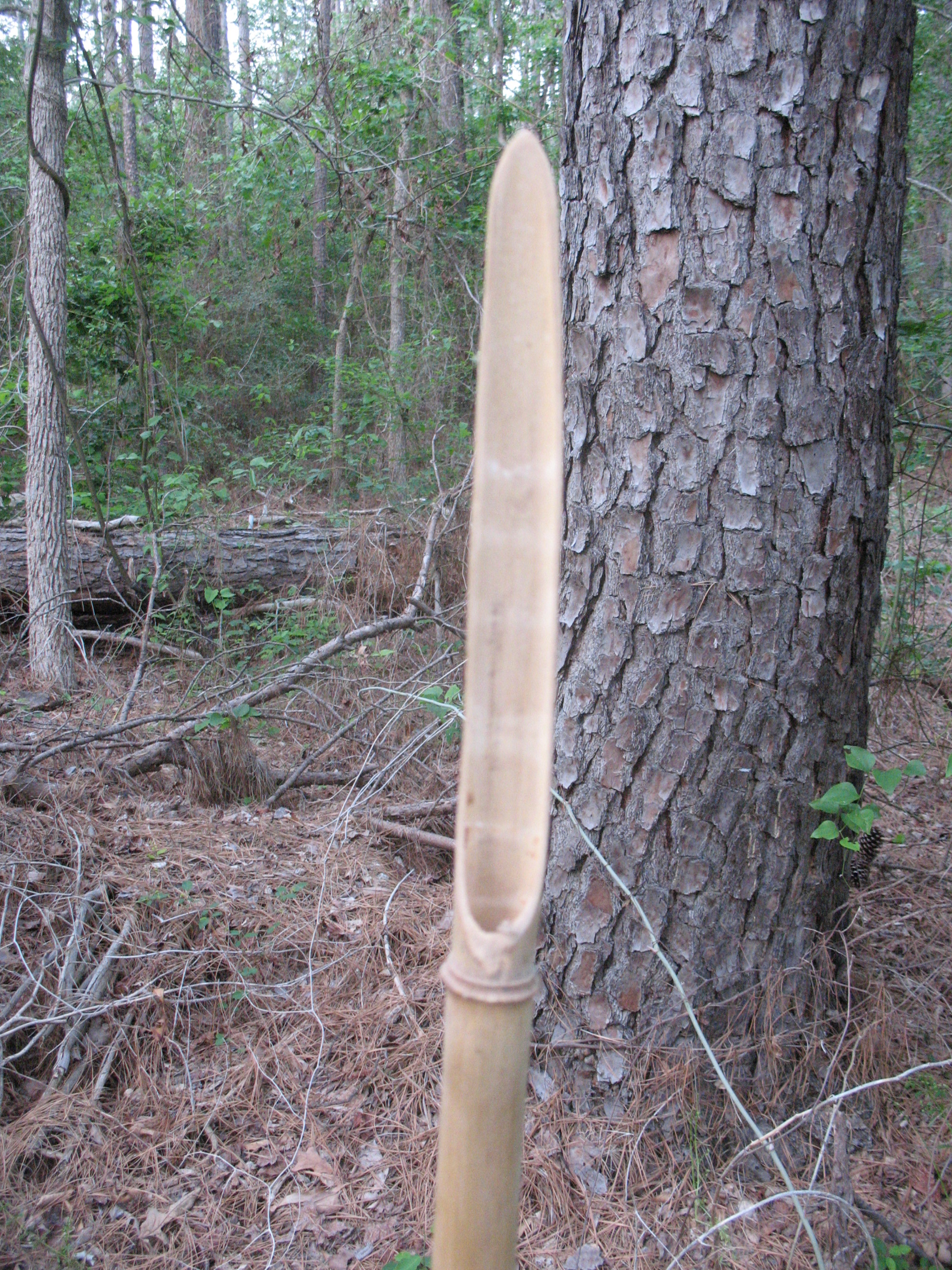

Don’t give either of these to your kids to play with. They may look like toys, but they can do some serious damage.
Heirloom seeds are all the rage among gardeners these days. Heirloom plants, for those who don’t already know, are older, non-hybrid plants. One advantage of heirloom plants are that they are bred for taste as opposed to modern hybrids which are bred for size, color, simultaneous maturity, and shelf-life. You see, if you are a gardener you want to plant tomato plants that produce tasty tomatoes that ripen throughout the growing season. This way you can have a continuing supply of fresh tomatoes and don’t get buried under a mountain of tomatoes that all ripen at once. If you are a commercial tomato producer you want tomatoes that all ripen at the same time so you can harvest a field all at once and be done with it. You also want tomatoes that are big and red so they look good in the grocery store; never mind that they are mealy and tasteless, that’s the consumer’s problem.
Another advantage of heirlooms over hybrids is that heirlooms produce seed that can be saved and replanted and this seed will reproduce true to type. With hybrids some of the seeds from a fruit may reproduce true to type, some of the seeds will produce plants like one or the other of the parent plants, and some of the seeds will be sterile. In other words, if you save hybrid seeds to replant, you have no idea what you will get.
So you can see why heirloom seeds are popular with gardeners with a survivalist mentality. Heirloom seeds are the only seeds that guarantee a continuing supply of viable seed over generations of planting.
Here’s the problem. A lot of seed companies are taking advantage of the heirloom seed craze to reap huge profits on some types of seed. Many of the seeds that companies have been selling for years are heirloom seeds, they just haven’t been labeled as such. So now these companies will take the same seed, put it in a package labeled “HEIRLOOM VARIETY”, and double the price. If you are not familiar with heirloom varieties, and you want to buy heirloom seeds, you may end up paying way more than you need to for your seed.
Here are a few examples of heirlooms that you can get for way below “heirloom” price.
Blue Lake 274 Bush Green Bean
This is a classic example. When you see a name like “Blue Lake 274” the first thing that comes to mind is that this must be some hybrid creation of modern agri-science. Not the case at all. The Blue Lake was developed by selective breeding from pole beans about fifty years ago. I plant it every year and it produces scads of great tasting green beans. I put up about twenty-five quarts of Blue Lakes off of one 3 foot by 25 foot bed. One popular heirloom seed dealer sells 40 to 60 seeds for $2.00. My local feed store sells them for $3.00 per pound. Pictured below: top, Blue Lake 274 seed; bottom, Blue Lakes growing in my garden 

Pink Eyed Purple Hull Pea
The Pink Eyed Purple Hull is a favorite Southern field pea. You can’t go much better than a plate full of purple hulls, some cornbread, and a mess of collard greens. One on-line retailer of heirloom seeds sells these for $2.35 per once. My local feed store sells them without the heirloom label for $2.50 per pound. Pictured below: Pink Eyed Purple Hull seeds 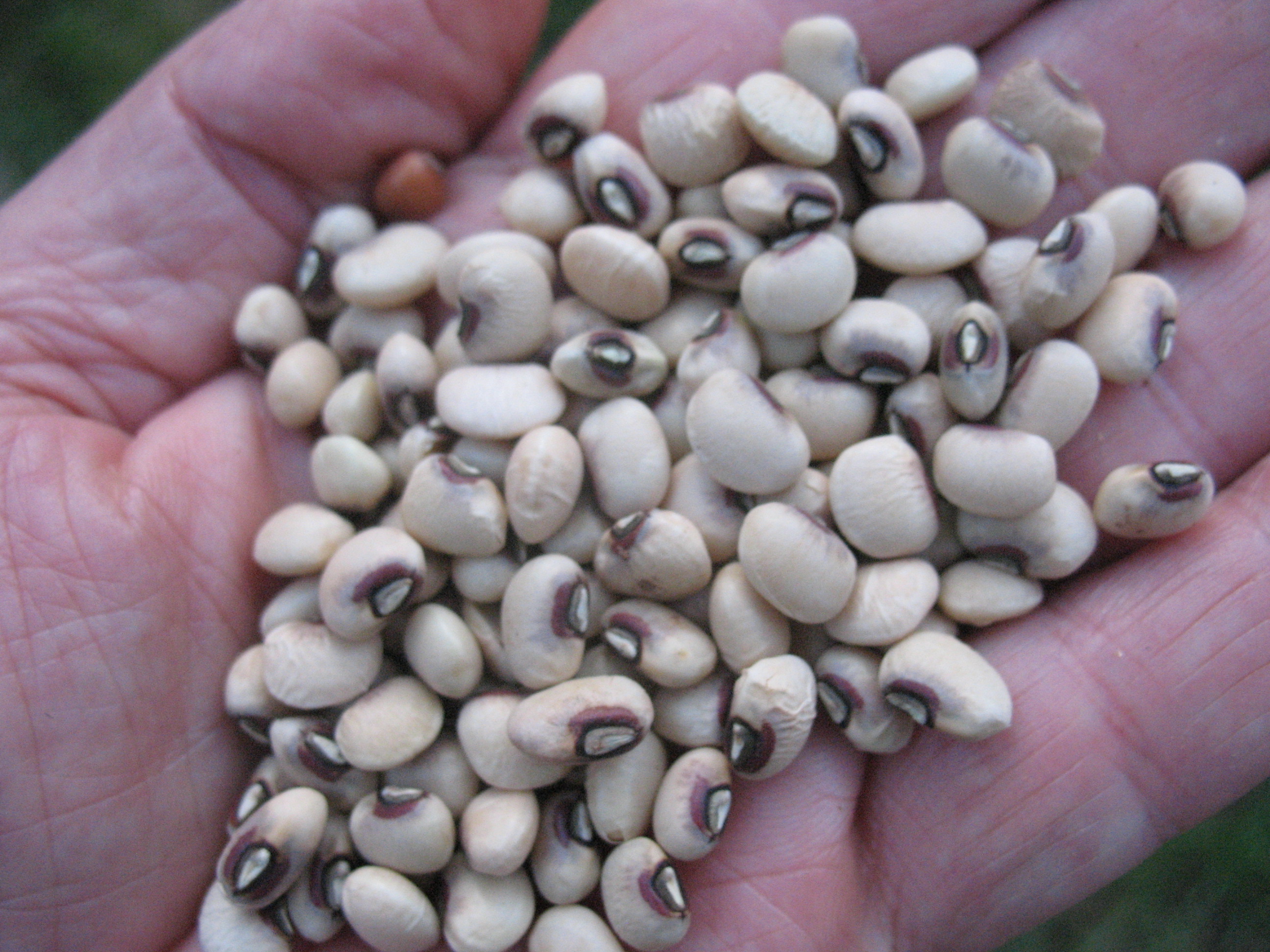
Anasazi Beans
Anasazi Beans were developed by the Anasazi tribe of Native Americans long before the first European set foot on North America. You can’t get much more heirloom than that. You can buy twenty-five of these seeds on-line for $1.49, or you can go to the grocery store and buy a one pound bag for about $3.50. Yes, you can plant dried beans that you get at the grocery store. You may have a slightly lower germination rate, but the difference in price makes this slight difference irrelevant.
Black Seeded Simpson Letuce
Black Seeded Simpson is a 150 year-old heirloom leaf lettuce. I like it because it is fairly heat tolerant and won’t bolt too early, an important characteristic here in East Texas. On-line these seeds sell for $6.40 for half an ounce. At the feed store, without the heirloom label, they cost $1.69 for half an ounce. Pictured below: Black Seeded Simpson Lettuce seed
Boston Pickling Cucumber
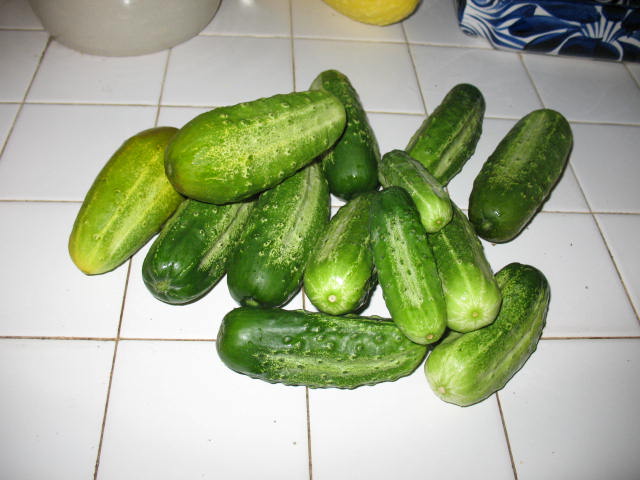
I always plant Boston Pickling Cucumbers. They make the best dill pickles in the world (see my canning recipe on my post of 6/23/2009). I usually buy these as a packet of seeds because I only plant about 30 or 40 of them. The thing to look for is how the packet is labeled. The packet with “HEIRLOOM” on it costs $1.99 for 25 – 35 seeds. The packet without the magic word costs $1.39 for 140 -160 seeds. I know, I know, why buy the big packet if you only need 30 or 40 seeds. Well, this way I get to give cucumber seeds to my neighbors, enhancing my reputation as a generous guy; and I save 60 cents in the bargain. Pictured below: top, Boston Pickling Cucumbers growing on a trellis in my garden; bottom, fresh cucumbers ready to become pickles 
Tomatoes
There are hundreds of varieties of tomatoes. I don’t know it for a fact, but I would be willing to bet that tomatoes are one of the most widely hybridized vegetables around. I generally stick with Arkansas Travelers because they are heat tolerant and will bare fruit all through the growing season. I usually by potted ones, although sometimes I start them from seed. I used to buy them on the cheap at feed or garden stores, but they have started falling prey to the heirloom label/price increase phenomenon. This year I could only find them in individual four inch pots, and they were $2.99 each. A little steep for an old country boy. I saved some seed for Travelers, but I didn’t start them in time. I figured that I would just buy some more plants. I was wrong. This year I’m trying Homestead tomatoes. They are another old heirloom that you can still find without the label, and hence they are still a relative bargain. Pictured below: top: Arkansas Travelers growing in my garden; bottom, fresh Arkansas Travelers and some dried for storage. 

These are just a few examples of how you can save money on heirloom seeds. There are many, many more. Do a little research on the internet and you can save on nearly every heirloom variety that you buy. And by the way, the whole point is to save the seed for next year. Let a couple of each vegetable grow to maturity and then save the seed. That way you won’t have to buy any more “heirloom” seeds.
Cornbread dumplings are an old Southern staple that are typically cooked and served with greens. Hot water cornbread is served throughout the Eastern United States and goes by many names. It is variously know as Johnny cake, hokeg, hoe cakes, fried cornbread, or hot water cornbread depending on what part of the country you are in. The reason that I am lumping these two recipes together is because they are really the same stuff, it’s just that one is boiled in water and the other is fried in grease. These are both super simple to make and are excellent trail food. The ingredients will keep indefinitely without refrigeration. Pictured below: Ingredients for making cornbread dumplings or hot water cornbread 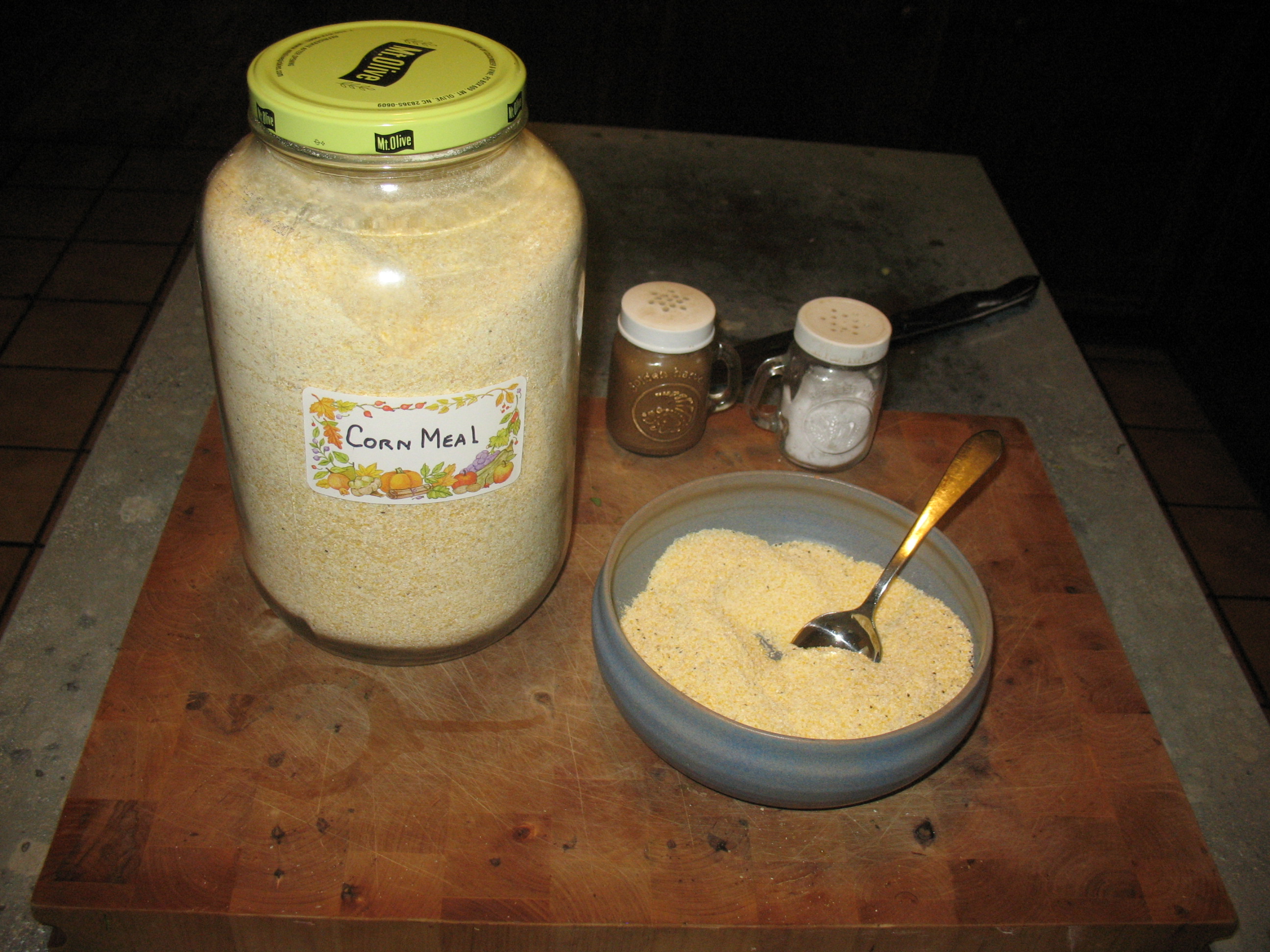
To make cornbread dumplings or hot water cornbread you will need:
1 cup of cornmeal (yellow or white)
1/8 teaspoon of salt
black or red pepper to taste
boiling water
Directions:
Mix dry ingredients together
Pour in just enough boiling water to form a very thick paste
Stir
That’s pretty easy isn’t it? The trick is to be sure and use boiling water. The boiling water causes the corn to release its gluten which makes the dough stick together. If you do the same thing with cold water you won’t form a dough, you’ll just end up with a handful of wet cornmeal. Pictured below: Cornmeal dough 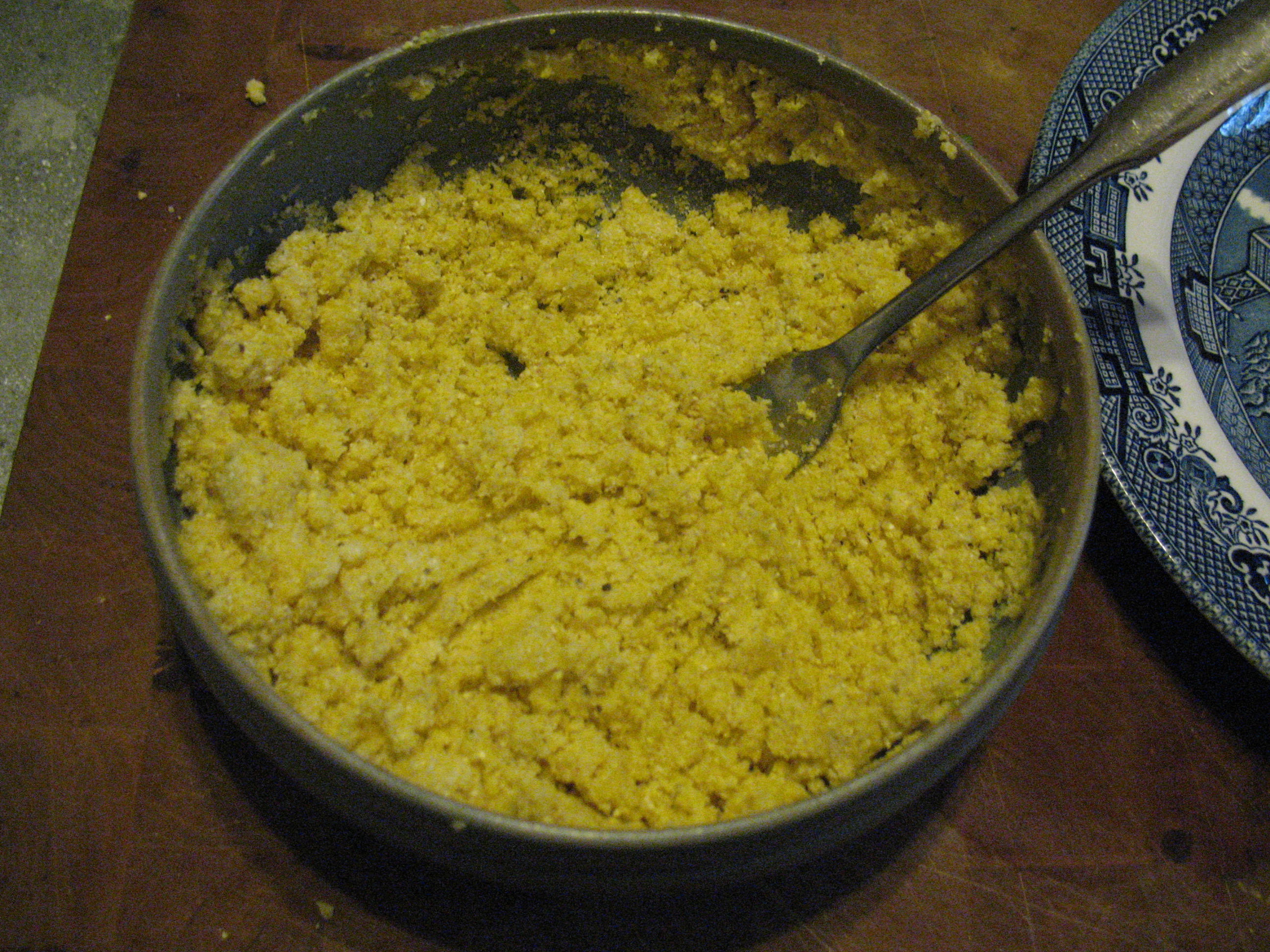
Now, at this point you choose whether you want to make dumplings or cornbread.
To make dumplings use your hands to form the dough into balls about the size of a pig-pong ball. Pictured below: Cornbread dough rolled into a dumpling 
Add these balls of dough to your greens for about the last ten minutes that they are boiling. Don’t stir the pot or you will break up the dumplings. Some people like to add chopped onion into the dough while making the dumplings. Either way they are powerful good. Pictured below: Cornbread dumplings cooking in a pot of collard greens 
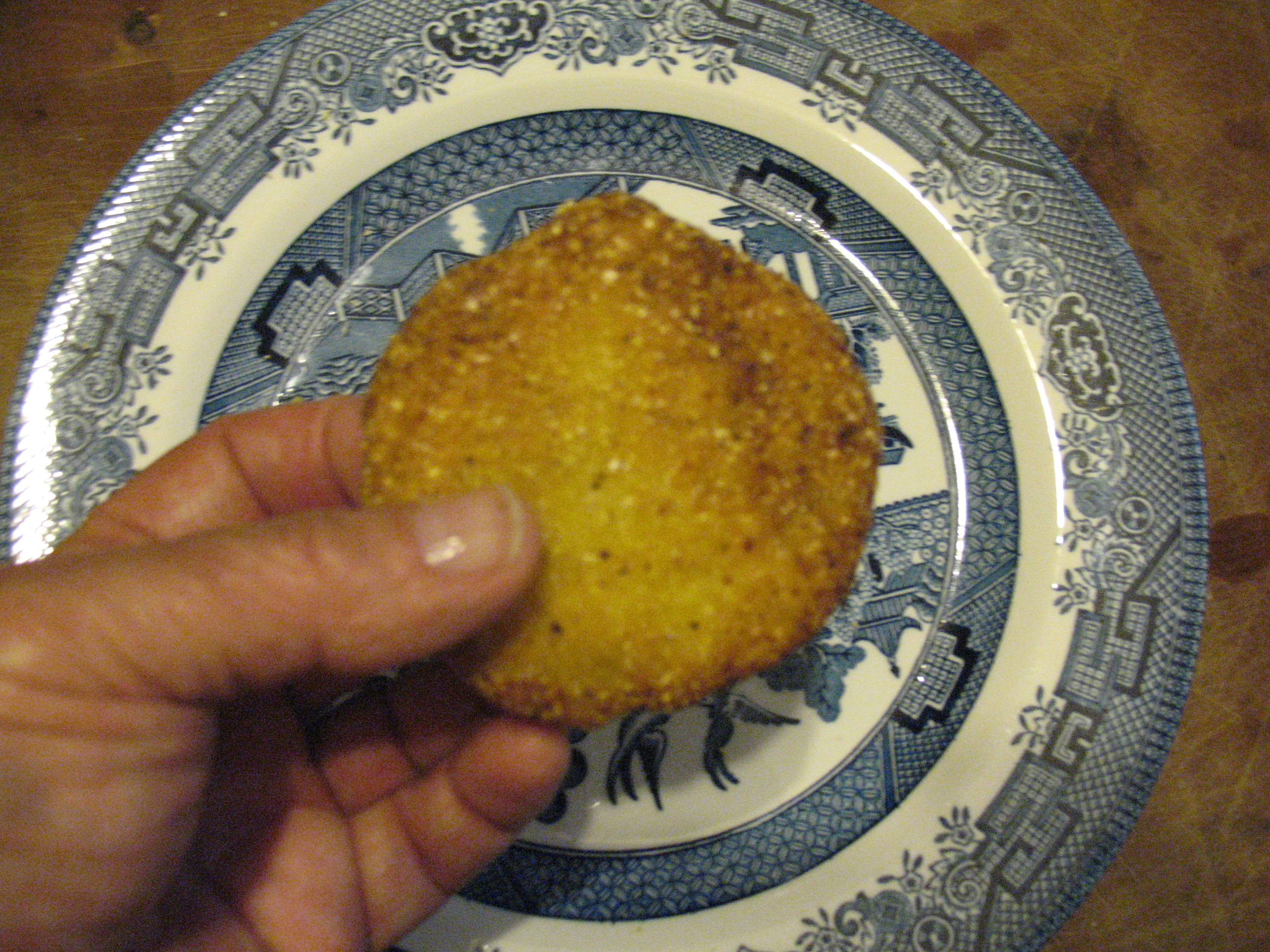
To make cornbread use your hands to pat the dough out into cakes that are about two-and-a-half inches across and half an inch thick. Pictured below: Four dumplings and one cornbread patty 
Heat up about a quarter inch of grease in a skillet and carefully place the cakes in the hot grease. Fry the cakes on each side until they are golden brown. You can eat the cornbread straight but if you put a little butter on them you will be in heaven. Pictured below: top, Frying cornbread; bottom, cornbread ready to eat 
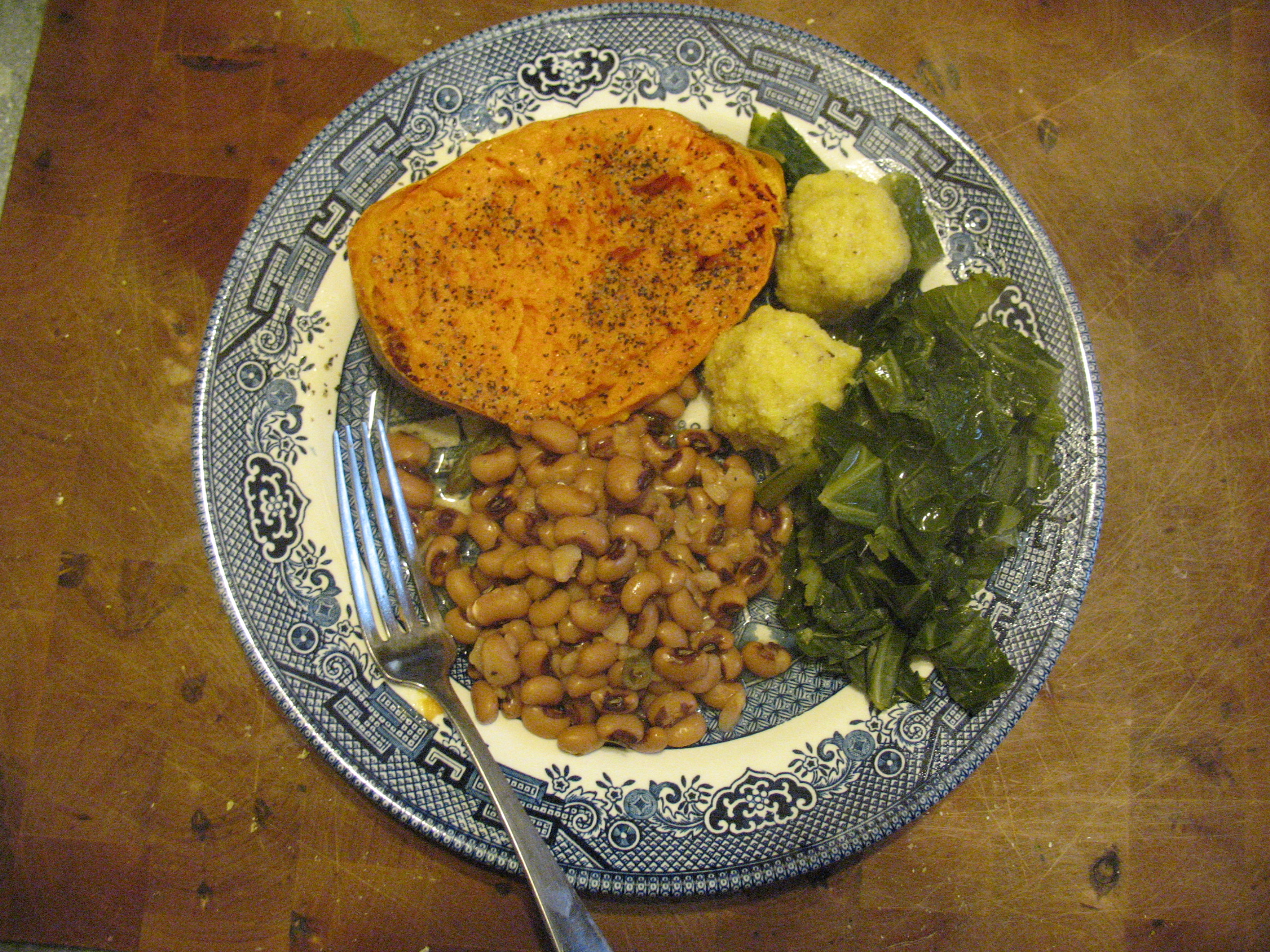
I love to cook cornbread on the trail. I usually take a hunk of summer sausage and a small bag of yellow cornmeal with me. I fry the sausage first then use the grease to cook hot water cornbread. It tastes great, is very nutrient dense, and really sticks to your ribs on a cold day. Pictured below: Southern country boy heaven, sweet potato, black-eyed peas, collard greens, and cornbread dumplings
DISCLAIMER: Don’t believe anything I or any body else tells you about edible wild plants. Don’t eat edible wild plants based on what you see in a book or on the inter-net. Get a qualified instructor to show you the plants, and don’t eat them until the instructor shows you how to prepare them, and then eats them him or herself. Be aware that you may be allergic to a plant that someone else can eat without harm. Be sure that any plants that you gather have not been sprayed with pesticides or herbicides.
Pokeweed (Phytolacca americana) goes by many names. Pokeweed, Poke Salat, Poke Salad, and Pokeberry are some of the most common. Poke is a spring green that is native to North America. Poke is one of those plants that can be dangerous if it is prepared wrong. Never eat Poke Greens raw, and never, ever eat the berries, stems, or roots at all, raw or cooked.
Poke will sprout up in the early spring in old pastures, fields, burned over areas, recently logged areas, or other areas where the soil has been disturbed. The season for gathering Pokeweed is very short. When it gets over a couple of feet tall it has too much saponin in it, and it will make you sick no matter how you prepare it. If you find small Pokeweeds later in the spring, don’t pick them. They will be too high in saponins even though they are still small. Pictured below: Young Poke in very early spring
 So, now that I have scared you to death; let’s talk about how to gather and prepare Pokeweed. Refer to the pictures above to identify Pokeweed. It has a pretty unique appearance, and I don’t personally know of any other plant around here that looks even remotely like Poke. It has shiny oval shaped leaves that are smooth on the edges and about four inches wide by six to ten inches long. The leaves are alternate, which is to say that they don’t grow exactly opposite on each side of the stalk; but rather there will be a leaf on one side of the stalk and then the leaf on the other side of the stalk will be a little higher or lower. After you have located a good Pokeweed, take a look at it. It should be all green. If the stem has started turning purple, that means that saponins are starting to build up in the plant and you don’t want it. If the plant looks good you can pull off the leaves. I usually do not pull any leaves that are over eight inches long.Pictured below: This Poke is ready to pick
Chop the leaves up into pieces one to two inches long, rinse in cold water and place in a pot filled with cold water. Wash your hands and the chopping knife with soap and water. Bring the pot to a full boil, and boil the Poke for about ten minutes. Pour off the Poke and water through a strainer, rinse the Poke. Rinse out the cook pot and refill with cold water. Place the Poke back in the pot, bring to a boil, and boil for another ten minutes. Strain, and rinse the Poke again. Rinse out the cook pot, refill with cold water, and boil the Poke for another ten minutes.
Poke tastes great when cooked with a little fatback and pepper, or you can cook it with just salt and pepper. But the absolute best is poke salit with cornbread dumplings. In my next post I’ll tell you how to make cornbread dumplings to go with poke, collards, or any other green.
Bamboo has been used for millennia to make fine bows. It is tough, straight grained, very flexible, and easy to work. Bamboo is used for backing on many traditional laminated bows. This bow is neither fine, nor traditional, nor laminated; but it is quick and easy to make, and it works.
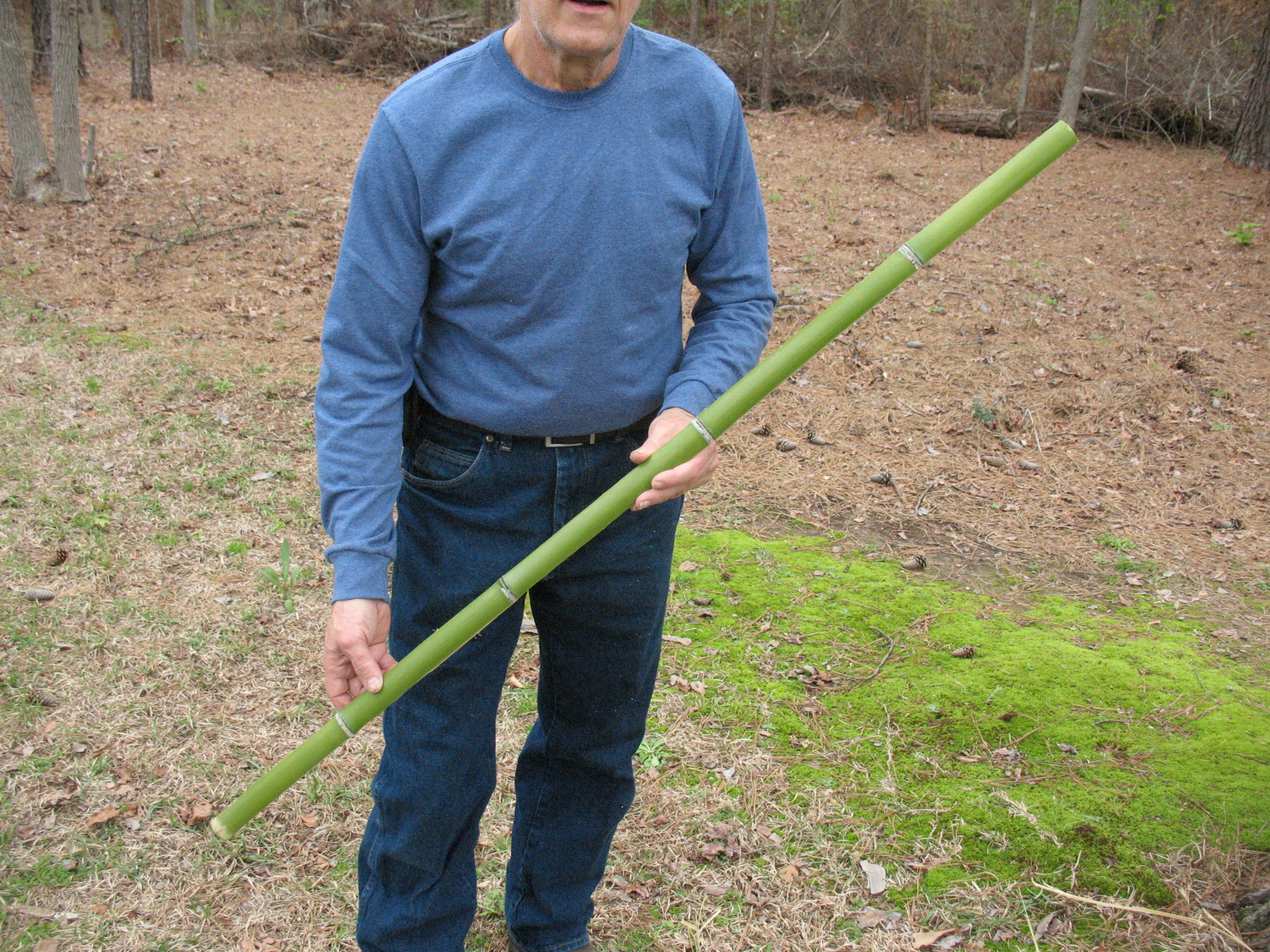
To build this bow you will need a nice large cane of bamboo. The walls of the cane should be at least three-eights of an inch thick, and the cane need s to be about five or six feet long. Pictured below: Bamboo for bow making 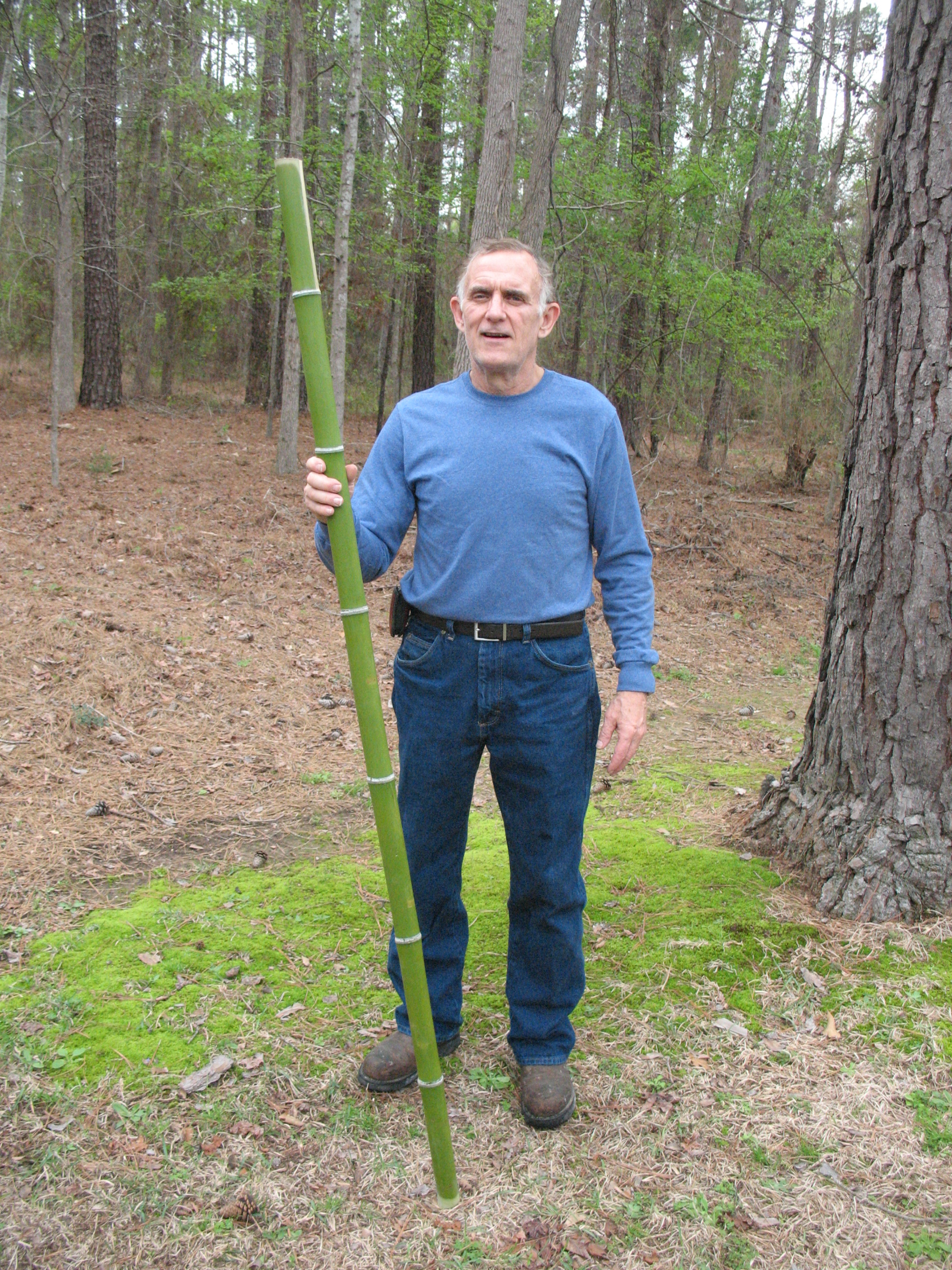
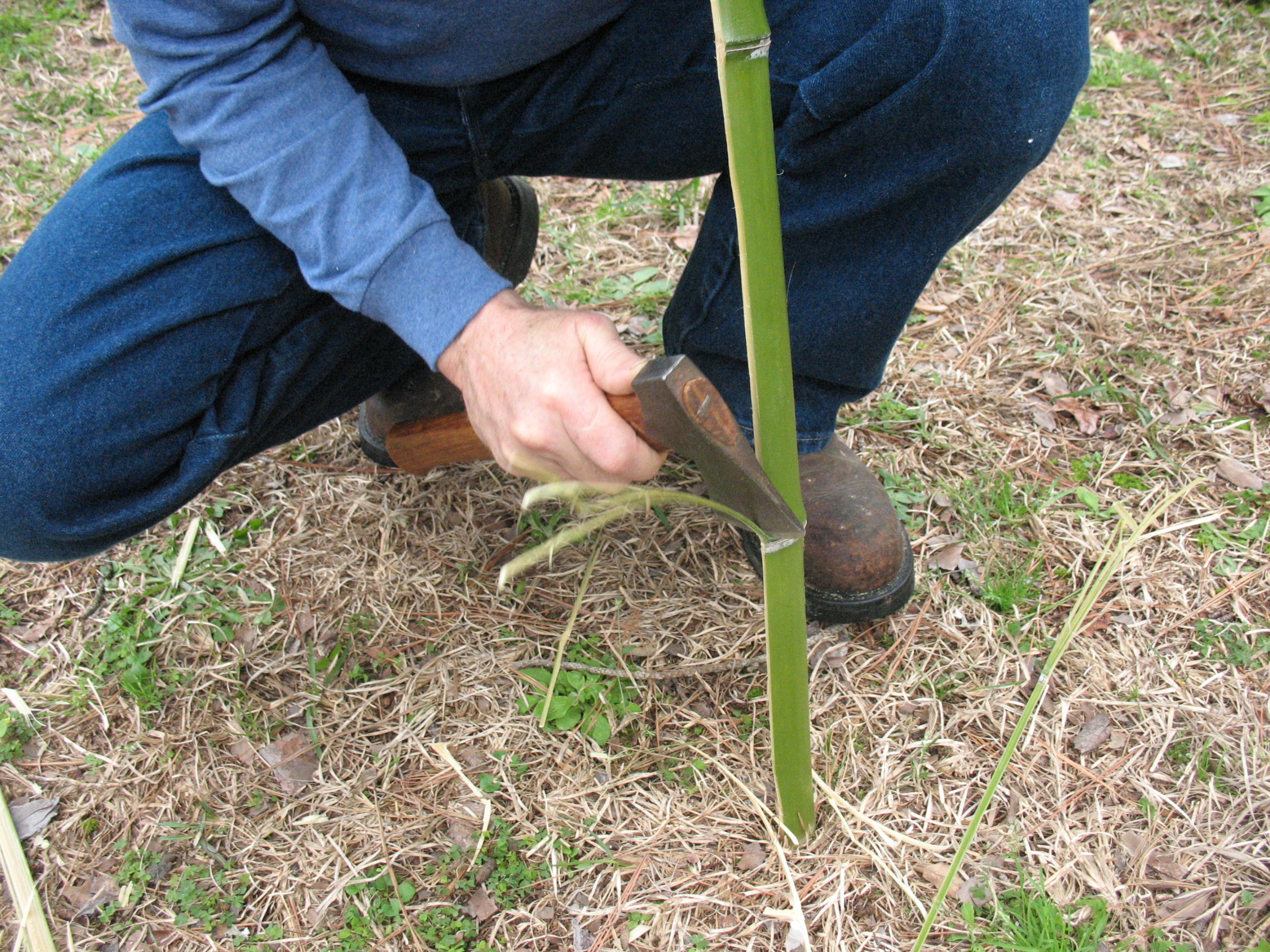
Use a hatchet, or heavy knife to split the cane in half. Pictured below: top, Splitting bamboo; bottom, two pieces of the split cane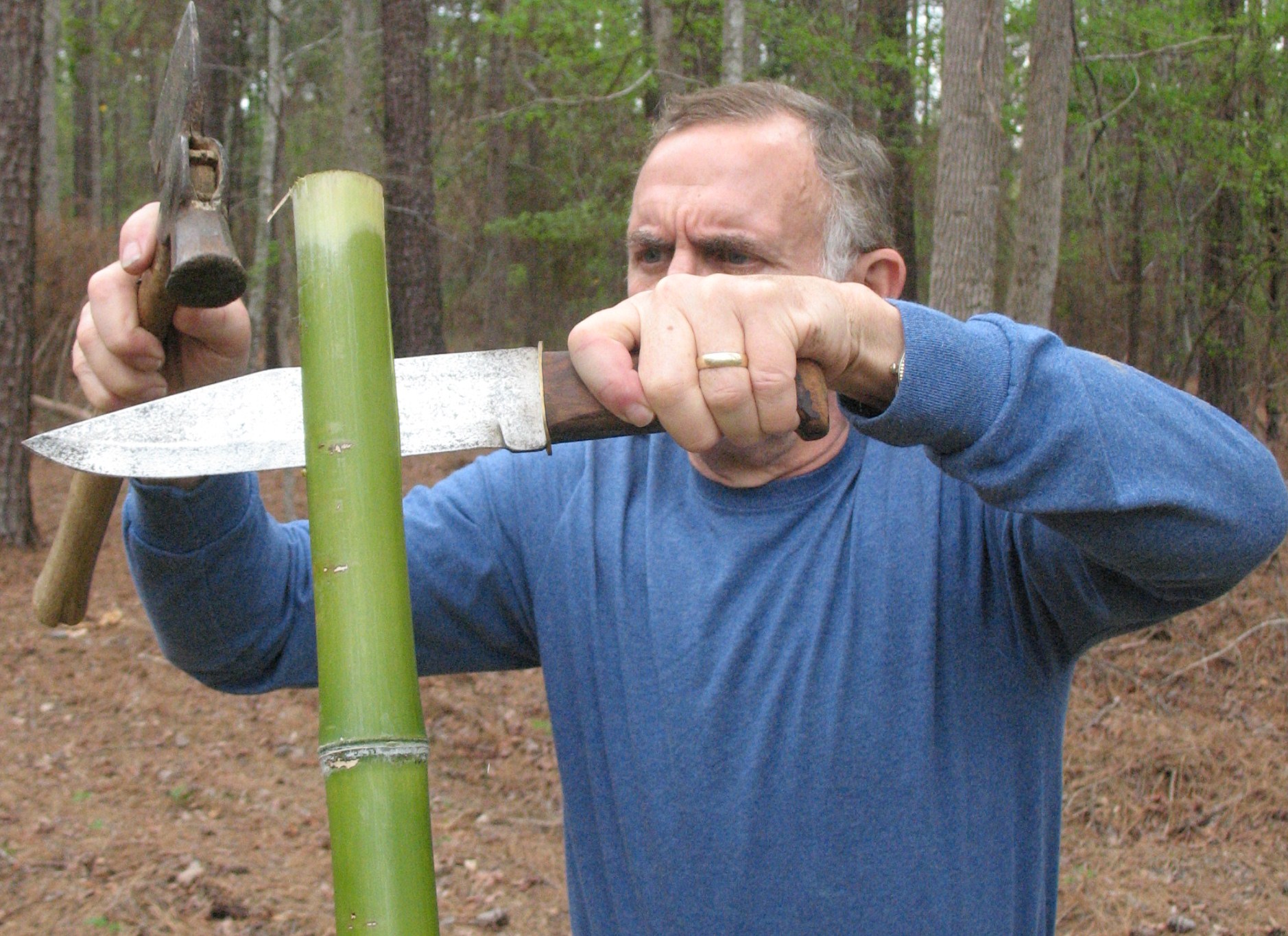
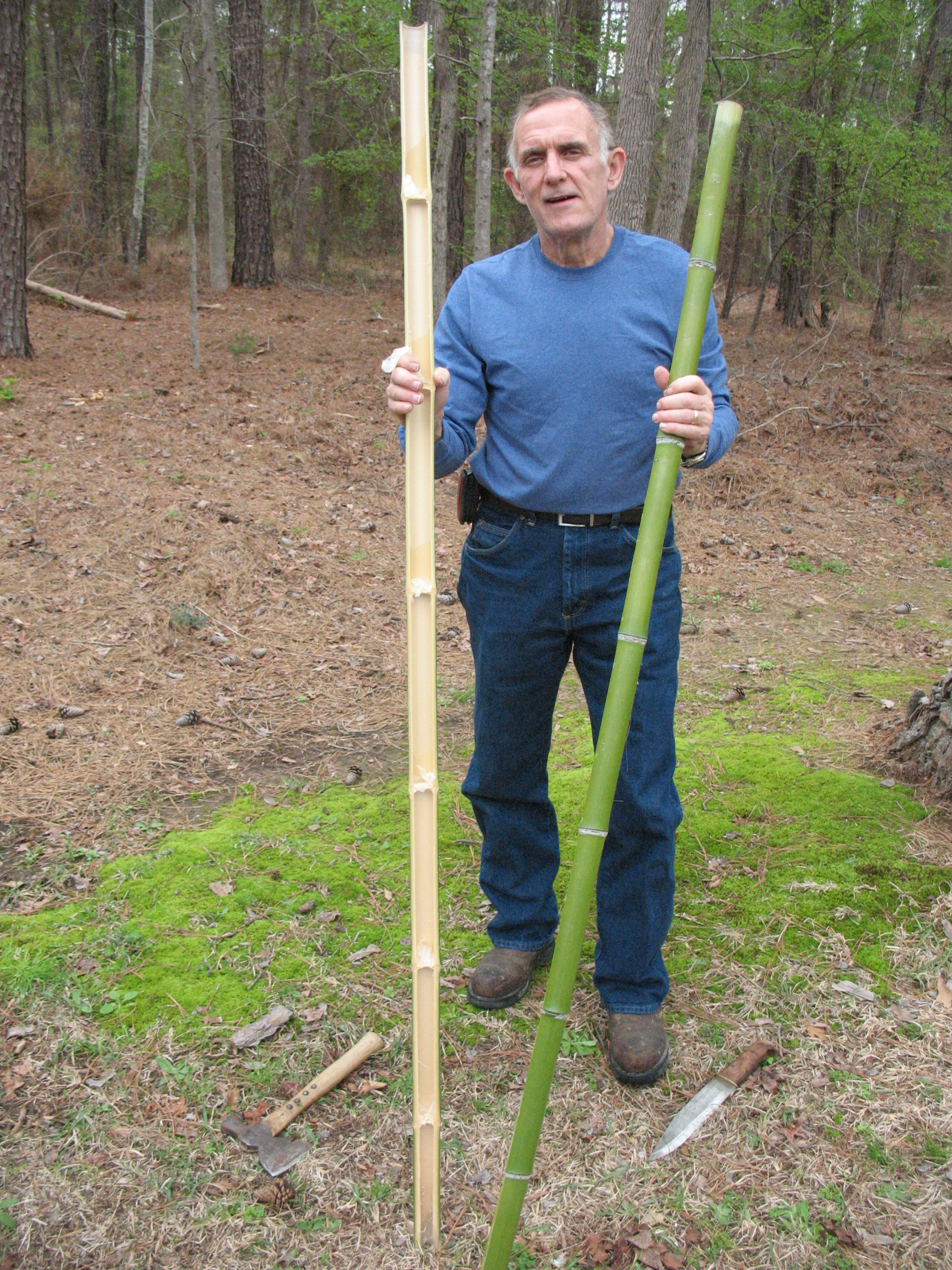
Now take one of the pieces of bamboo and use your hatchet or knife to split off the sides and narrow the part that you will use to about two inches in width. Pictured below: top, Splitting off sides; bottom, two inch wide stave 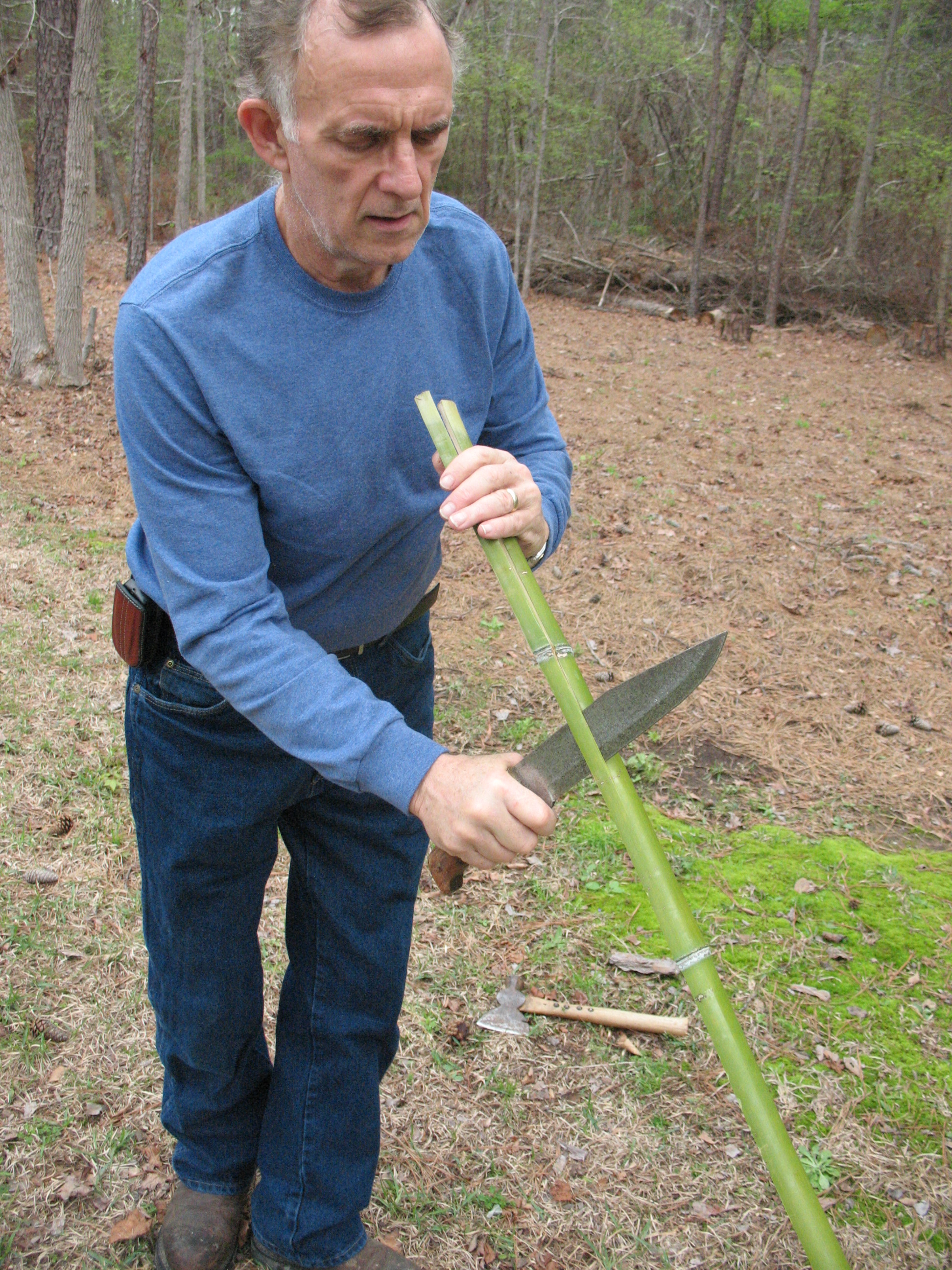
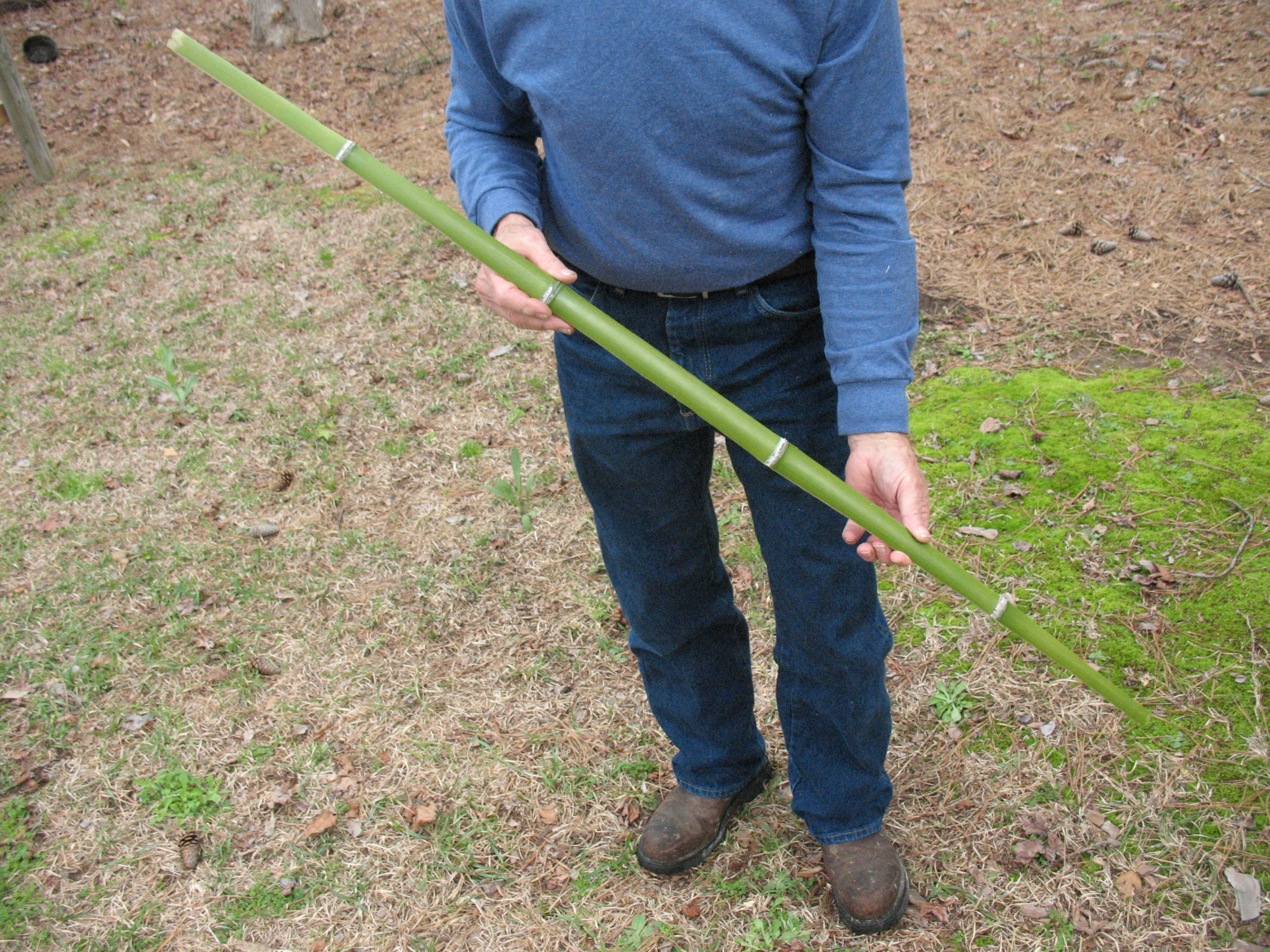
Use you hatchet and knife to shape the front profile of the bow. It should be about two inches wide in the middle and taper to about one inch on the tips. Pictured below: top, Shaping bow with the hatchet; middle, tapering the limbs; bottom, finished profile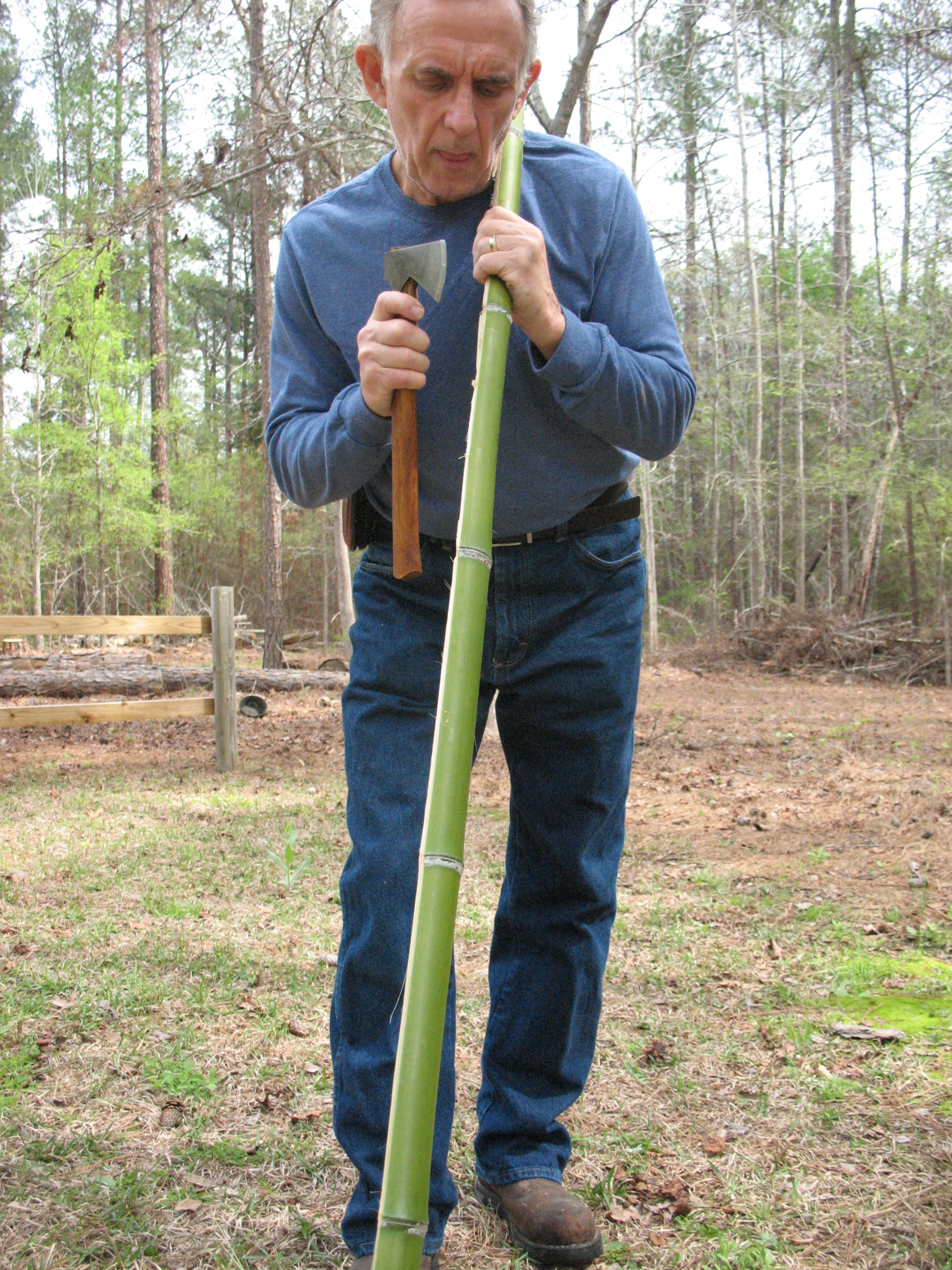
Next you can use your knife to carve a couple of notches in each end for the bowstring. Pictured below: Carving notches 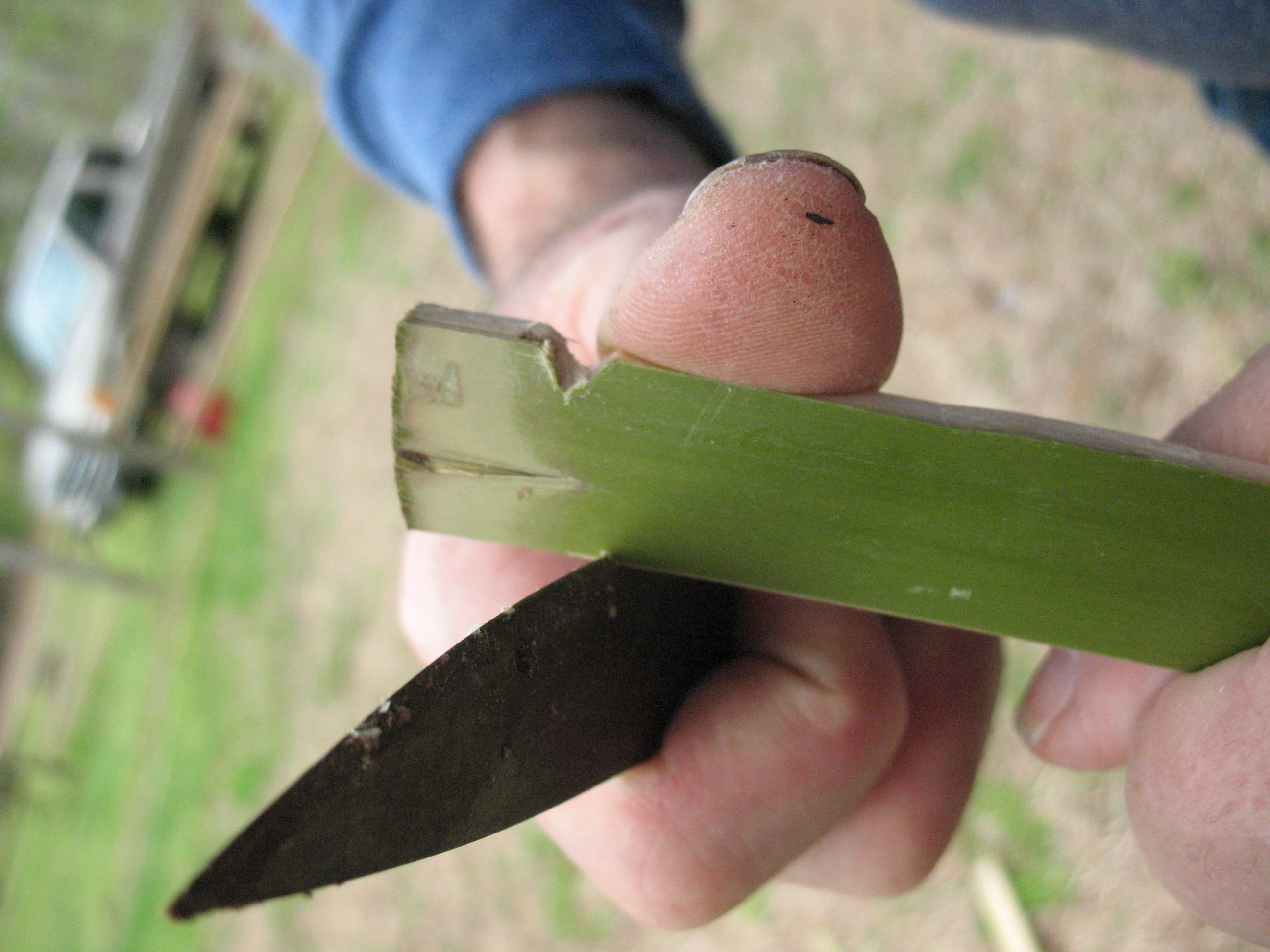 Now it’s time to make the handle. Cut a stick that is about an inch to an inch-and-a-half in diameter and about a foot long. Taper the ends of the stick as shown below. Pictured below: tapering the handle stick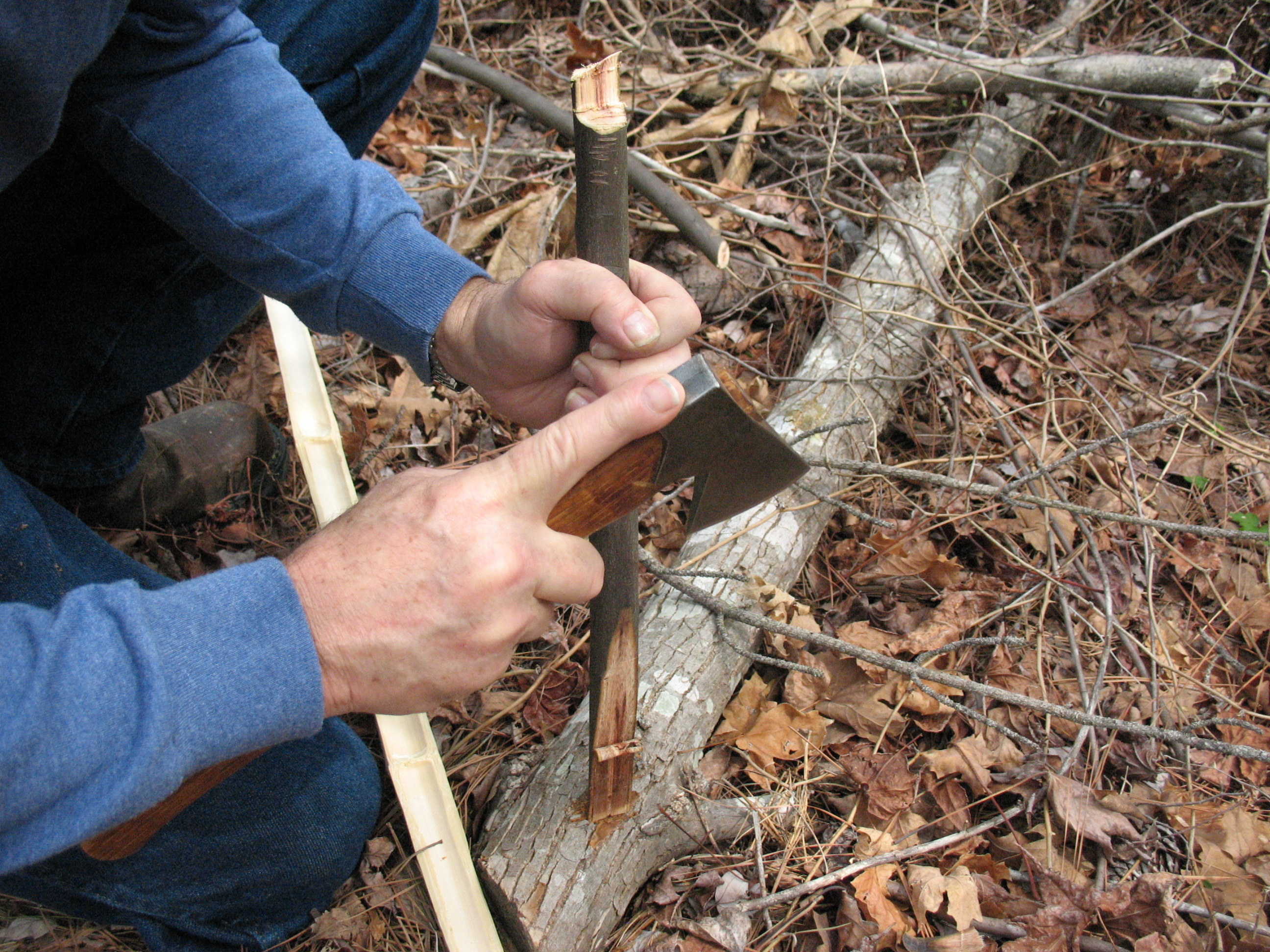
Carve out any joints in the area where the handle will rest then test the fit of the handle. Pictured below: top, carving out a joint; bottom, handle resting in place in the cane 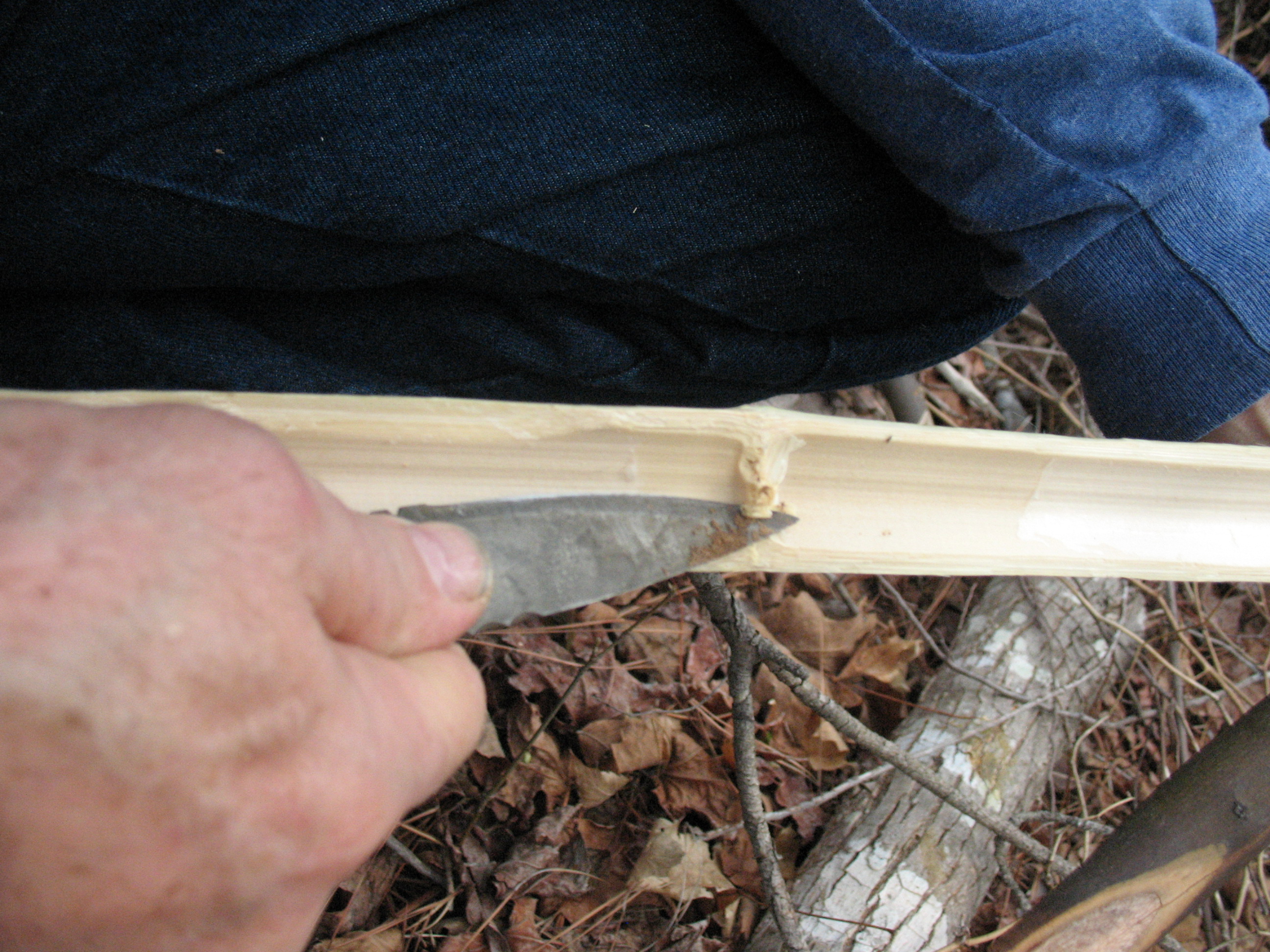
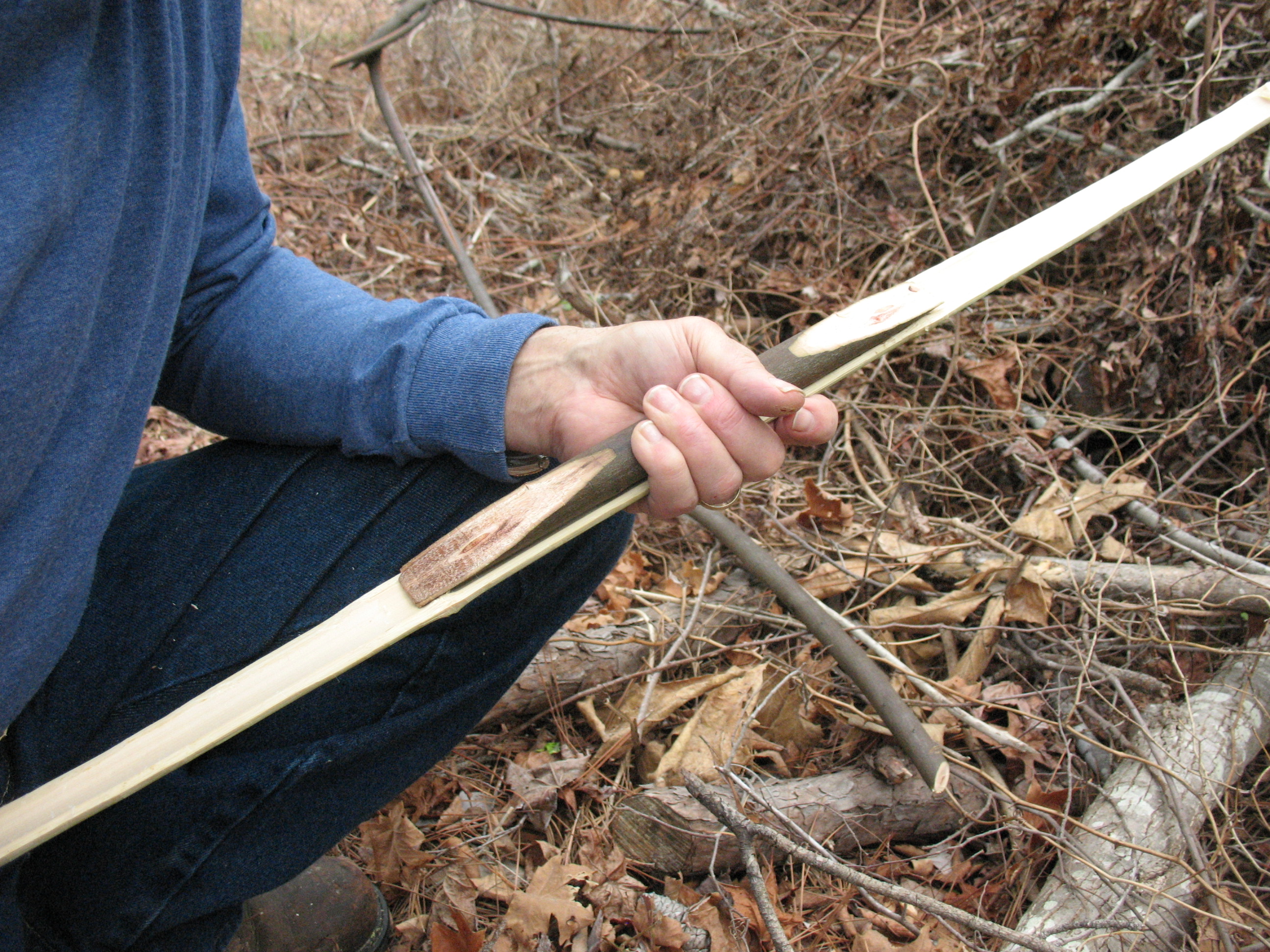
If the handle fits you can take some cordage and wrap the handle to secure it in place. In the illustration below I am using some yucca cordage that I had made earlier, but you can use para-cord, a shoelace, or anything else that you have. Pictured below: Wrapping handle
All you need now is a bowstring. I used some more yucca cordage for my bowstring. Pictured below: Finished bow, strung and ready for use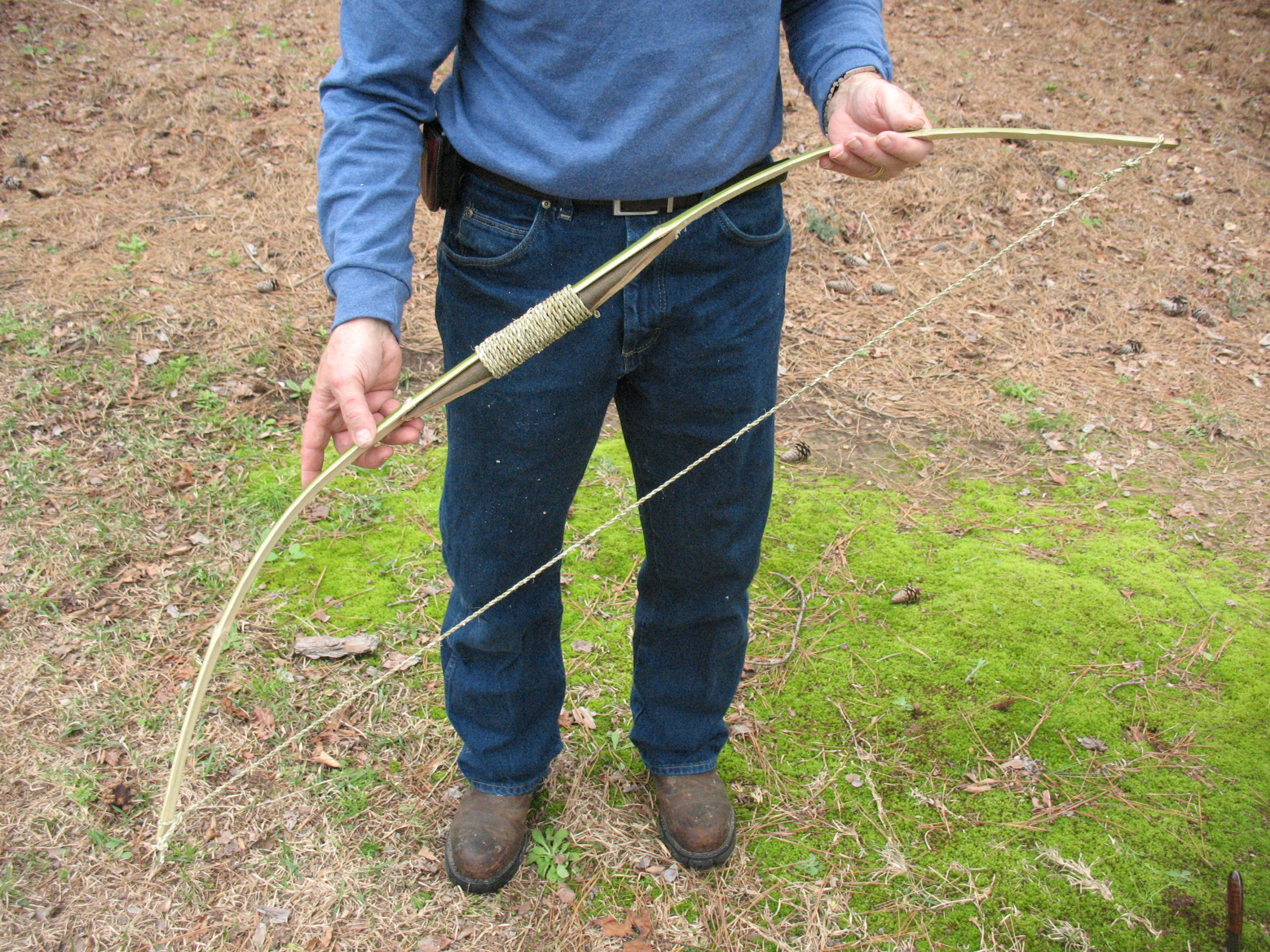 This particular bow, which is only about a quarter inch thick, is not all that powerful, about twenty pounds; but thicker bamboo will make a more powerful bow. I wouldn’t hesitate to use this bow to try and take a rabbit, coon, possum, or other small game. Pictured below: Bamboo bow at full draw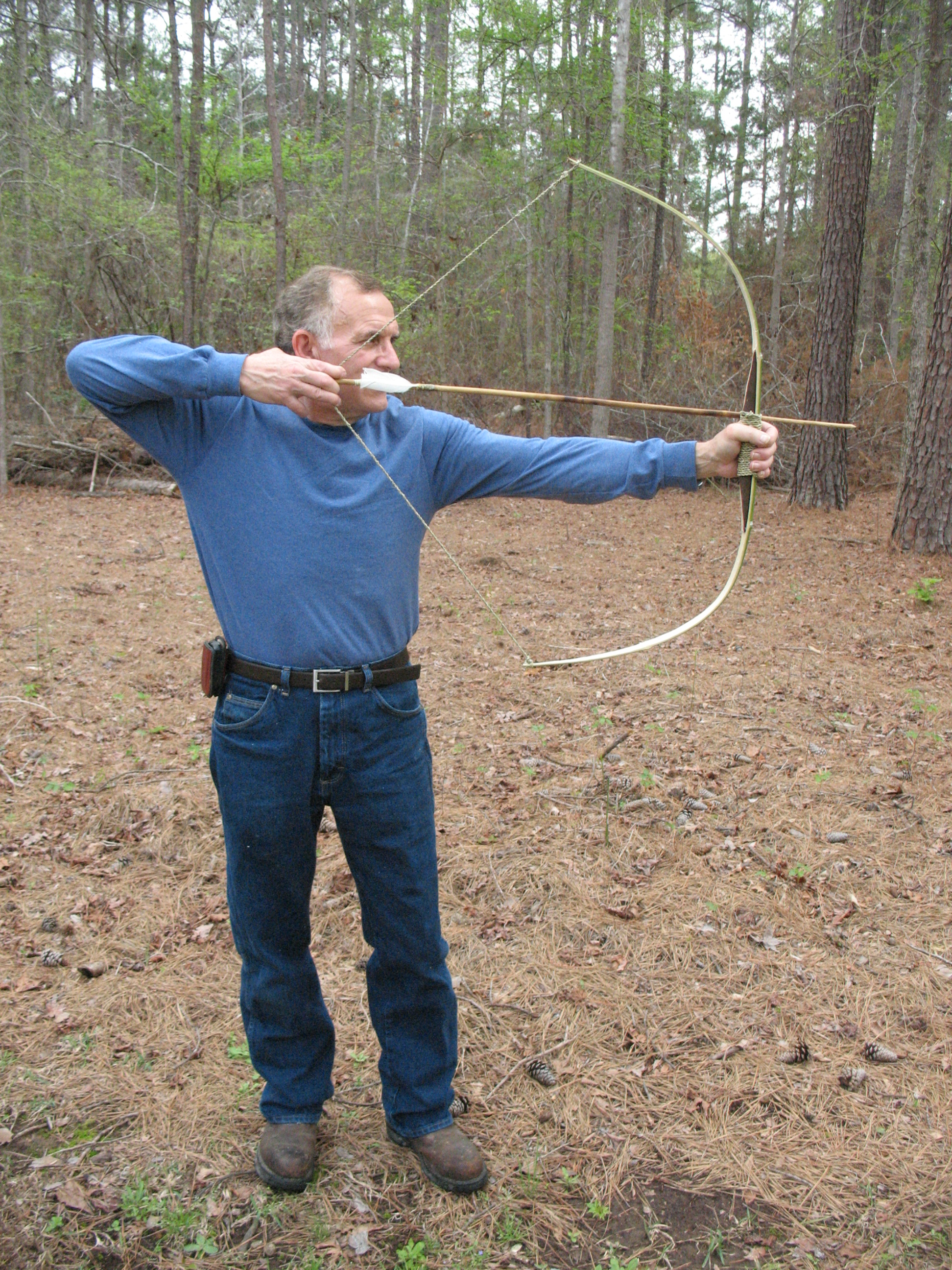
 Sensible Survival