Note: I wrote this article a couple of years ago but never posted it. It really is hitting home this year, so I am posting it now. We have had over 80 cases of West Nile virus and 5 deaths in East Texas this summer; so mosquitoes are a problem even in the “developed” world. Read, and be warned about these little killers.
Nearly anywhere that you live in this world you will encounter mosquitoes. Most people these days think of mosquitoes as a nuisance; but the fact is, they are a deadly danger to human health. Mosquitoes are fairly well controlled in most developed nations, so the diseases that they carry are no longer a major health risk. In developing nations mosquitoes are responsible for huge numbers of illnesses and deaths, and the cost to these nations is very high in terms of dollars, lost production, and weakening of future generations.
What would happen in developed nations if government agencies could no longer carry out mosquito control programs. Well just look at the mosquito related health problems in some of the developing nations around the world. According to a 2010 report of the World Health Organization there are over 225 million cases of malaria (a mosquito borne illness) throughout the world every year. Nearly 800,000 people die from malaria each year. The majority of these deaths occur in sub-Saharan Africa and most of these victims are children.
Because of changing climate, some mosquito borne diseases, like West Nile virus, that were once considered “tropical” diseases have begun to spread to the temperate zones. I live in Texas, and in recent years there have been several cases of West Nile virus. This is a disease that has never been known in this area, and it has appeared in spite of the aggressive mosquito control programs that we have.
So the bottom line is: government break-down equals no more mosquito control programs which equals you’re on your own as far as preventing mosquito borne illnesses. You need to prepare for this. What are some things that you can do to prevent mosquito borne disease?
1. Drain standing water where mosquitoes can breed.
2. Avoid going out at dusk and nighttime (the time when mosquitoes are most active).
3. Wear protective clothing.
4. Wear insect repellant. (You need to lay in a good supply of DEET)
5. Make sure that you have screens on all windows and doors.
6. Sleep under a mosquito net if you are out doors.
Most of these precautions against mosquitoes used to be common place in the USA and other now developed nations, but with modern mosquito control we have fallen out of the habit of protecting ourselves. It’s time to start thinking about them again, because a mosquito can kill you just as dead as a bullet from an AK-47.
The title of this post is a little misleading. What I’m really going to show you is how to tell how much time has passed rather than how to tell the exact time. This is a little trick that my grand-dad taught me when I was a boy. Grand-dad was a cowboy back in the late 1800’s. In those days a time-piece was an expensive luxury that most working men didn’t own, and if a man did have a watch he certainly didn’t wear it when doing range work. But cowhands still had to have some way of telling the approximate time at night so they would know when to change guards on the herd. Here’s how they did it, and how you can do the same. By the way, this only works if you live in the Northern Hemisphere.
First you need to locate the North Star (see my post of 9/3/2012). Now look for the two constellations Cassiopeia (shaped like the letter “W”) and Ursa Major (the big dipper). If you live in the lower latitudes, like the southern United States or Mexico, you may not be able to see both of these constellations at the same time. That’s not a problem. As long as you can see one of them this will still work. 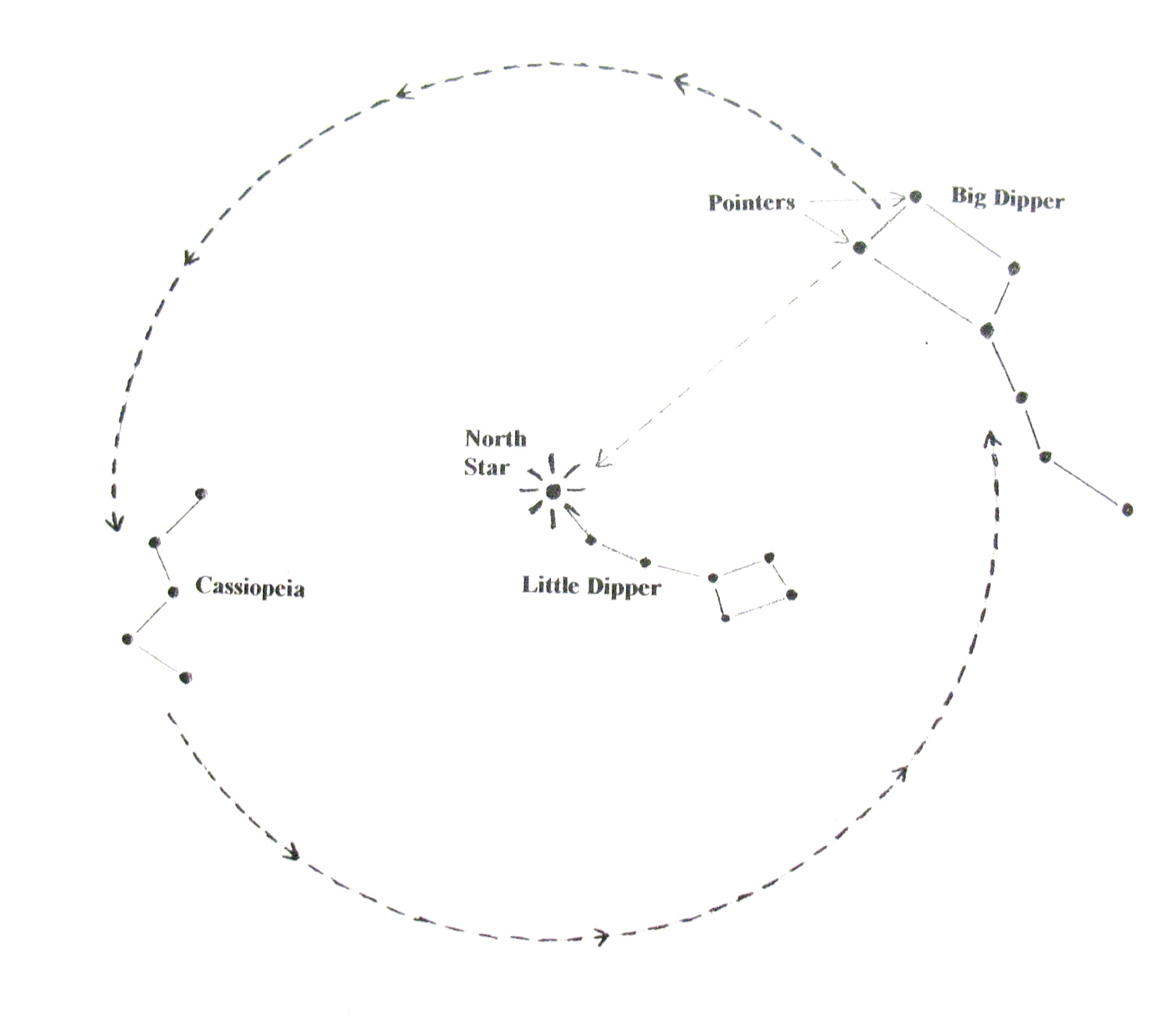
OK, the North Star, because it’s located directly above the North Pole, appears to stay in the same position in the sky at all times. The constellations Cassiopeia and Ursa Major appear to rotate in a counter-clockwise direction around the North Star, and they make one complete trip around the North Star every twenty-four hours.
So the first thing the old cowboys would do was take note of the position of the constellations when they went out on night watch. Pictured below: How the stars might have looked at the beginning of night watch 
When the constellations had moved forty-five degrees around the North Star, the cowhand knew that three hours had passed. Pictured below: Position of the constellations three hours later 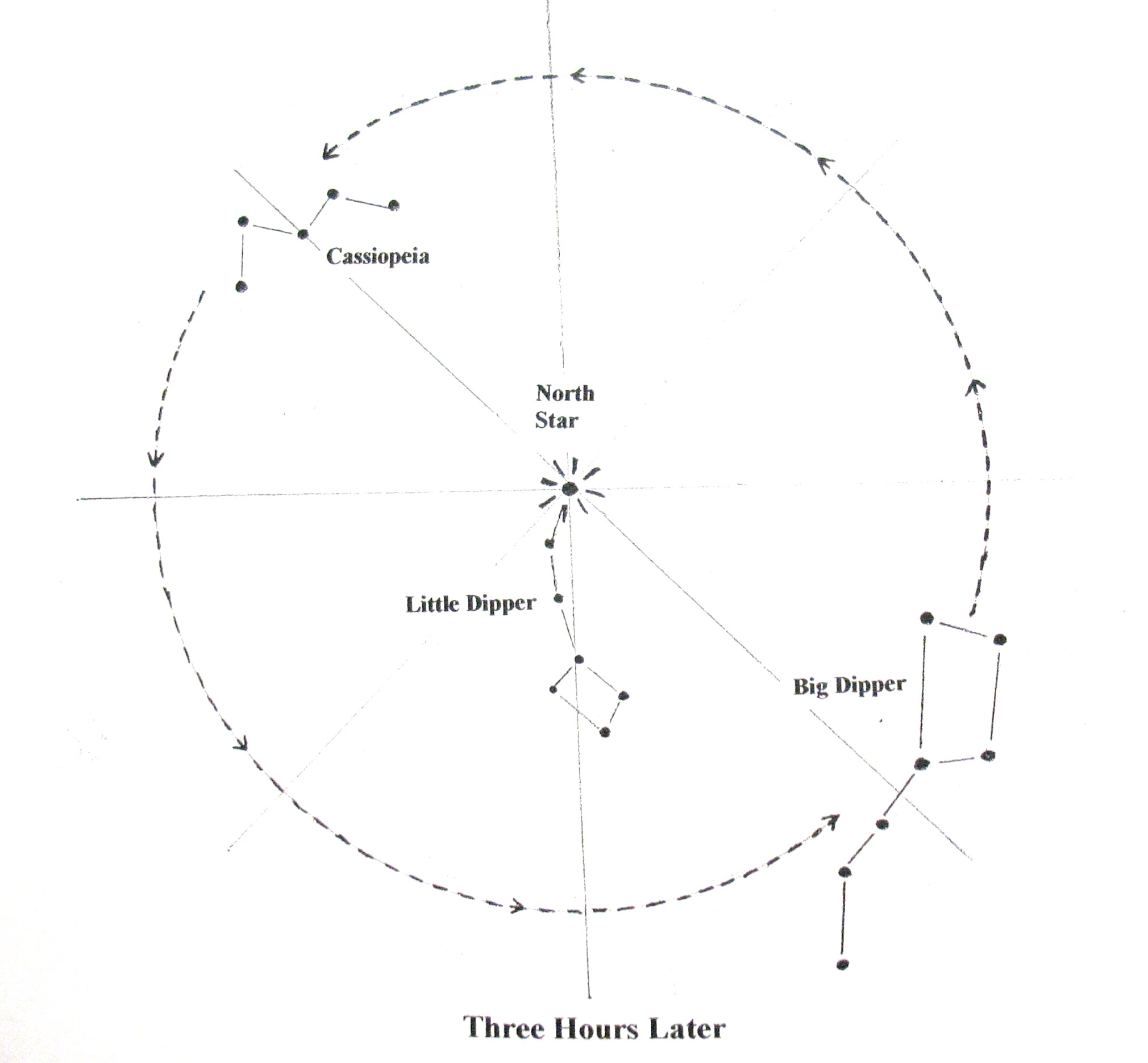
When the constellations had moved ninety degrees around the North Star, he knew that six hours had passed. Pictured below: Position of the constellations six hours later 
With a little practice a man could tell the passage of time with surprising accuracy. In the example I just gave I used three hours and six hours to make it easy for you to visualize. In the old days, night watch was usually in four hour shifts; and the cowboys could read the stars accurately enough to get their timing pretty close to right.
It is not a good idea to travel at night in the wilderness unless you are in desert terrain, but night-time is a good time to orient yourself and figure out directions. In the Northern Hemisphere the North Star (Polaris) has been used for thousands of years to establish which direction is north. Contrary to popular belief, the North Star is not the brightest star in the night sky. In fact there are forty-seven stars that are brighter than the North Star, so we must use some method other than brightness to locate the North Star. The North Star is at the end of the handle of the constellation we call the Little Dipper (Ursa Minor). Unfortunately, the stars of the little dipper are not very bright, and this constellation can be difficult to locate. Two easily identifiable constellations will help you locate the North Star. One of these is the constellation that we call the Big Dipper (Ursa Major). If you draw a straight line through the two stars at the end of the cup in the dipper (called the pointer stars), the line will point toward the North Star. The distance to the North Star is about five times the distance between the two pointer stars. 
Depending on the time of night, the month of the year, and your own latitude; the Big Dipper may not be visible to you. If this is the case you can look for the constellation Cassiopeia. Cassiopeia also revolves around the North Star and is located on the opposite side of the North Star from the Big Dipper. Cassiopeia looks like the letter “W” or the letter “M” depending on where it is in its path around the North Star.
Once you have located the North Star you can take a sharp stick and draw a line on the ground. Draw the line from where you are standing so that it points toward the north. Label the end of the line that points toward the star with an “N”. Label the other end of the line with an “S”. Now draw another line that crosses your north/south line at a ninety degree angle. As you face the north, the right end of your second line will be pointing to the east. Label it with an “E”. Label the other end of this line with a “W”. Now get a good night’s sleep and when you wake up in the morning you will have a compass drawn on the ground that will help you get started in the direction you want to travel.
The split-shaft fletched cane arrow is one of the quickest and easiest types of arrow to make. You will need the following tools and materials to make this arrow.
A piece of cane (bamboo or river cane) that is about three feet long and about the size of your little finger on the large end
A dried hardwood shoot about three-eights inch in diameter and about a foot long
A wild turkey tail feather
A yucca leaf
About a teaspoon of pine sap
A sharp knife
Pictured below: Materials needed to make a cane arrow with split cane fletching 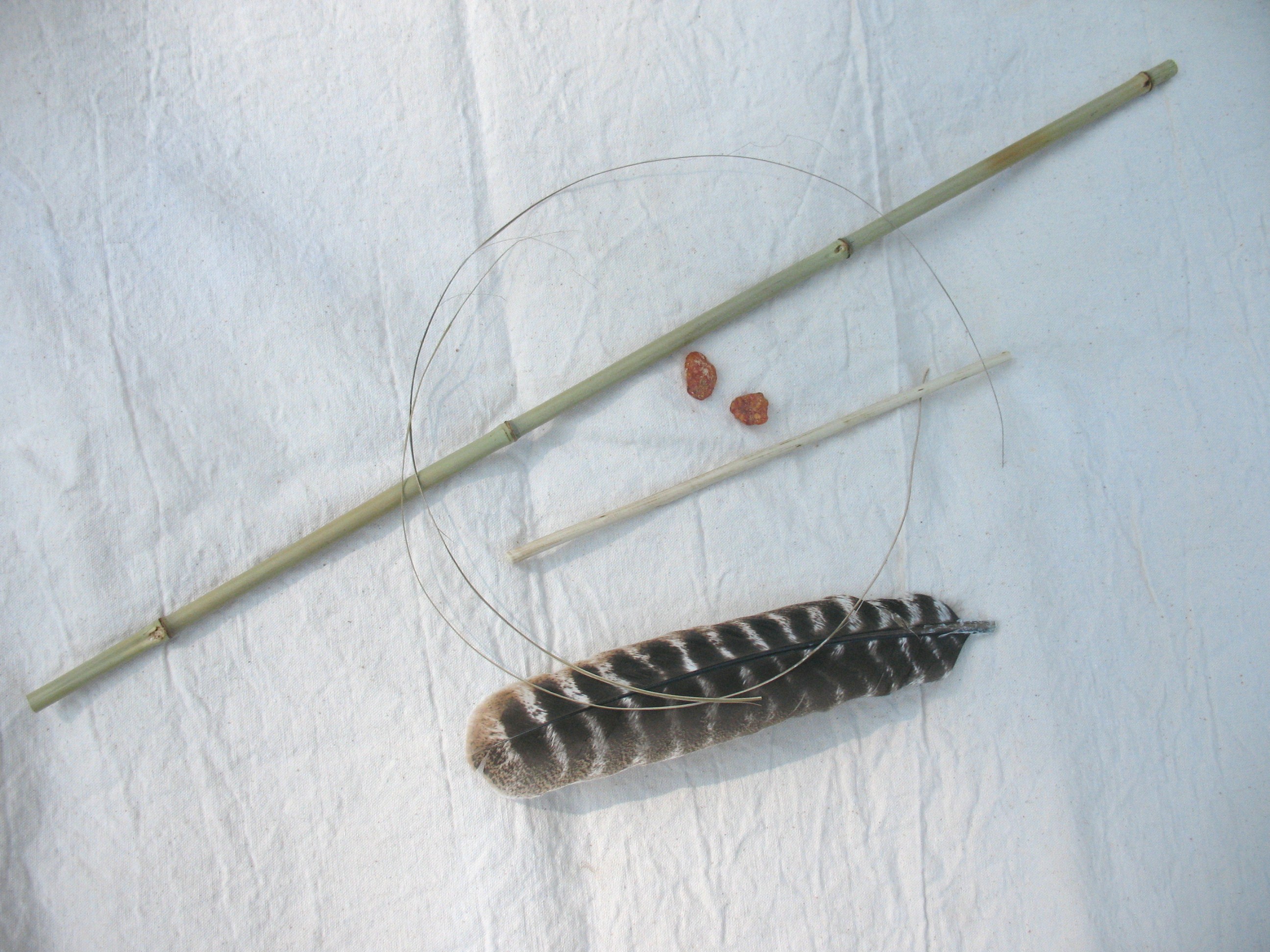
A cane arrow shaft consists of two parts; the main shaft which is made of cane and the fore-shaft which is made of hardwood. The cane portion of the shaft will be twenty-four to twenty-eight inches long, depending on your personal draw length. To make the cane portion of the shaft you will need a piece of river cane or bamboo that is about the thickness of your little finger on the large end. It should be several inches longer than you need the finished shaft to be. This will give you some leeway in positioning the cane joints on the finished shaft, and it will also make the shaft easier to straighten.
You want to select the straightest canes that you can find for making arrows. This will save you a lot of work when you straighten the shafts. To straighten the shafts you will need to heat them gently over flame or coals and then bend them straight and hold them until they cool. Canes can be straightened at the joints or in between the joints, whichever is necessary. Be sure and heat the shafts slowly so the do not scorch or burn. Rubbing grease or oil on the shafts before you heat them will help keep them from scorching. To check the straightness of a shaft you can sight down the shaft and turn it slowly. Any kinks or curves will be quickly visible. Be sure and wear gloves or use pot-holders when straightening the hot shafts.
Now we need to cut the shaft to length. It is very important where you locate the joints in this kind of arrow. The large end of the cane will be to the front of the arrow, and the hardwood fore-shaft will fit down into the hole in the cane. In order for the fore-shaft to have a solid base to rest on, you want to have cane joint located about two inches back from the front of the cane. The back of the cane is where we will have our nock, and where we will insert our fletching; so you need to have a joint about an inch from the back of the shaft.
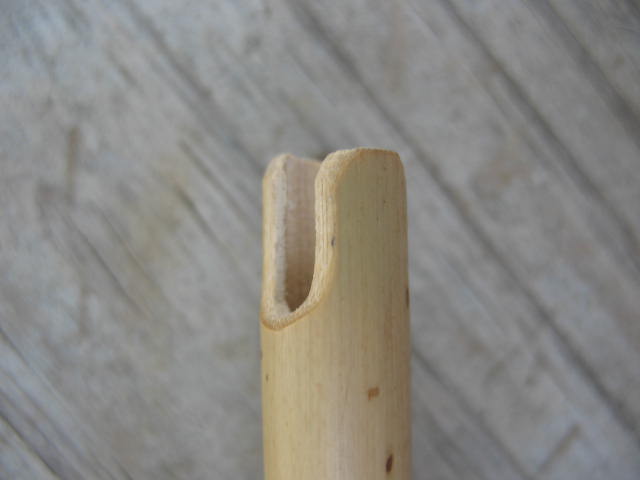
The string nock at the back of your arrow can be created by shaving of a about a half inch sliver of the cane on opposite sides of the cane. This will leave a nice little nock. You will need to use your knife to smooth down and flatten the part of the nock that comes into contact with the string. If it is left sharp it may cut the string. Pictured below: top, straightened and smoothed cane; bottom, close-up of the finished nock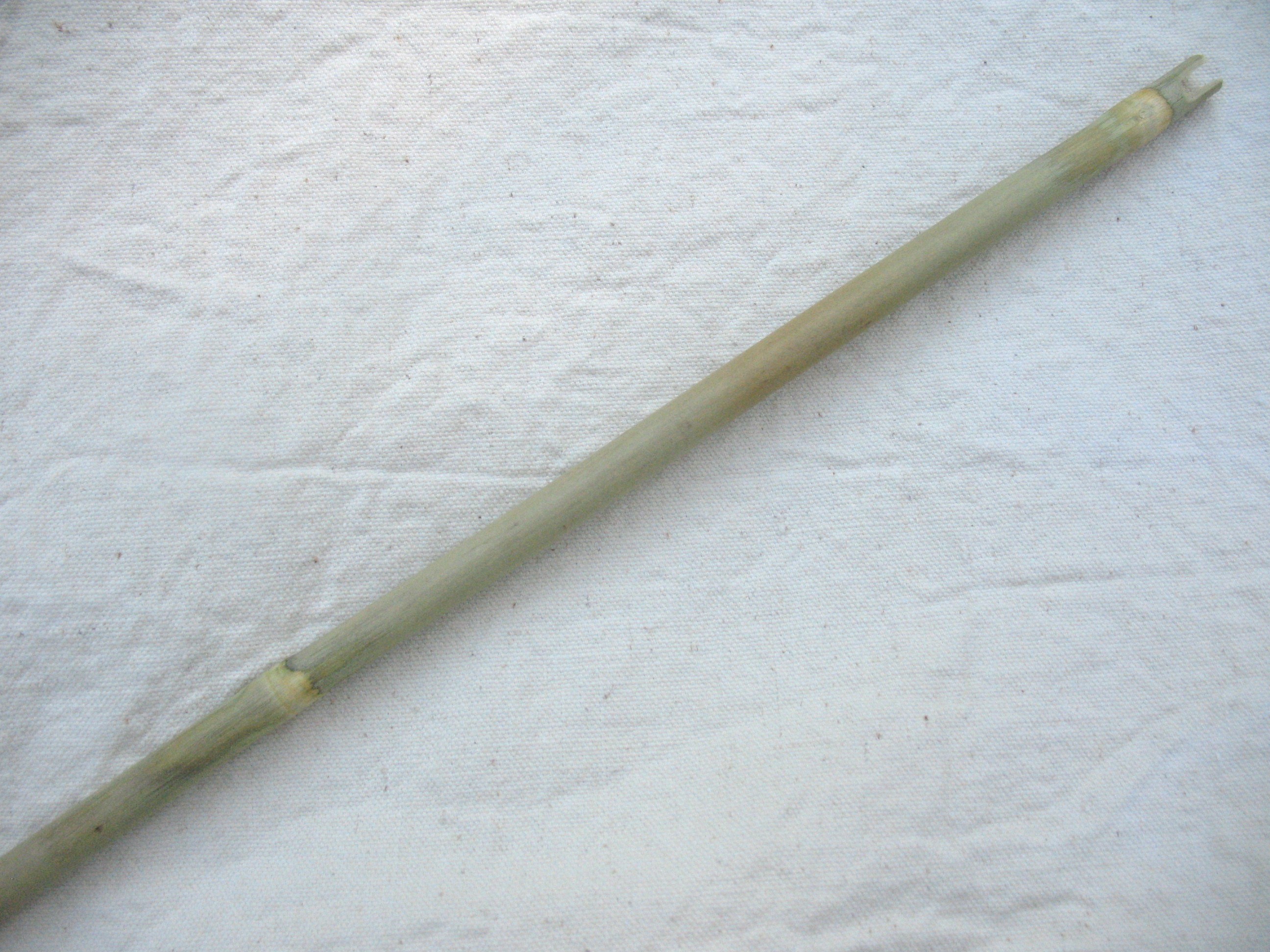
Now place you knife blade down into the bottom of the nock and very carefully split the cane down to the last joint on the back of the cane. This is where you will insert your fletching. Pictured below: splitting the cane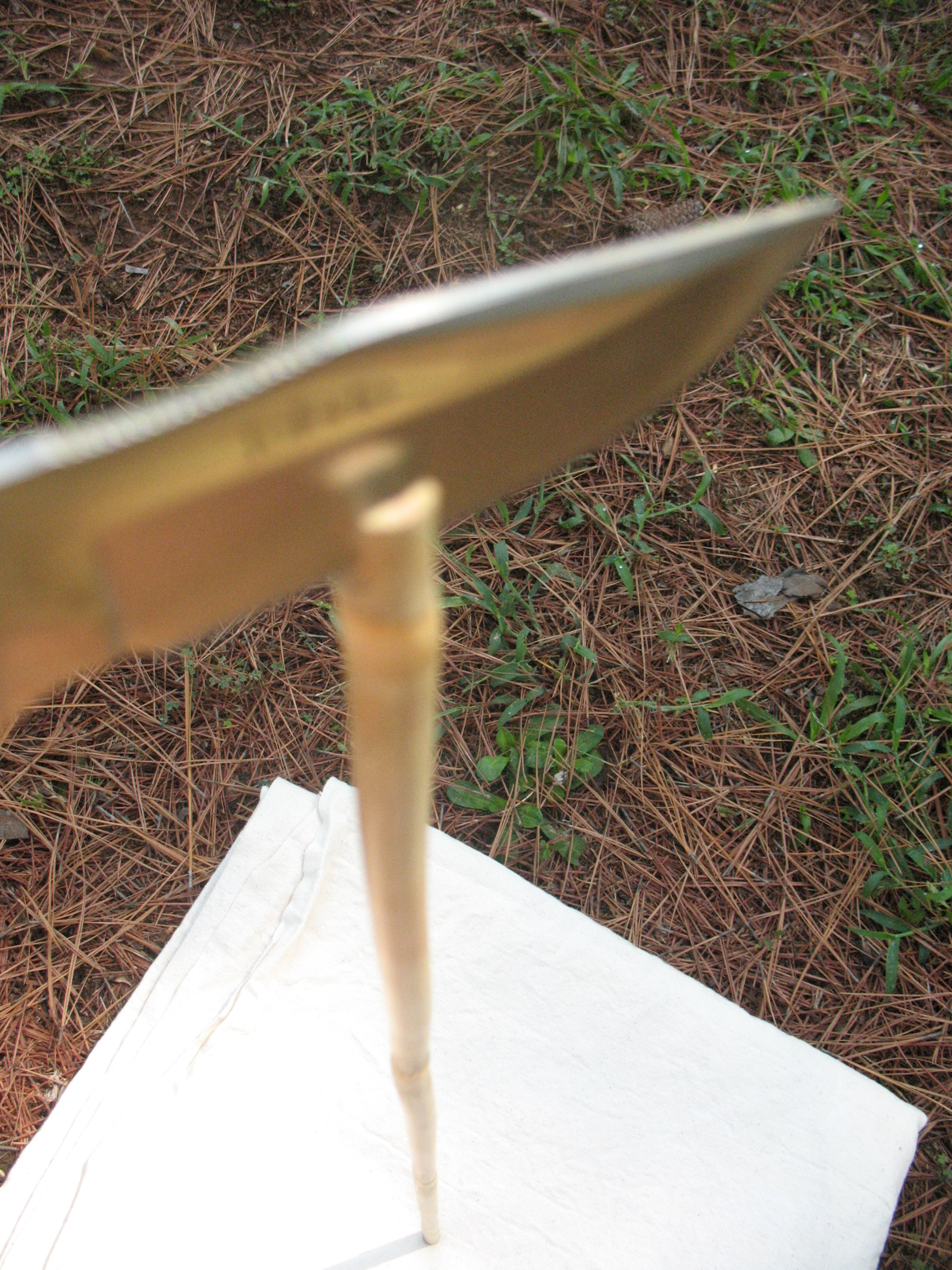
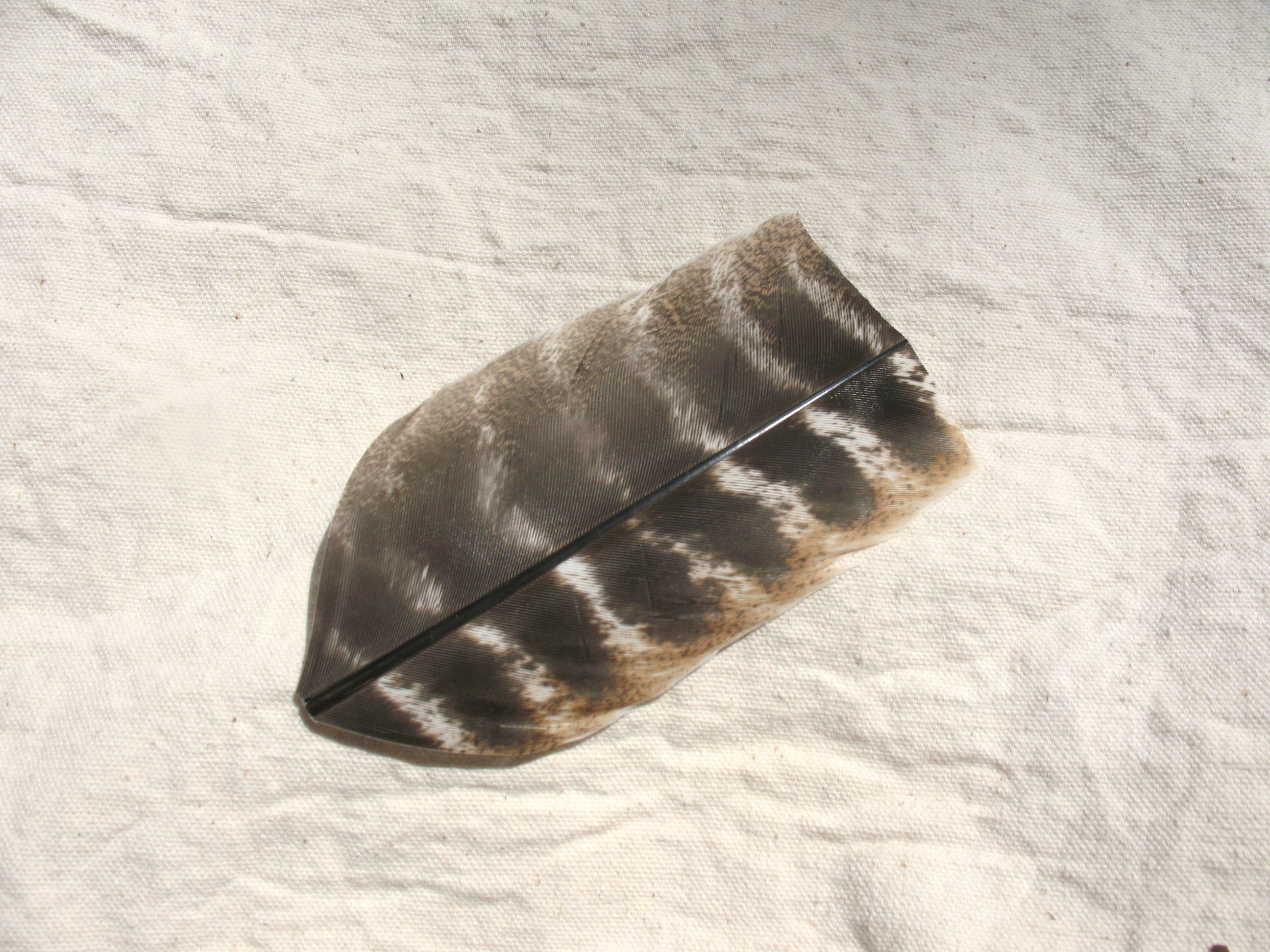
We are going to fletch this arrow with a wild turkey feather. Be sure to select a feather that has a good vane on both sides of the quill, and make sure that the vanes don’t curve too much.Take your turkey feather and cut a five inch section across the width of the entire feather. Pictured below: top, Wild turkey feather; bottom, section cut from whole feather 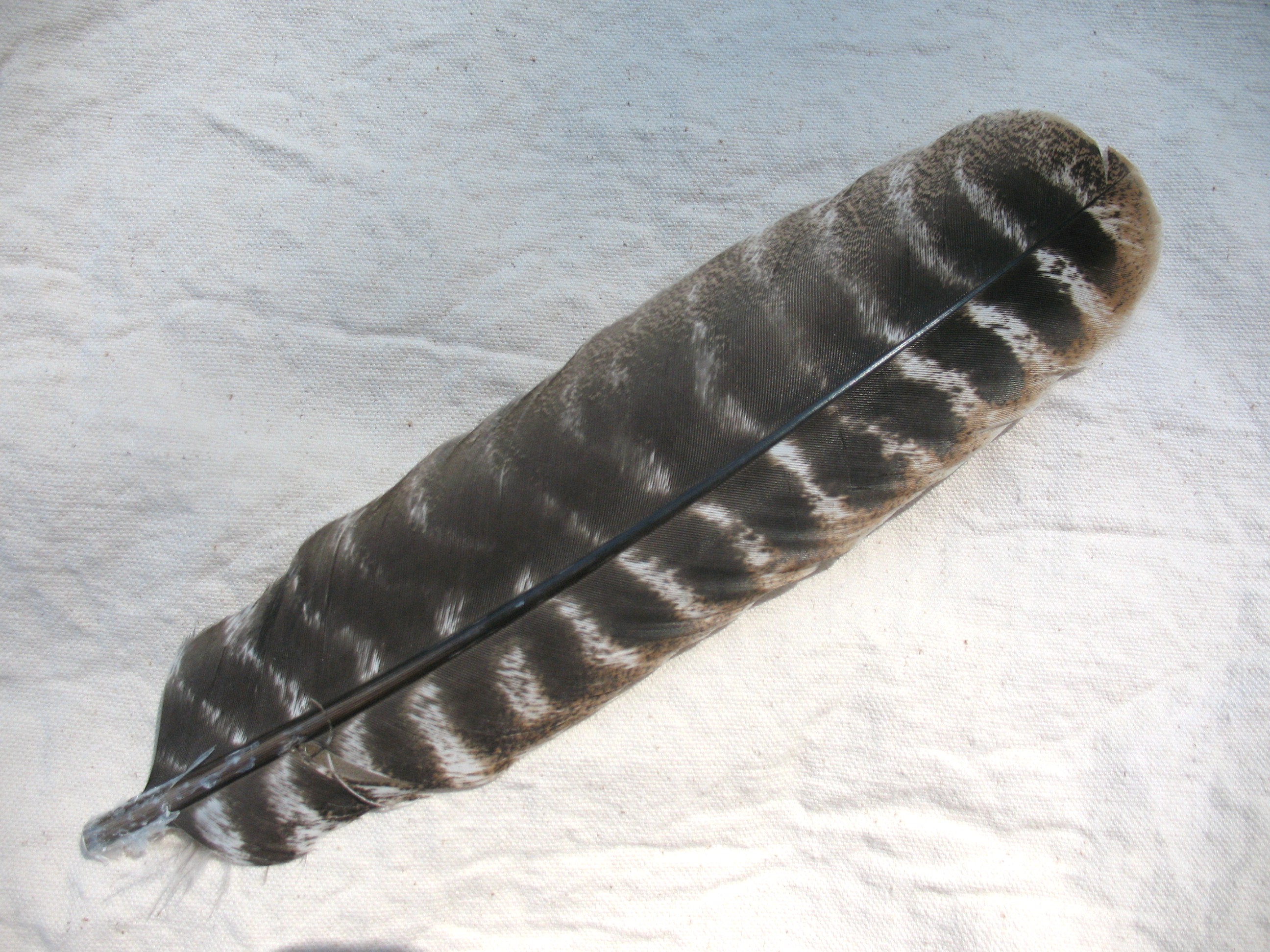
Very carefully open up the split in the back of the arrow shaft and slide the quill of the feather into the hole in the cane. The vanes of the feather will stick out of the splits on each side of the shaft. Pictured below: feather in place in cane shaft 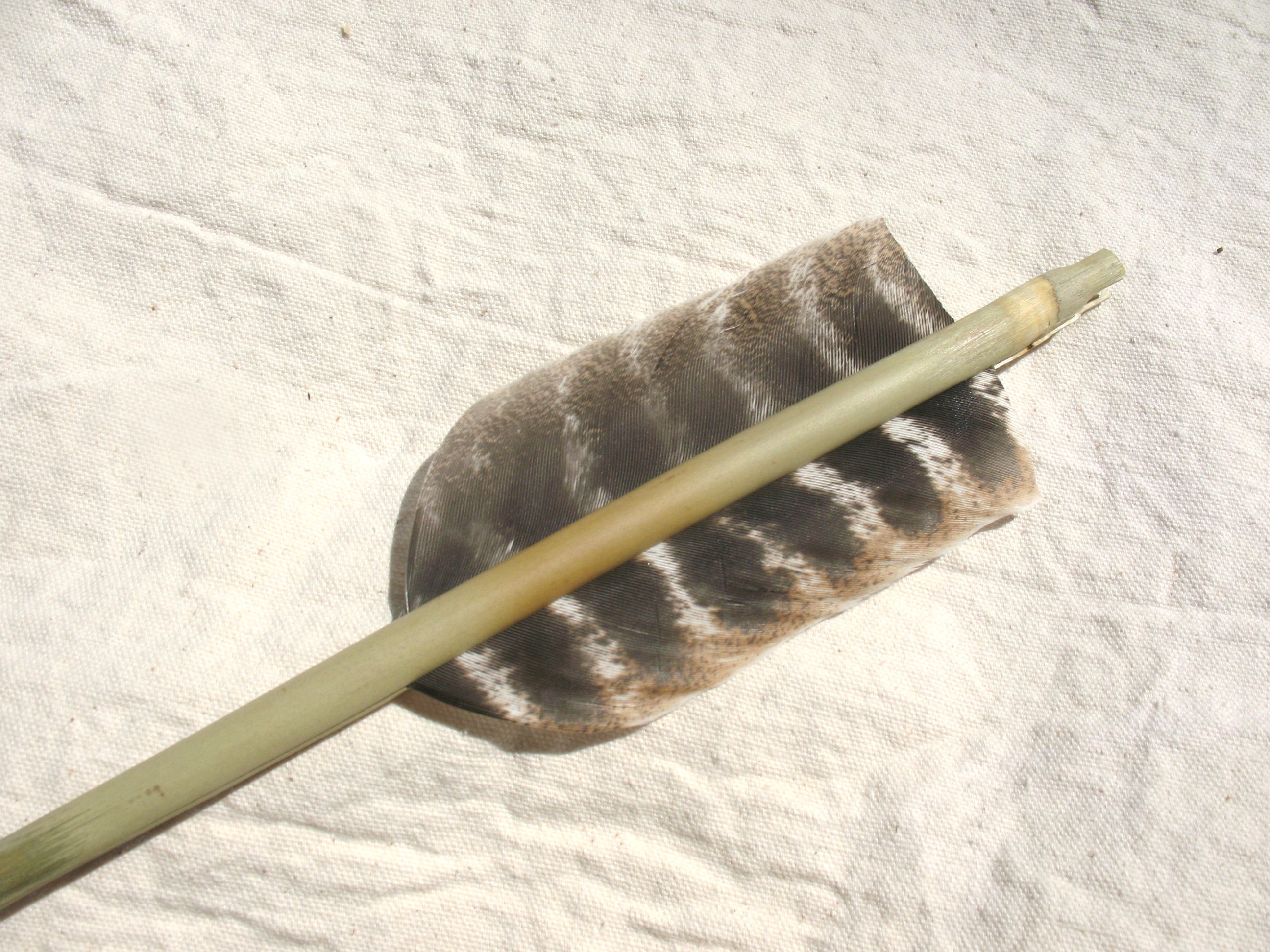
When you have the feather positioned where you want it, take some yucca leaf fiber and wrap it tightly for about a half-inch in front of and a half-inch behind the feather. Coat the wrappings with a little pine sap to help hold them in place and protect them from moisture. Use a sharp knife or a flint flake to trim the fletchings to the desired shape. Pictured below: finished fletching 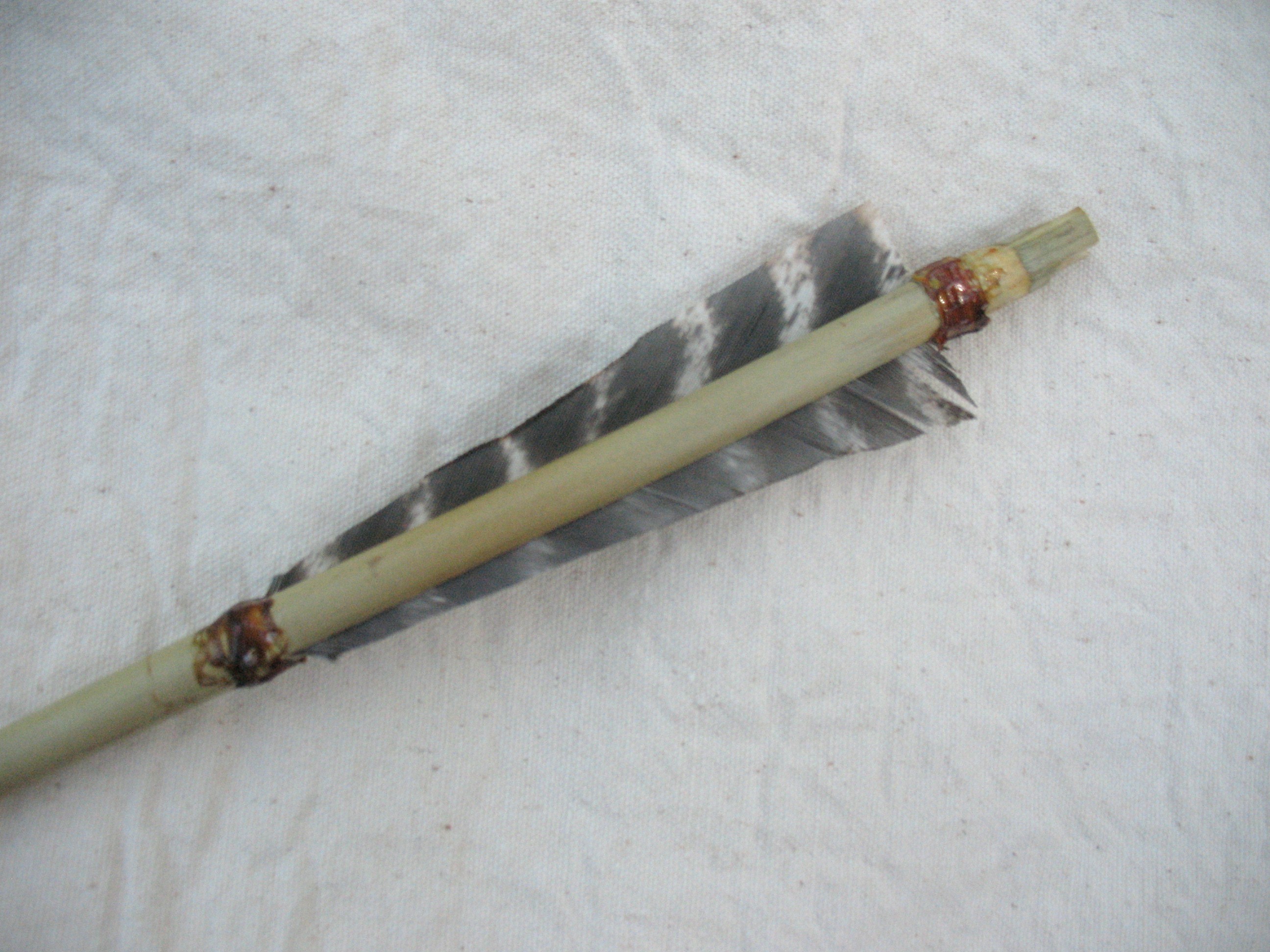
Now we need to put a fore-shaft into the front of the cane. The fore-shaft is the only part of the arrow that will penetrate your target so it needs to be long enough to do some damage. You will want about six to eight inches of fore-shaft to stick out of the cane. Since you need to add the two inches that will fit down into the cane, the total length of the fore-shaft needs to be eight to ten inches. You can just cut a fore-shaft to length, sharpen the point, and call it done; or you can use a larger diameter stick and whittle out a wooden broadhead type point. Drop a little pine sap in the front of the cane and insert the foreshaft. That’s it. Pictured below: front of cane shaft with foreshaft glued in place 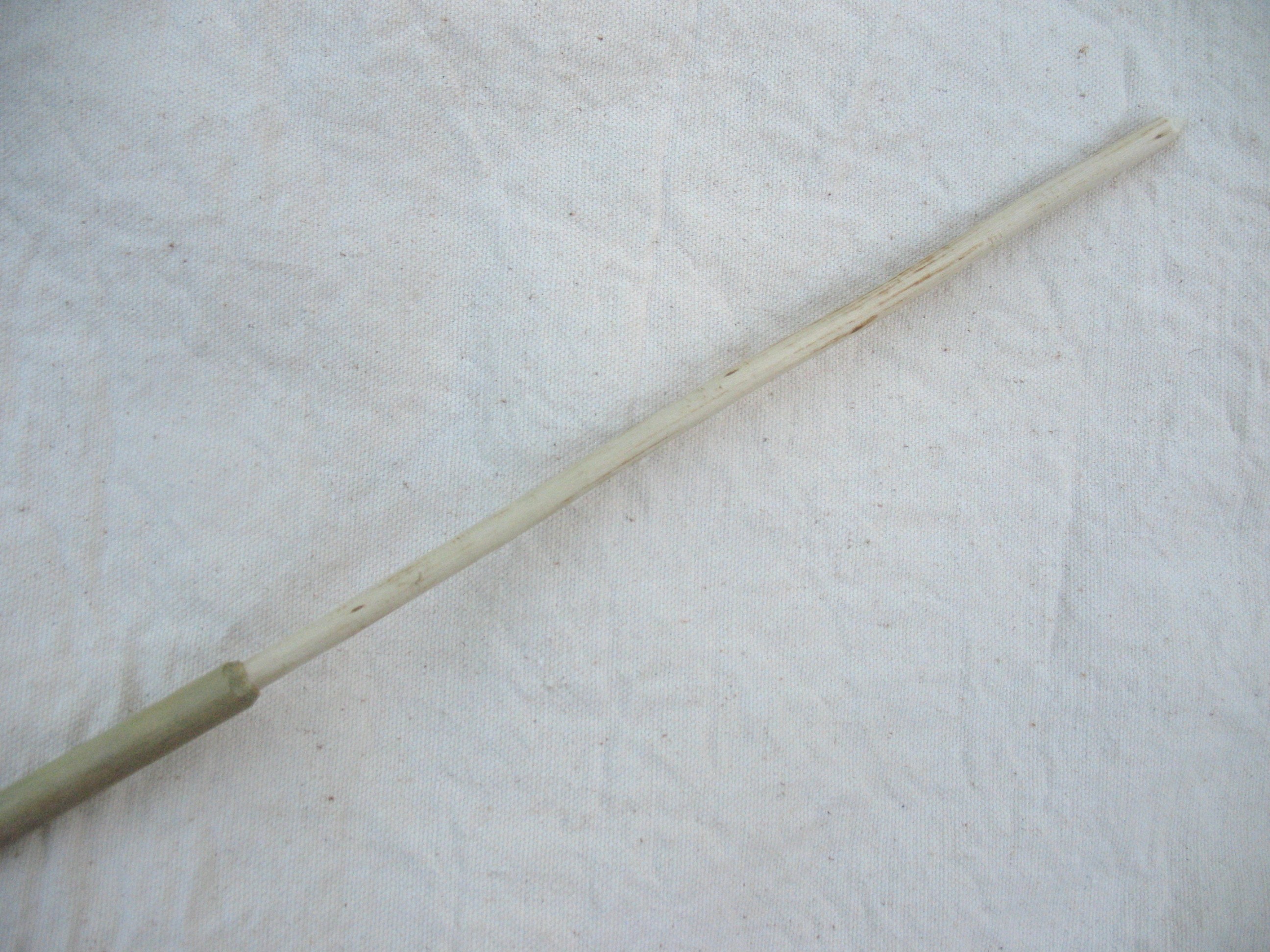
If you don’t have a Swiss army knife with a saw blade it can be a little tricky to cut the nocks on the back of arrows. It’s even harder to cut the deep notch needed to attach a stone or glass arrow point. There is a way to make those notches with nothing but a knife blade. This was taught to me by the old man who was my mentor in the wilderness. I’m not sure where he learned it, but it’s a pretty good trick.
First of all you need to cut your arrow shafts about six inch longer on the front and back than you want the finished arrow to be. The reason for this extra length will become apparent in a moment.
Now to cut a nock in the back you need to take your knife and make a couple of little cuts on opposite sides of the shaft at the point that you want to be the back of your arrow. Make these cuts about one-eighth of an inch deep.

Now turn the shaft 90 degrees, drop down about three-eighths of an inch, and make two more cuts on opposite sides of the shaft. 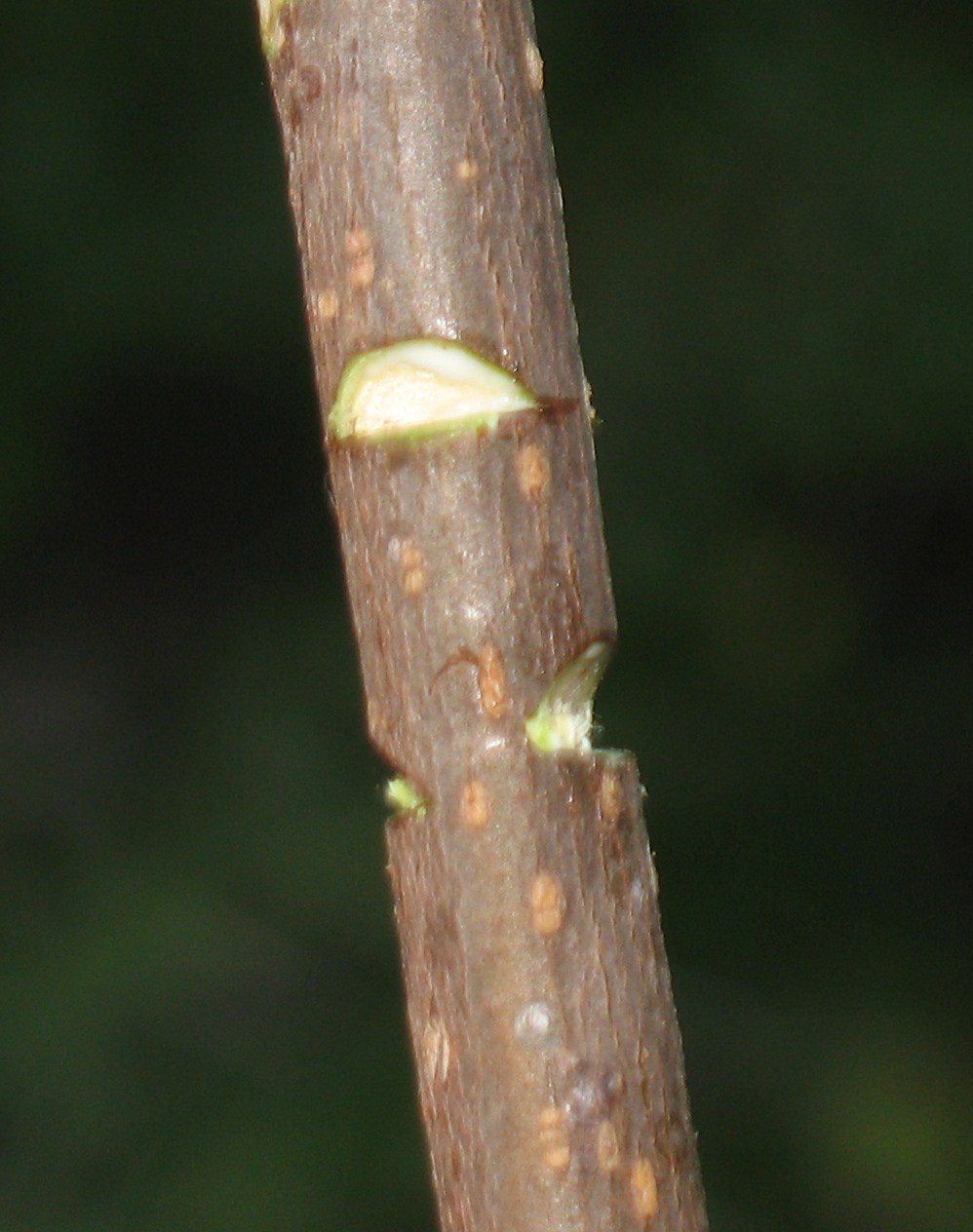
Now for this next part you really need to look at the pictures because it’s kind of hard to explain. You’re going to grab hold of the extra shaft length above the soon-to-be nock and pull it gently toward one of the top cuts. Then you’re going to push it in the opposite direction toward the other top cut. As you rock the shaft back and forth, the grain of the wood should separate and run down from the two cuts. 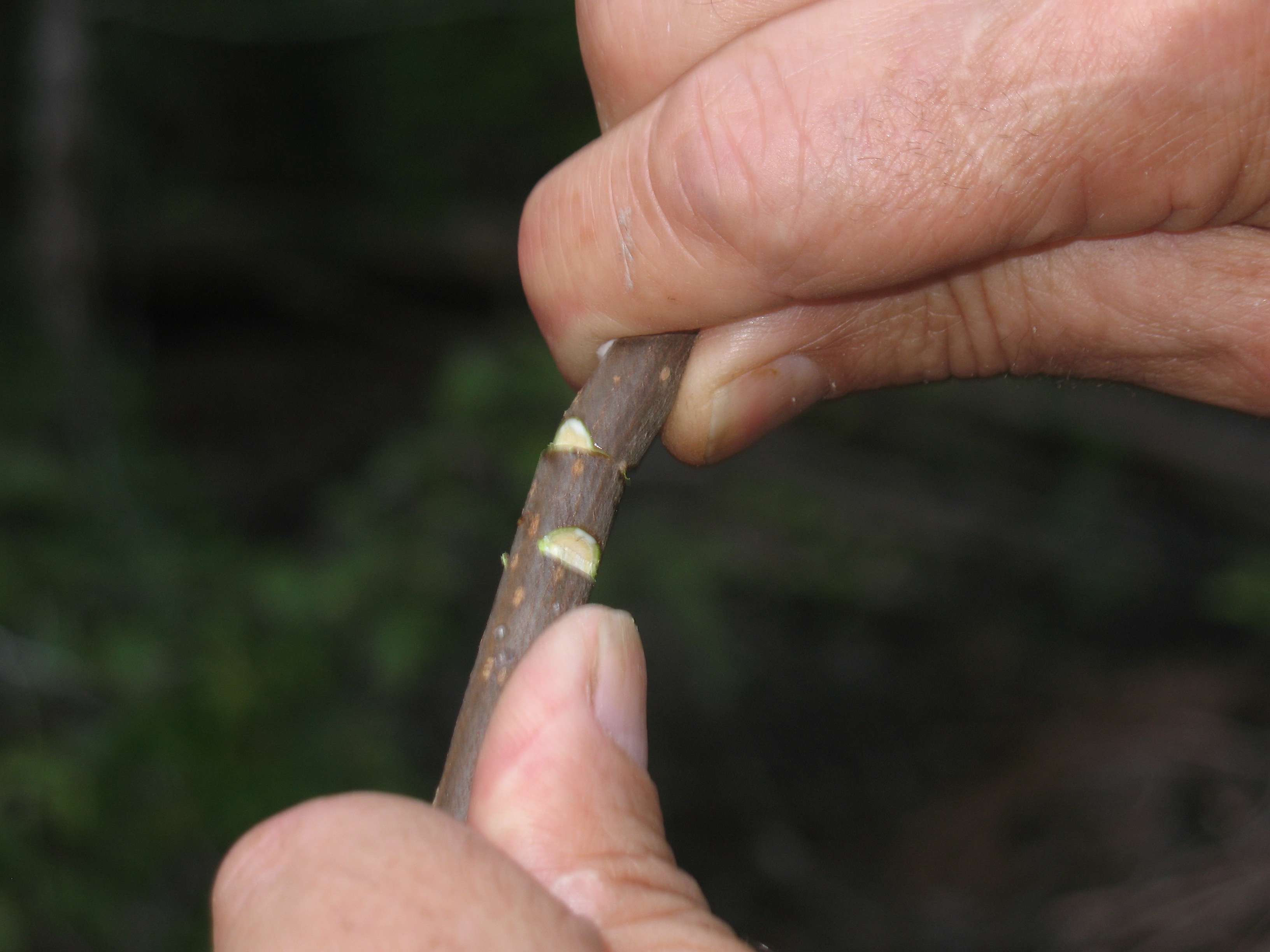

Now start rocking the part that you are holding again, but this time you want to rock it ninety degrees from how you did the first time. In other words, if you were pushing forward and backward the first time; now you want to be rocking from side to side.
Put some more pressure into the motion until the bottom cuts snap and come loose. You should now be left with an arrow that has a nock in it. 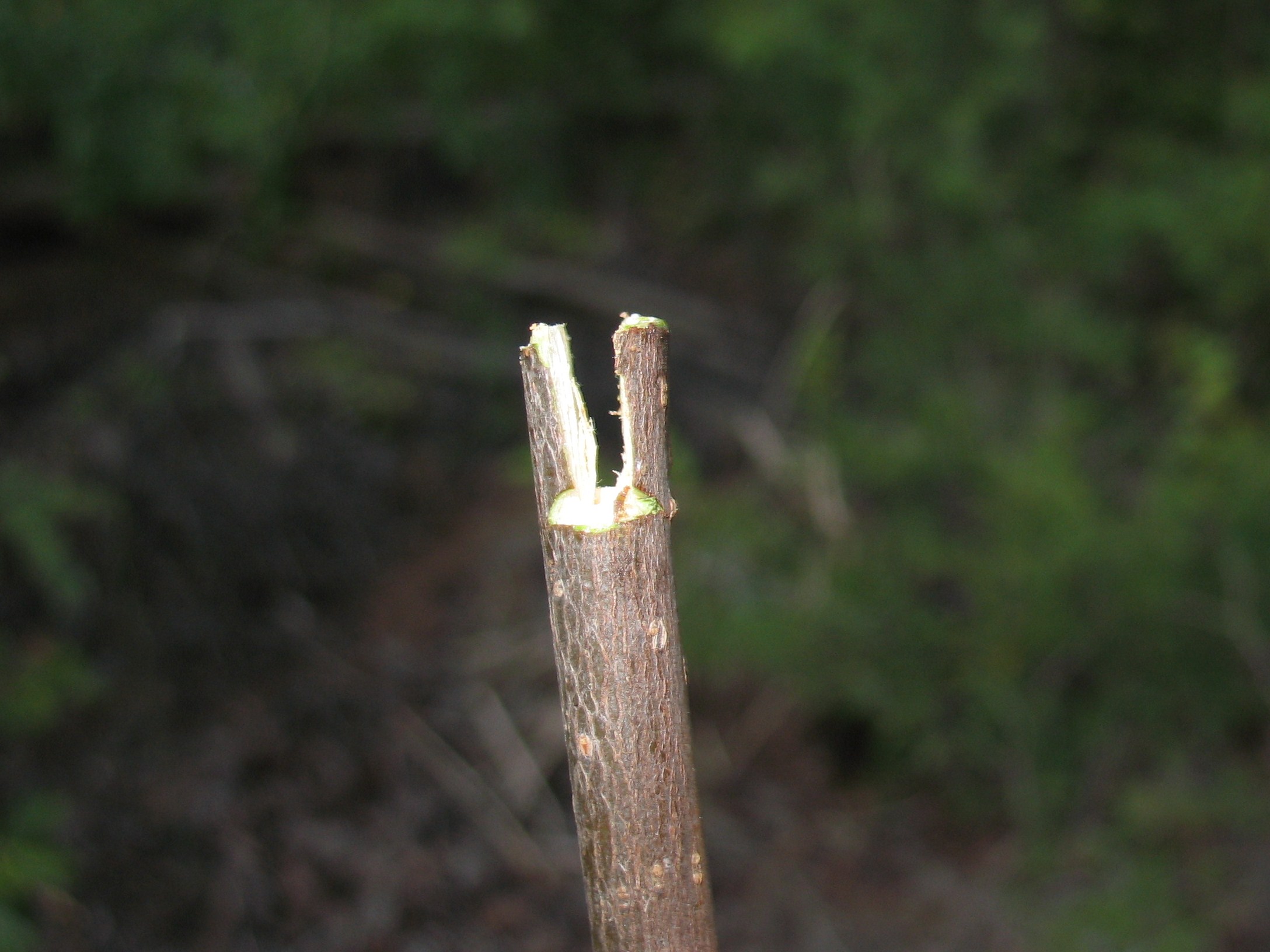
Do the same thing on the front of the arrow only make the notch longer, about three-quarters of an inch. This will give you a nice deep notch to seat an arrowhead in.
I wouldn’t use this method to make a nice finished arrow, but for a quickie, survival type arrow it’s a good trick to know.
DISCLAIMER: Don’t believe anything I or any body else tells you about edible wild plants. Don’t eat edible wild plants based on what you see in a book or on the inter-net. Get a qualified instructor to show you the plants, and don’t eat them until the instructor shows you how to prepare them, and then eats them him or herself. Be aware that you may be allergic to a plant that someone else can eat without harm. Be sure that any plants that you gather have not been sprayed with pesticides or herbicides.
In the “old days” it was common practice for pioneer families to imbibe a spring tonic. This ritual was part medicinal and part psychological. It was medicinal in that the tonic in question usually had some medicinal benefit, either real or imagined; and it was psychological in that it was an acknowledgment that the natural world was renewing itself and man, by the act of taking this purifying herb, was to be part of this renewal. In the South, one of the most common spring tonics was Sassafras tea.
The Sassafras (Sassafras albidum) is a fairly small tree, sometimes up to 40′ tall, which grows throughout the Eastern United States. The easiest way to identify the Sassafras is by its leaves. You will find that the Sassafras has three distinctly different shaped leaves on the same tree. Some of the leaves are oval shaped, some of the leaves are mitten shaped, and some of the leaves are three lobed. All of the leaves have smooth edges, and are shiny on the upper surface. Pictured below: The three different shaped leaves found on the sassafras tree 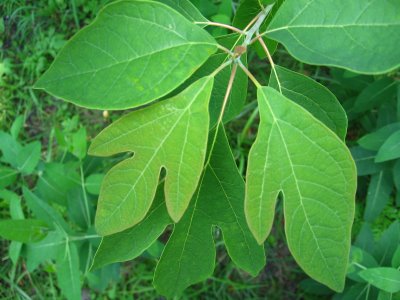
If you have any doubts about whether you have correctly identified a Sassafras, all you have to do is dig up a small root and smell of it. Sassafras root smells exactly like rootbeer.
To make Sassafras tea, dig up several small roots and wash the dirt from them. Bring a pot of water to a boil and throw the roots into the boiling water. Let the roots boil for a few minutes until the water begins to turn a deep red. Remove water from heat and let the tea steep. Serve hot or cold. Add honey or sugar if you like. Native Americans added maple sugar.
Old timers referred to Sassafras tea as a blood thinner. They said that it helped a person tolerate the coming summer heat better. Modern science tells us that Sassafras contains a mild narcoleptic, a drug that induces drowsiness. The Food and Drug Administration also warns us that Sassafras can cause cancer if given in large doses to laboratory rats over extended periods of time (so don’t give your pet rat a washtub full of Sassafras tea every day).
Apparently mosquitoes do not like the smell of Sassafras. Take some of the tea and rub it on exposed areas of your skin to repel these pesky little critters.
Yet another use of Sassafras is as a thickener in stews. You may remember the Hank Williams song about “Jambalya, crawfish pie, and filet gumbo.” Well, filet is the substance used to thicken gumbo, and filet is made from dried and powdered Sassafras leaves. If you make your own filet be careful to remove the sharp stems and veins after the leaves have been crushed. These can cause major stomach problems. Also, be sure and don’t give your pet rat too much gumbo.
I have read that Sassafras can be used to make a fire-bow-drill, but I have had no success with this. The wood seems to be too hard. I have intended to try and dig up a large Sassafras root, let it dry for six months and see if that wouldn’t make a usable fire-bow-drill. The root of the Cottonwood is the only part of that tree that I have ever been able to start a fire-bow fire with, and I was thinking that the same may hold true for the Sassafras, but I haven’t got around to trying it yet. Maybe you’ll try it first and let me know.
A Flemish loop is a loop that is twisted up as a permanent part of a bow string. It is not a tied loop. It is built in during the process of making the string. I have never seen an example of an old Native American bowstring with a Flemish loop, nor have I ever seen any documentation of Native Americans using the Flemish loop. This is not to say that they didn’t; it’s just to say that I have never seen any proof of it. So, if you are trying to make a reproduction of an authentic Native American bow, you probably don’t want to make a string with a Flemish loop. If, like me, you make wooden bows to shoot; a Flemish loop is a nice addition to the string. I personally make my strings with a Flemish loop on one end, and then I tie the other end of the string to the bow with a permanent knot. I do this whether the string is made of sinew, rawhide, yucca fiber, linen, or waxed Dacron. In this example I am making a string from eight strands of waxed Dacron. The string will be constructed by using the reverse wrap (posted elsewhere on this blog) to twist together two bundles, each bundle composed of four strands of waxed Dacron. Here is how you make a Flemish loop in the string:
First lay cut and lay out your eight strands of waxed Dacron. I generally cut the pieces one and-a-half times the length of the bow. 
Now separate the strands into two bundles of four strands each. Offset the strands in each bundle by about an inch apiece. 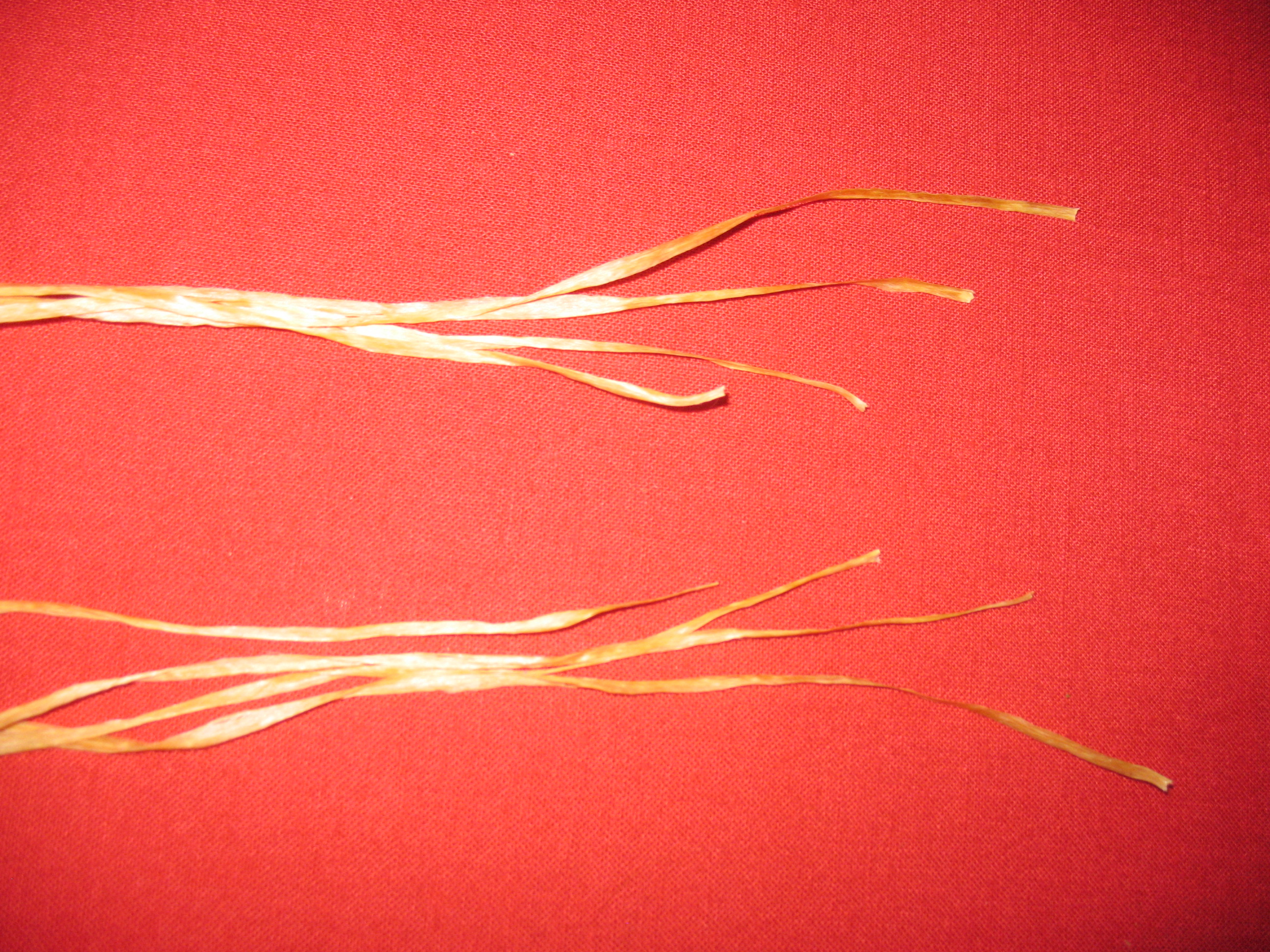
Now drop down about two inches below the shortest strand in each bundle and begin twisting the two bundles together using the reverse wrap. Keep twisting until you have twisted up about two or two-and-a-half inches of string (this will depend on how large you want your loop). 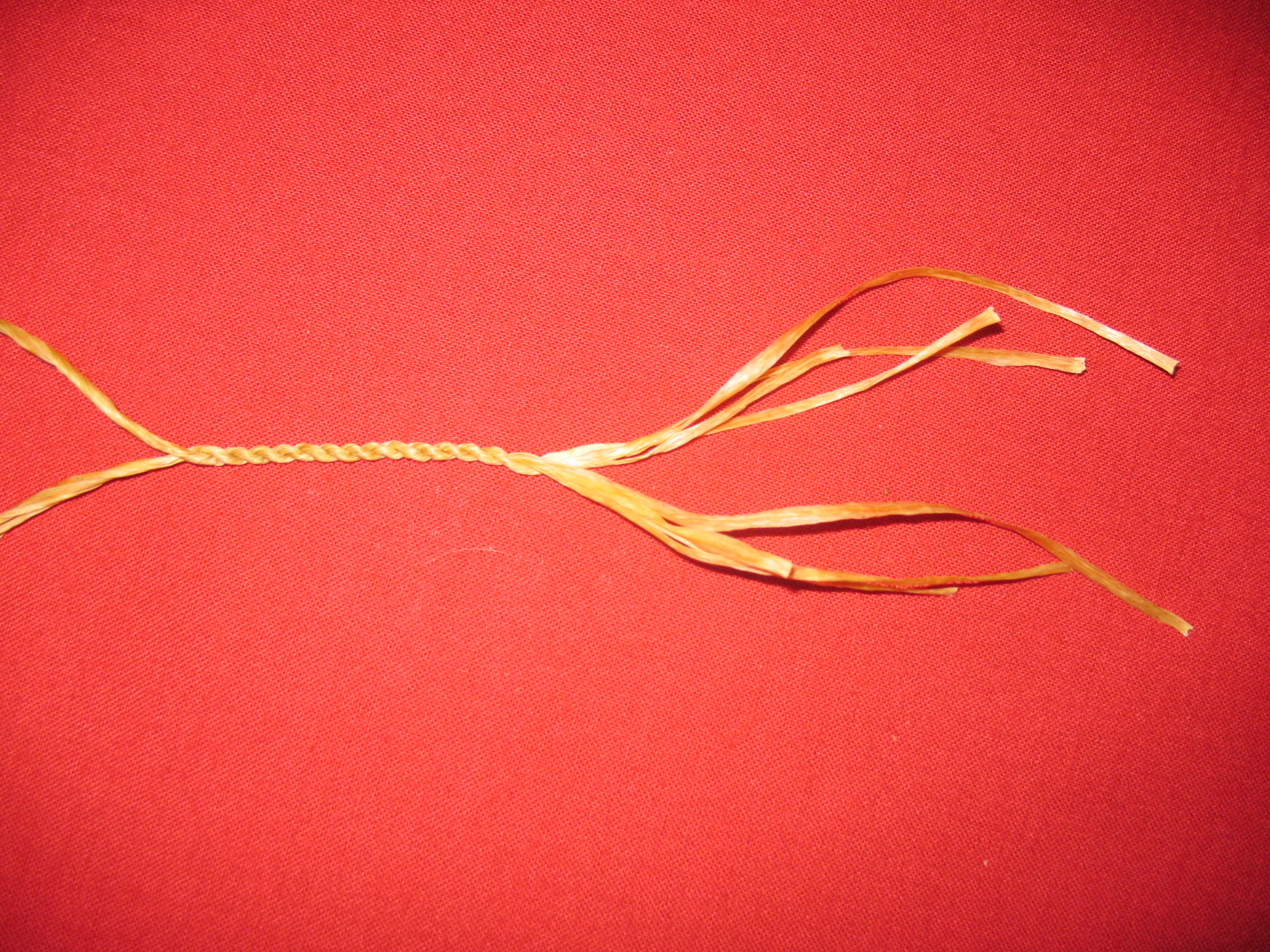
Next fold the twisted part of the string over onto itself to form the loop. 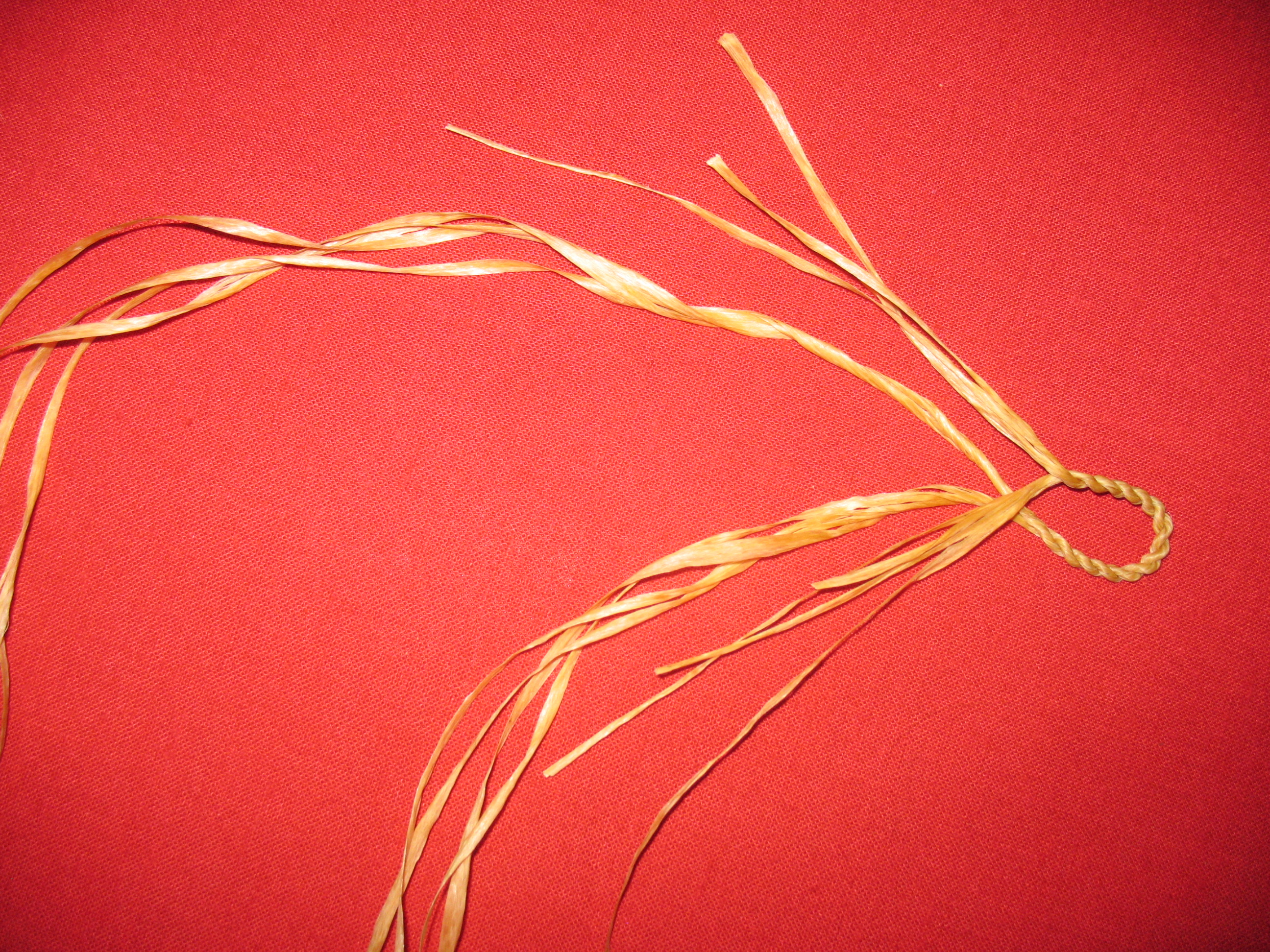
Take each of the offset ends of the bundles and lay one of them down on each of the long portions of the bundles. With waxed Dacron you can kind of squeeze them to meld the offset portion into the corresponding long portion. 
Now continue your reverse wrap with the melded bundles. Because you off set the strands to start with, the string will now taper down smoothly as you continue twisting. 
When you get to the point where each bundle has only four strands in it, you can stop and go back with a pair of scissors and trim of any ends that are sticking out from the offset strands. 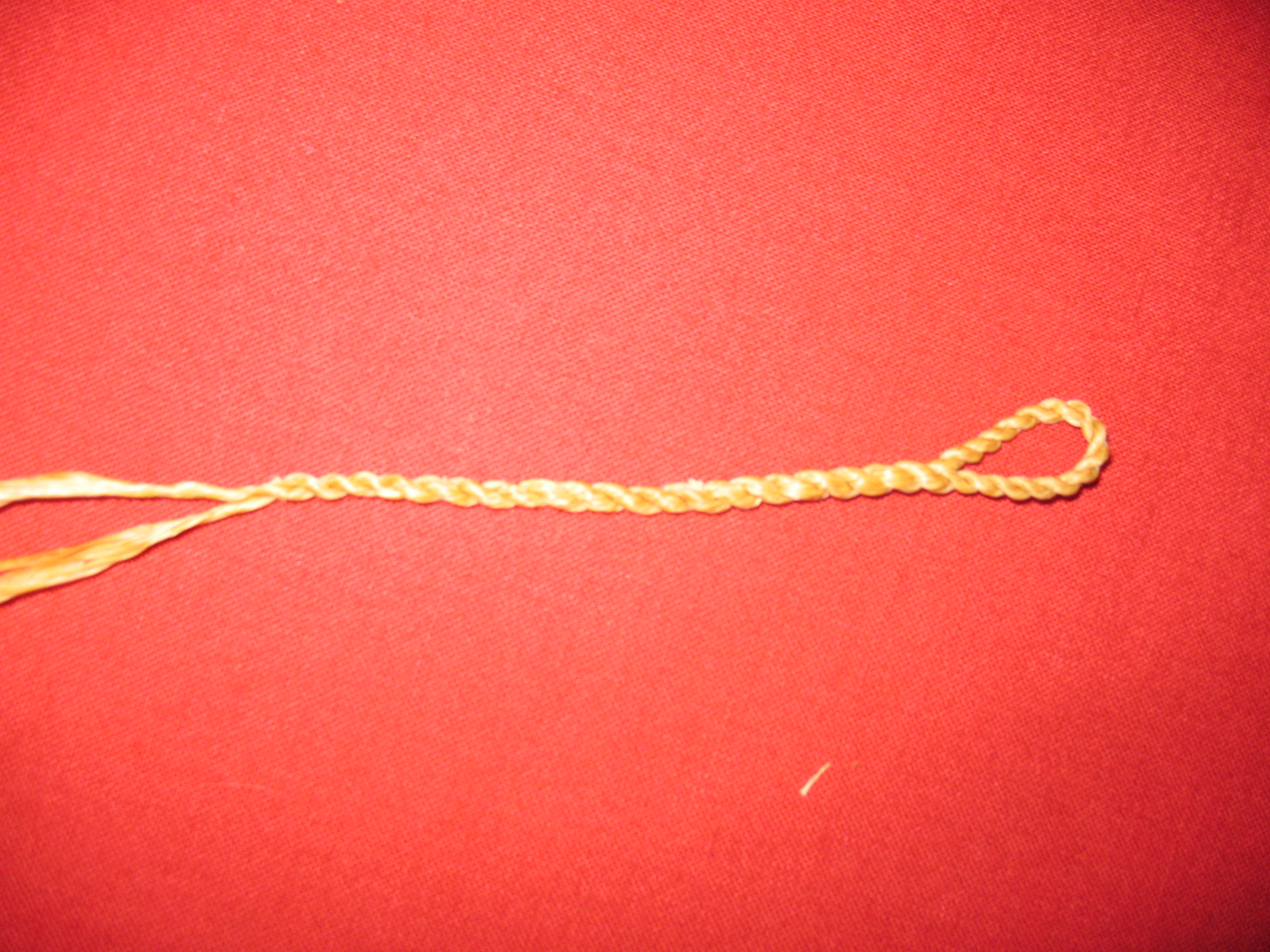
Continue twisting until you have completed the entire string and tie an overhand knot in the end of the string to keep it from unraveling. That’s all there is to it. 
SIGNAL FOR HELP
There are four ways you can signal for help. These are:
1. Building signal fires
2. Using your signal whistle
3. Using your mirror to signal aircraft
4. Constructing ground-to-air rescue symbols.
SIGNAL FIRES
The universal smoke signal for distress is three columns of smoke. A good signal fire is visible for miles. Try to build your signal fires in an open area so tree branches don’t diffuse the smoke. Build your three fires well apart from each other so that you will have three distinct columns of smoke. To produce smoke, build a fire as you normally would. Then the fire is burning well, pile green branches and leaves on it. This will produce billowing columns of white smoke.
THE SIGNAL WHISTLE
A signal whistle can be heard over a great distance. Blow three loud, shrill blasts on the whistle. Pause for a minute and blow three more times. Repeat three or four times. Follow this routine about every 20 minutes.
THE SIGNAL MIRROR
If an aircraft passes near you, take out your signal mirror and hold it at an angle that will reflect the sun toward the aircraft. Move the mirror from side-to-side and up-and-down. This will create a series of bright flashes that may attract the pilot’s attention.
GROUND-TO-AIR SIGNALS
Build your signals in an open area, clearly visible from above. Signals may be built from rocks, logs, lines of fire, or trenches dug in the ground. Build them big; at least 40 feet long. The 5 internationally recognized ground-to-air signals are:
V – meaning “I require assistance”
X – meaning “I need medical assistance”
N – “No”
Y – “Yes”
–> – meaning “Proceed this direction”
Use ground-to-air signals in conjunction with your signal mirror if an aircraft is spotted.
WATER
Locate a reliable source of fresh water. If you are able, return to the last source of water that you encountered. If you are unable to do this, begin searching for water. Remember, water seeks the lowest ground; so downhill is the direction to search. In open country, a line of trees, especially willow or cottonwood, often indicates a stream. Dig a hole in a dry stream bed and water will sometimes pool in the hole. A fair amount of water can be obtained by wiping dew from rocks and plants. Use a handkerchief or other item of clothing and mop up the dew. Squeeze the moisture directly into your mouth. Be sure that you are not wiping the dew from a poisonous plant. Some plants contain a lot of moisture. Remove the spines from prickly pear pads, cut into strips, and chew. Swallow the moisture and spit out the fibers. Wild grapes and berries contain moisture, but be sure you know what you are chewing on. Cut a section of grapevine 5 or 6 feet long and drain the liquid from it. You can drain the “water” directly into your mouth. Any water collected from springs, streams, or rivers should be purified before drinking. Collect the water in your canteen or in the plastic bag from your survival kit. Use water purification tables according to directions on the bottle. If you have a pot or metal can you can boil water to purify it. Boil at least 10 minutes. Note, boiling will kill bacteria but it will not remove harmful chemicals. Don’t sip your water to ration it. This will waste moisture. When you are thirsty drink at least a half-pint of water at a time. Snow and ice can be used for water, but they should not be eaten as this will lower your body temperature and make you more susceptible to hypothermia. Melt snow and ice next to your fire, then drink it.
BE PATIENT!! PEOPLE ARE LOOKING FOR YOU!! If you can avoid doing so, don’t try to walk out on your own until you have given rescuers at least 72 hours to find you.
 Sensible Survival